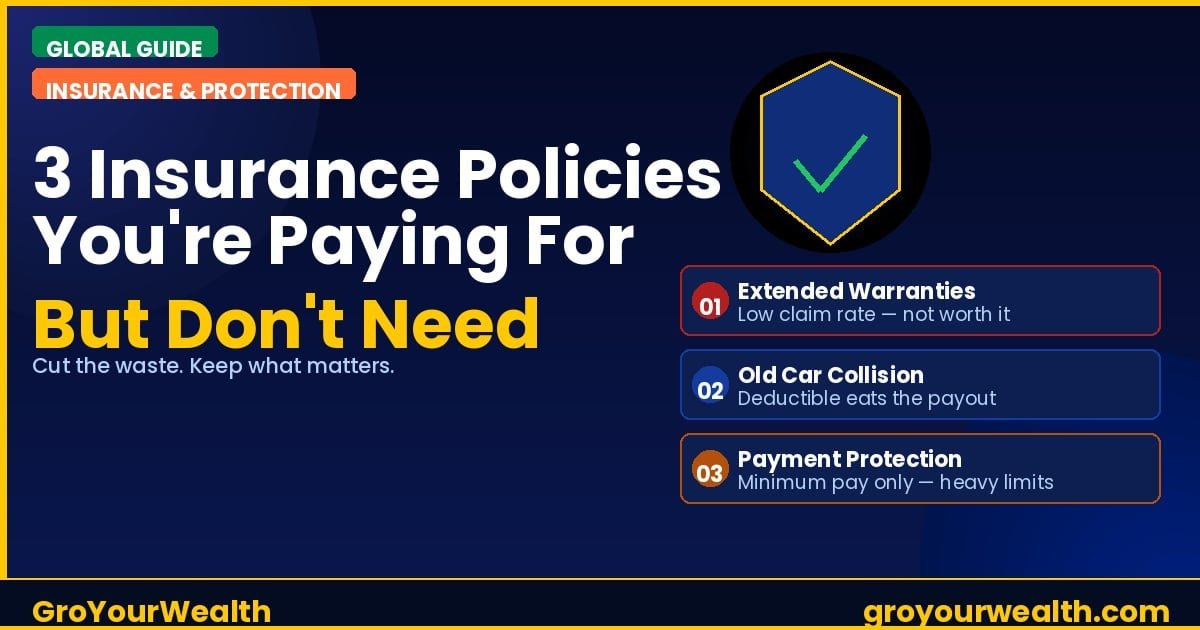
Most people assume every insurance policy they hold is there for good reason. But the truth is, the insurance industry is built on selling you coverage — whether you need it or not. This guide breaks down three common insurance policies that millions of people pay for every month that quietly drain their money while delivering little or no real value. If any of these sound familiar, it may be time to cancel and redirect that money somewhere smarter.
▶ Watch the short video above, then read the full breakdown below.
30%+
of households carry at least one insurance policy they rarely or never use
$400–$900
average annual spend on unnecessary or duplicate insurance coverage
3
of the most commonly over-purchased insurance types revealed in this guide
Why You’re Overpaying for Insurance
Insurance companies make money when you pay premiums and don’t claim. The more policies they can sell you — through banks, car dealerships, online checkout pages, and employer benefits packages — the more revenue they collect. This system is designed to make adding coverage feel automatic and removing it feel complicated.
The result? Most people are carrying at least one policy that provides little practical value relative to what it costs. Some policies duplicate coverage you already have elsewhere. Others protect against scenarios so unlikely that the premium you pay over a lifetime would far exceed any realistic payout. And some are simply profitable products dressed up as essential protection.
Understanding which policies fall into these categories is one of the most straightforward ways to free up money in your monthly budget — without taking on any meaningful extra risk.
💡 The Key Question to Ask
Before paying for any insurance policy, ask: Could I cover this loss myself with savings — and would the total premiums paid over several years exceed what I’d ever likely receive in a payout? If the answer is yes to both, it may not be worth it.
Policy 1 — Extended Warranties and Product Protection Plans
Extended warranties are sold at the point of purchase for almost every major consumer product: televisions, appliances, laptops, smartphones, and home electronics. They feel like sensible protection for an expensive purchase. In reality, they are one of the most profitable products retailers and manufacturers sell — which tells you exactly how often claims are made.
Why Extended Warranties Rarely Pay Off
Most consumer electronics either fail early — within the manufacturer’s standard warranty period — or last for years without issue. The middle ground where a device fails outside the original warranty but within the extended coverage window is relatively narrow. Consumer research consistently shows that the majority of extended warranty customers never make a claim.
Manufacturer warranties already cover early failures. Most products come with at least 12 months of warranty covering manufacturing defects — the most common reason for early failure.
Credit cards often include extended warranty protection. Many credit cards automatically extend manufacturer warranties on purchases made with the card — at no extra cost. Check your card benefits before buying additional coverage.
The premium is structured to favour the seller. Extended warranties are priced to be profitable — meaning the average payout per customer is significantly lower than the premium collected.
Self-insuring is often more effective. The cost of a replacement or repair for most household electronics is comparable to or less than years of extended warranty payments — especially as product prices fall over time.
⚠️ Watch Out For
Extended warranties are often added automatically at checkout — including online checkboxes and in-store upsells. Always double-check your receipt and statement to confirm you haven’t been automatically enrolled. Return windows for declining these add-ons are typically short.
Policy 2 — Collision Coverage on Old Vehicles
Collision and comprehensive insurance cover repairs to your own vehicle after an accident. For a new or high-value car, this coverage makes clear financial sense. But many drivers continue paying for full collision coverage on older vehicles long after the point where it becomes cost-effective — often without ever reconsidering whether it still makes sense.
When Collision Coverage Stops Making Sense
The core issue is straightforward: if the market value of your vehicle is low, the maximum payout from a collision claim is also low. When you factor in the deductible you’d pay before the insurer contributes, the net benefit of a claim can be minimal — sometimes close to zero. Yet the annual premium continues to be charged at a rate that doesn’t fall proportionally with the vehicle’s value.
Check your vehicle’s current market value. Use a reputable used vehicle valuation tool to find what your car would actually sell for today — not what you paid or what you owe on it.
Apply the 10% rule as a starting point. If your annual collision and comprehensive premium exceeds roughly 10% of your vehicle’s current market value, the coverage may be marginal at best.
Factor in your deductible. If your deductible is equivalent to 30–50% of your car’s value, the insurer’s actual contribution after a total loss claim may be surprisingly small.
Liability coverage remains essential. Removing collision and comprehensive does not mean going uninsured. Third-party liability coverage is legally required in most jurisdictions and should never be dropped.
If you have savings, you can self-insure the vehicle. Ask yourself: could you replace this car from savings if it were written off? If yes, the case for paying monthly collision premiums weakens considerably.
📌 Practical Step
Look up your vehicle’s current private sale value today. Compare it to your annual collision and comprehensive premium plus your deductible. If the math feels unfavourable, call your insurer and ask for a revised quote with liability-only coverage. The savings are often immediate and significant.
Policy 3 — Credit Card Payment Protection and Debt Insurance
Credit card payment protection — sometimes called debt cancellation cover, balance protection, or credit life insurance — is a product sold by banks that claims to cover your minimum payments if you lose your job, become ill, or die. It sounds reassuring, particularly if you’re carrying a balance. But the reality is that this product has an exceptionally poor value-to-cost ratio for most people who hold it.
Why Payment Protection Rarely Delivers Value
The premiums for payment protection insurance are typically charged as a percentage of your outstanding balance each month. This means the cost compounds — as your balance grows, your premium increases. The payout conditions are usually heavily restricted: you may need to meet specific criteria around employment type, the nature of illness or injury, or waiting periods before coverage activates. Many claims are declined on technical grounds.
The payout only covers minimum payments — not the full balance. In a genuine crisis, receiving your minimum payment covered does not resolve your debt situation. The balance continues to grow with interest.
Pre-existing conditions are typically excluded. If your inability to work relates to a health condition that existed before the policy started, many insurers will not pay out.
Better alternatives exist for income protection. If you’re genuinely concerned about losing your income, a standalone income protection policy provides much broader coverage at a more transparent and competitive price.
Regulators have repeatedly flagged this product. Financial regulators in multiple countries have investigated payment protection insurance and found systematic issues with mis-selling, restrictive exclusions, and poor value.
Cancelling is almost always straightforward. Unlike some insurance policies, payment protection can usually be cancelled by calling your bank or card issuer directly. The monthly saving is immediate.
⚠️ How It Gets Added Without You Noticing
Payment protection is often offered during credit card application as an opt-in — but may be enrolled automatically in some cases. Check your statement for line items labelled “balance protection”, “payment shield”, “credit insurance”, or similar. If you don’t remember choosing it, call your issuer to confirm whether you can cancel.
What to Do With the Money You Save
Cutting unnecessary insurance is not about reducing your financial security — it’s about redirecting money from low-value products into higher-value ones. The premiums you stop paying can be put to work in several smarter ways.
Build or top up your savings buffer. A solid savings cushion reduces your dependence on insurance for smaller, predictable risks — and earns interest rather than disappearing into premiums.
Review your core insurance coverage. It’s worth ensuring your genuinely important policies — health, home, life, and liability — have adequate limits now that you’ve freed up budget room.
Invest the difference. Even a modest monthly saving redirected into an index fund or retirement account competes very favourably with extended warranty or payment protection payouts over a 5–10 year horizon.
Do a full annual insurance review. Set a reminder once a year to go through every insurance policy you hold, check the premium, compare alternatives, and ask whether your circumstances have changed enough to justify a different level of coverage.
How to Know If a Policy Is Worth Keeping
Not all insurance should be cut. The policies worth paying for share a common characteristic: they protect against losses that would be financially devastating and that you couldn’t reasonably absorb from savings. Life insurance when you have dependants, comprehensive health coverage, home insurance, and liability protection all fall into this category.
The policies worth questioning are those that protect against small, manageable losses — or that duplicate coverage you already have elsewhere. A useful framework: think about the worst realistic outcome if you did not have the policy. If the answer is serious financial difficulty, keep it. If the answer is a manageable out-of-pocket expense, reconsider.
Quick Checklist Before Cancelling Any Policy
Confirm you’re not legally required to hold it. Third-party vehicle liability, minimum health coverage, and building insurance tied to a mortgage may be compulsory — check before cancelling.
Check for duplicate coverage elsewhere. Credit card benefits, employer policies, and existing home contents insurance may already cover risks you’re paying to insure separately.
Understand the cancellation process and any refunds. Some annual policies refund unused months on a pro-rata basis. Ask your insurer before you cancel.
Get the cancellation in writing. Always confirm cancellation in writing — email confirmation or a reference number — so you have a record if future charges appear.
Insurance Policies: Worth Keeping vs Worth Reviewing
Policy Type
Verdict
Why
Action
Extended warranty (electronics)
Usually unnecessary
Low claim rates; credit card may already cover it; premiums often exceed likely payout
Decline at purchase; check credit card benefits first
Collision on old vehicles
Review carefully
Net payout after deductible can be minimal if vehicle value is low
Compare vehicle value vs premium + deductible annually; consider liability-only
This article is for educational purposes only and does not constitute financial or insurance advice. Insurance needs vary by personal circumstances, jurisdiction, and applicable law. Always review your own situation before making changes to your insurance coverage. Consult a qualified financial adviser if you are unsure.