You got a raise. You moved to a bigger apartment, upgraded your car, started dining out more. Your income went up — but somehow your bank account looks the same. That’s lifestyle inflation in action. This guide explains exactly why earning more often doesn’t make you richer, and what Americans can do to break the cycle for good.
▶ Watch the full video on YouTube — Why Earning More Doesn’t Make You Richer (MF-04)
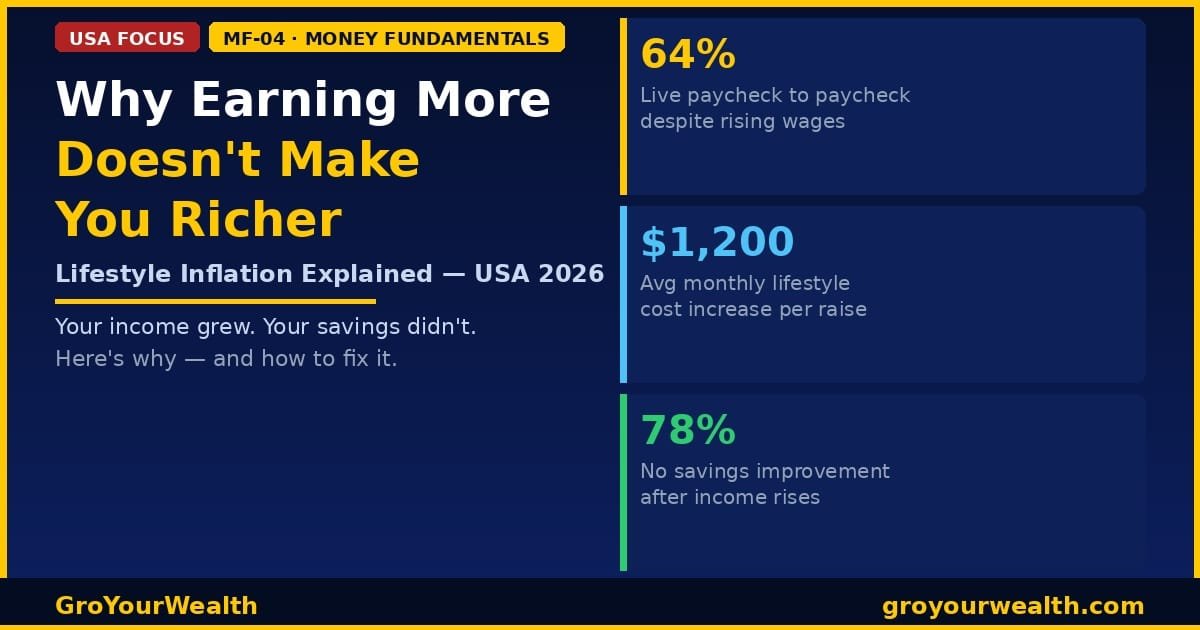
64%
of Americans live paycheck to paycheck despite rising wages
$1,200
average monthly lifestyle cost increase when income rises 20%
78%
of workers who got raises in 2024 reported no improvement in savings
What Is Lifestyle Inflation?
Lifestyle inflation — sometimes called lifestyle creep — happens when your spending automatically rises to match your income. Every time you earn more, you spend more. The gap between what you earn and what you keep stays the same or actually shrinks.
The tricky part? Most lifestyle inflation feels completely reasonable in the moment. A bigger apartment after a promotion feels deserved. Upgrading from a used car to a new one when you’re making more seems logical. Adding streaming services, gym memberships, and delivery apps feels like small stuff. But these individually small decisions compound into a pattern that silently erases your wealth-building potential.
According to a 2025 Bankrate study, the majority of American households that saw meaningful income increases over the past three years reported spending all or nearly all of those increases within 12 months. Wealth didn’t grow — lifestyle did.
Why Your Brain Is Wired for Lifestyle Inflation
Understanding lifestyle inflation means understanding how human psychology handles money. There are three core forces at work:
Hedonic Adaptation
Humans adapt quickly to new comfort levels. A new car feels amazing for about three weeks, then it becomes ordinary. A nicer apartment feels luxurious for a month, then it just feels like home. Once you’ve adapted, the old standard feels inadequate — not neutral, but actively worse. So the cycle continues upward.
Social Comparison
Americans are intensely influenced by peer spending. When colleagues at your new salary level drive newer cars, vacation more frequently, or live in certain neighborhoods, not matching those standards can feel like falling behind. Research from the Federal Reserve consistently shows that social comparison is one of the strongest drivers of discretionary spending increases.
Mental Accounting Errors
Most people calculate what they can “afford” by what’s left after their current spending, not by what aligns with their financial goals. When income rises, the new surplus mentally becomes “spending money” rather than “saving or investing money.” This default mental accounting keeps wealth stagnant even as income rises.
💡 The Core Problem
Lifestyle inflation isn’t about being irresponsible with money. It’s a predictable psychological response to increased income. The only way to beat it is to have a deliberate, pre-decided plan for every dollar of a raise before you receive it.
The Real Cost of Lifestyle Creep Over Time
The numbers make the impact concrete. Suppose you earn $60,000 a year and receive a $10,000 raise. If you spend the entire raise on upgraded lifestyle — as most Americans do — your net worth impact over 30 years at a 7% investment return is zero. But if you invest $7,000 of that raise and allow modest lifestyle improvement with the remaining $3,000, you add approximately $740,000 to your net worth over that same period.
This is why two Americans can have identical incomes over a 30-year career and retire with dramatically different financial positions. The difference is almost never income — it’s the percentage of each income increase that gets saved versus spent.
5 Signs Lifestyle Inflation Has Crept Into Your Finances
Your savings rate hasn’t changed despite income growth. If you were saving 8% of income two years ago and you’re still saving 8% today after two raises, lifestyle inflation is consuming the difference.
You can’t explain where the extra money went. Most lifestyle inflation is invisible in the moment. Subscriptions, food delivery, rideshares, and incremental upgrades don’t feel like decisions — they feel like normal life.
Your fixed expenses have risen faster than investments. Rent, car payment, and insurance costs growing faster than your brokerage or retirement contributions is a classic inflation signature.
Your financial anxiety hasn’t decreased with your income. More money should reduce money stress. If it hasn’t, your lifestyle has expanded to absorb the relief margin.
You feel like you need your current income to survive. If dropping back to your salary from three years ago would feel like a crisis — not just uncomfortable, but impossible — lifestyle inflation has locked you in.
The Lifestyle Inflation Trap by Age Group
Lifestyle inflation affects different age groups in predictably different ways. Understanding which pattern applies to you makes it easier to interrupt it.
Your 20s: The Foundation Years
Entry-level to mid-level salary jumps in your 20s are when lifestyle inflation causes the most long-term damage. Every dollar not saved in your 20s costs dramatically more in future value because of lost compounding time. The most dangerous pattern in this decade: upgrading your living situation to match new peers rather than your actual financial goals. A 24-year-old saving $400/month who keeps that habit through raises can accumulate over $1.2 million by retirement. A 24-year-old who keeps lifestyle matching income growth may save almost nothing.
Your 30s: The Acceleration Zone
The 30s are typically the decade of the largest lifestyle inflation events: first home purchase, marriage, children, career acceleration. Each of these is a legitimate life milestone — but they also each represent a massive cost platform increase. Americans in their 30s who lock in high fixed costs (large mortgage, expensive childcare, luxury vehicles) often find that even excellent incomes leave no margin for wealth building. The key is distinguishing between necessary life upgrades and status-driven ones.
Your 40s–50s: The Golden Window
Peak earning years with grown children and a paid-down or lower mortgage represent the most powerful wealth-building window Americans get. Lifestyle inflation in this decade — the “empty nest upgrade” pattern — is one of the most consequential financial mistakes possible. Americans who keep lifestyle flat while income peaks in their 40s and 50s can compress decades of wealth building into just 10–15 years.
⚠️ The “I Deserve It” Trap
The most common justification for lifestyle inflation is that you’ve worked hard and earned the upgrade. This framing is emotionally correct but financially misleading. Enjoyment of your income is completely valid — the danger is when every single increase goes to lifestyle rather than being split strategically between enjoyment and future security.
How to Stop Lifestyle Inflation Without Feeling Deprived
The goal isn’t to live like a monk. It’s to make deliberate decisions about which lifestyle upgrades actually increase your wellbeing versus which ones just raise your baseline spending without improving your life in a meaningful way.
The “Raise Rule”: Allocate Before You Adapt
The most effective technique is simple: before a raise hits your account, decide its allocation in writing. A commonly effective split is 50/30/20 — 50% to savings and investments, 30% to meaningful lifestyle improvements you’ll actually appreciate, 20% to catch up on any financial gaps like debt payoff or emergency fund. The exact percentages matter less than the pre-commitment. Once money lands in your account and gets absorbed into normal spending, it’s psychologically gone.
Audit Your Subscriptions Quarterly
Services like Rocket Money or Truebill can identify subscriptions you’ve forgotten or stopped using. Americans average 4–7 subscriptions they don’t actively use. Cutting even three at $15/month each frees $540/year — and more importantly, prevents that creep from accelerating.
Automate the Gap
Every time income increases, immediately increase automated contributions to your 401(k), Roth IRA, or brokerage account before you touch anything else. Pay your future self first. What never lands in your checking account never gets spent. Even increasing your 401(k) contribution by 1% per year on each raise is a powerful anti-inflation mechanism.
Separate “Meaningful” from “Status” Spending
Not all lifestyle improvements are equal. Research consistently shows that experiences — travel, meals with people you care about, activities — produce lasting satisfaction. Object upgrades — a bigger TV, a newer car, designer items — produce brief spikes followed by rapid adaptation. Prioritizing experience spending over object spending gives you more genuine enjoyment per dollar while keeping fixed cost inflation lower.
Automate savings increases immediately on every raise — set it before you can spend it.
Track your savings rate, not just your savings amount — the percentage should rise with income.
Review your fixed costs annually — rent, car, insurance, subscriptions are the biggest inflation drivers.
Ask before every upgrade: “Will I still value this in 6 months?” — most lifestyle inflation items don’t pass this test.
Lifestyle Inflation vs. Intentional Lifestyle Improvement
There’s an important distinction to make: not all spending increases are lifestyle inflation. Intentional lifestyle improvement is choosing specific, high-satisfaction upgrades that you’ve deliberately decided are worth the cost — with full awareness of the trade-off. Lifestyle inflation is when spending rises automatically and unconsciously to match income, with no deliberate decision-making involved.
If you got a $15,000 raise and consciously decided to spend $6,000 of it on a trip to Japan you’ve wanted for years, invest $7,000, and use $2,000 to make your home office more functional for remote work — that’s intentional. If the raise just quietly disappeared into daily life with no memory of where it went — that’s inflation.
Lifestyle Inflation Comparison: Proactive vs. Default Approach
Scenario
Income Change
Spending Behavior
10-Year Net Worth Impact
Rating
Full lifestyle match
+$15,000/yr
All spent on upgrades
~$0 additional
Harmful
50/50 split
+$15,000/yr
$7,500 invested, $7,500 lifestyle
~$104,000 additional
Good
70/30 split
+$15,000/yr
$10,500 invested, $4,500 lifestyle
~$145,000 additional
Strong
Lifestyle freeze
+$15,000/yr
All invested, lifestyle unchanged
~$208,000 additional
Maximum
Intentional upgrade
+$15,000/yr
Pre-decided allocation, meaningful spending only
Varies — sustainable long-term
Optimal
Projections based on 7% average annual return over 10 years. For illustration only — not financial advice.
Lifestyle Inflation Calculator — How Much Is Creep Costing You?
Lifestyle Inflation Cost Estimator
See how much lifestyle creep could cost you over time vs. investing that amount
Subscribe to my channel for daily personal finance and investing insights — built for Americans who want real financial progress, not just bigger paychecks.
Disclaimer: This article is for educational purposes only and does not constitute financial advice. Investment projections are illustrations based on assumed returns and are not guaranteed. Always consult a qualified financial advisor before making investment decisions. Past performance does not guarantee future results.