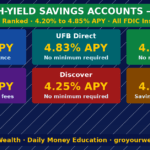
Your savings account is not working as hard as it should — and your bank is counting on you not noticing. The average American earns just 0.41% APY on a standard savings account while high-yield alternatives offer 4.5% to 5.2% APY. That gap quietly costs you hundreds — sometimes thousands — of dollars every year. This guide reveals exactly what your bank is not telling you, and what you can do about it right now.
Watch the full breakdown on YouTube ↑
0.41%
Average US bank savings APY (2026)
5.2%
Top HYSA APY available today
$630+
Annual loss on a $15,000 balance
Why Your Bank Wants You to Stay Ignorant
Traditional banks make a predictable profit from a very simple arrangement: they borrow your money at 0.41% and lend it out at 7%, 15%, or even 24% on credit cards. The wider that gap, the more profit they pocket. Educating you about better alternatives is not in their financial interest.
This is not a conspiracy — it is simply how the business model works. The FDIC reports that the national average savings rate at traditional banks sits at just 0.41% APY as of early 2026. Meanwhile, high-yield savings accounts at online banks and credit unions are regularly offering 4.5% to 5.2% APY — more than ten times as much.
The Real Cost of Staying Put
If you have $15,000 in a standard savings account earning 0.41% APY, you earn about $61.50 per year. Move that same money to a HYSA at 4.9% APY and you earn $735 — a difference of $673.50 per year, every year, for doing nothing except switching accounts.
The 5 Things Banks Are Not Telling You
1. Your Rate Is Almost Certainly Below Inflation
The Federal Reserve’s long-term inflation target is 2%. A savings account earning 0.41% means your purchasing power is shrinking by roughly 1.59% per year in real terms. You are not saving money — you are slowly losing value. Banks will never frame it this way on your statement.
2. High-Yield Savings Accounts Are Just as Safe
One of the most common misconceptions is that higher rates mean higher risk. This is simply not true for FDIC-insured accounts. Whether your money sits at a traditional branch bank or an online bank like Marcus by Goldman Sachs, Ally Bank, or Synchrony Bank, the FDIC insures up to $250,000 per depositor. The safety is identical — the rate is not.
3. Introductory Rates Are Bait-and-Switch Traps
Some banks advertise a high promotional rate to attract new depositors, then quietly drop it after three to six months. The fine print matters. Always check whether the rate is promotional or the ongoing rate. Reliable high-yield accounts from established online banks tend to keep rates competitive because their entire business model depends on attracting savers — not on trapping them with branch overhead.
Watch Out For These Red Flags
Promotional APY valid for only 3–6 months with no clear ongoing rate disclosed
Monthly maintenance fees that erode your interest earned
Minimum balance requirements of $10,000+ just to earn the advertised rate
Variable rates that drop without notice — always check your statements quarterly
4. Savings Account Interest Is Compounded Daily — But Only If You Stay
Most savings accounts compound interest daily and credit it monthly. This means the longer your money stays, the more aggressively it grows. But here is what banks do not tell you: switching to a better rate does not reset this compounding advantage. You take your full balance with you, and it immediately begins compounding at the higher rate. There is no penalty for moving your savings to a better account.
5. You Probably Qualify for a Better Rate Right Now
Most Americans believe that getting a higher savings rate requires a large balance or a special membership. This is false. Many of the best high-yield savings accounts in the US have no minimum balance requirement, no monthly fees, and are open to any US resident. You can open one in under ten minutes with just a Social Security Number and a linked external bank account.
The Best High-Yield Savings Options in the USA Right Now
As of April 2026, several online banks and credit unions are offering competitive rates that leave traditional banks far behind. The accounts below are all FDIC or NCUA insured, which means your deposits are federally protected up to $250,000.
Marcus by Goldman Sachs — One of the most consistently competitive rates, no minimum balance, no fees. Excellent mobile app for transfers.
Ally Bank — Long-established online bank with strong customer service and competitive ongoing APY. No minimum balance required.
Synchrony Bank — Frequently among the top rates nationally. No monthly fees and an optional ATM card for easy withdrawals.
American Express High Yield Savings — Trusted brand, competitive rate, no fees. Transfers can take 1–3 business days.
SoFi Savings — Offers an elevated rate when you set up direct deposit, plus a checking account bonus. Great for those who want one primary banking relationship.
Credit Unions (Local) — Many credit unions offer rates that rival or beat online banks, with the added benefit of personal service. Check MyCreditUnion.gov to find federally insured options near you.
What to Do With Money That Sits in a Checking Account
Many Americans keep far more cash in their checking account than they need for daily expenses. This is one of the most common and costly money mistakes in the country. Your checking account likely earns 0% APY. Any money beyond one to two months of living expenses sitting in checking is effectively a gift to your bank.
A simple rule: keep one to two months of expenses in checking for liquidity. Move everything else — your emergency fund, savings goals, and any idle cash — into a high-yield savings account. The transfer takes minutes and the difference over 12 months can be substantial.
The Simple Two-Account System
Account 1 — Checking: 1–2 months of expenses only. Used for bills, debit card spending, day-to-day transactions.
Account 2 — High-Yield Savings: Everything else. Emergency fund, short-term savings goals, idle cash. Let it compound at 4–5% instead of 0%.
How Savings Account Rates Are Set
Understanding why rates change helps you make smarter decisions. Savings account APYs are closely tied to the Federal Funds Rate set by the Federal Reserve. When the Fed raises rates — as it did aggressively from 2022 to 2024 — high-yield savings accounts respond quickly with better rates. When the Fed cuts rates, HYSA rates gradually decline too.
Traditional banks historically pass along Fed rate increases much more slowly to savers (and pass along rate cuts much faster). Online banks with lower overhead tend to be more responsive because competing on rate is their primary acquisition tool. This structural difference is one of the biggest ongoing reasons to prefer online savings accounts over traditional branch banking.
Savings Accounts vs Other Short-Term Options
Once you understand that your savings account should be earning 4–5%, you may wonder whether there are even better short-term options for money you do not need immediately. Here is a quick comparison to help you make the right choice for your situation.
Account / Product
Typical APY (2026)
Liquidity
Risk
Best For
Traditional Savings
0.3–0.5%
Instant
None (FDIC)
Daily banking — nothing else
High-Yield Savings (HYSA)
4.5–5.2%
1–3 business days
None (FDIC)
Emergency fund + all short-term savings
Money Market Account
4.0–5.0%
Instant (often)
None (FDIC)
Higher balances wanting check-writing
3-Month Treasury Bill
4.8–5.0%
At maturity only
None (US Gov’t)
Money you will not need for 3 months
6-Month CD
4.7–5.1%
At maturity (penalty if early)
None (FDIC)
Money you definitely will not touch
I-Bonds (TreasuryDirect)
3.1% (current)
1 year minimum hold
None (US Gov’t)
Inflation hedge for 1+ year horizon
Stock Market (S&P 500)
10% avg long-term
Next trading day
High (variable)
5+ year investment horizon only
Savings Account Interest and Taxes
One important detail your bank definitely will not volunteer: savings account interest is fully taxable as ordinary income at your marginal tax rate. If you earn $700 in interest this year and you are in the 22% tax bracket, you owe approximately $154 in federal tax on that amount. Your bank will send you a 1099-INT form in January for any interest earned above $10.
This does not mean you should avoid high-yield savings accounts — the after-tax gain is still dramatically better than earning almost nothing. But it does mean you should account for this in your planning. If your income is high, parking very large sums in a savings account may be less efficient than tax-advantaged options like a 401(k) or IRA for longer-term money.
Savings Account Earnings Calculator
See how much more you could earn by switching to a high-yield savings account
How to Switch to a High-Yield Savings Account in 5 Steps
Step 1 — Choose your account: Research current rates at Ally, Marcus, Synchrony, or SoFi. Verify the rate is ongoing (not promotional), that there are no monthly fees, and that the account is FDIC-insured.
Step 2 — Open the account online: Most applications take 5–10 minutes. You will need your SSN, a government-issued ID, and your current bank’s routing and account numbers to fund the new account.
Step 3 — Link your checking account: Add your existing checking account as an external account. Most banks verify this with two small test deposits within 1–2 business days.
Step 4 — Transfer your savings: Move your emergency fund and any idle savings to the new HYSA. Keep your checking account open — you will still need it for everyday transactions and bill payments.
Step 5 — Set up automatic transfers: Automate a recurring transfer from checking to your HYSA on every payday. This removes the decision entirely and builds your savings on autopilot.
This article is for educational purposes only and does not constitute financial advice. APY rates quoted are approximate as of April 2026 and subject to change. Always verify current rates directly with the financial institution before opening any account. Deposit accounts at FDIC-member banks are insured up to $250,000 per depositor. GroYourWealth is not a licensed financial advisor.