Investing
Most investors obsess over picking the right stocks. But the mistake that quietly destroys more wealth than any bad stock pick is something entirely different — and you’re probably doing it without realising. It’s not what you buy. It’s how you behave after you buy it.
Watch: The Investing Mistake That Costs You More Than Bad Stock Picks — GroYourWealth
Why Your Behaviour Beats Your Stock Picks — Every Time
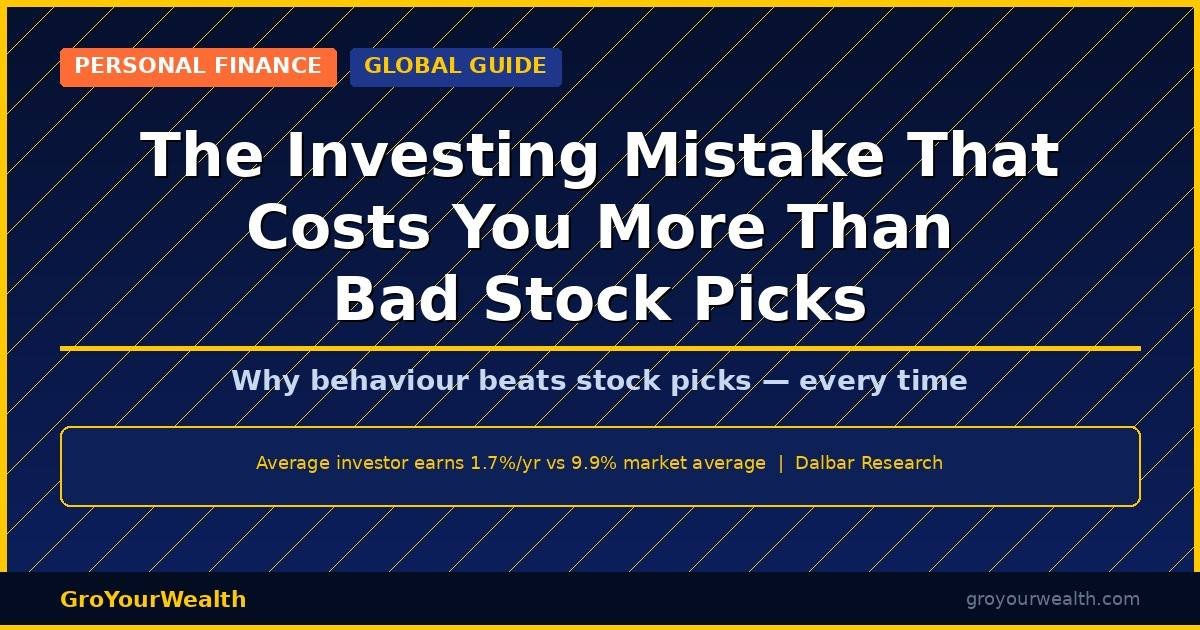
Research from Dalbar has tracked the gap between what markets return and what investors actually earn for decades. The gap is enormous — and it has nothing to do with picking the wrong companies. It has everything to do with what investors do during market volatility.
When prices fall, fear kicks in and people sell. When prices rise, greed kicks in and people pile back in — usually too late. This cycle of buying high and selling low is the single most expensive investing mistake in existence. And almost every investor commits it at some point.
A mediocre portfolio held consistently for 30 years will outperform an expert portfolio sold in every downturn. Time in the market — not timing the market — is the defining variable in wealth building.
The 3 Behavioural Mistakes That Cost You the Most
1. Panic Selling During Market Drops
Markets drop regularly. A 10–20% correction happens on average every 1–2 years. Investors who sell during these periods lock in real losses and then face a second decision: when to get back in. They almost always re-enter too late, missing the recovery that follows. The cost is permanent — those gains are gone forever.
The solution is not to ignore risk. It is to build a portfolio you can emotionally hold during turbulence — then hold it. If a market drop makes you want to sell everything, your portfolio is not calibrated to your actual risk tolerance, not your imagined one.
2. Chasing Recent Performance
When an asset has just had a spectacular year, it attracts enormous investor attention and capital. People buy in expecting more of the same. But markets mean-revert. The asset that surged last year is statistically more likely to underperform next year — and the investors who chased it often buy at the peak and sell at the trough.
This is especially common with individual sectors, thematic ETFs, and high-momentum stocks. Study the fund flows into any asset class just before a major correction and you will find the pattern repeating without fail.
3. Checking Your Portfolio Too Often
This sounds harmless. It isn’t. Research by behavioural economists shows that frequent portfolio checks increase the emotional response to short-term volatility. Investors who check daily are far more likely to make reactive, emotion-driven changes than investors who review quarterly. Myopic loss aversion — the tendency to feel losses more acutely than equivalent gains — is amplified by constant monitoring.
The fix is simple but requires discipline: set a review cadence of once per month or once per quarter. Automate your contributions. Then let compounding do its work without interference.
Imagine your portfolio drops 30%. You sell. The market recovers 43% to get back to where it was. You missed that 43% recovery and still need an equivalent gain just to break even — from a now-smaller base.
What Long-Term Investors Do Differently
Investors who build real wealth over decades are not necessarily better stock pickers. They are better at doing nothing when the urge to act is strongest. They understand that volatility is the price of admission for long-term returns — not a signal to exit.
- Automate contributions: removing the decision removes the emotion. Direct debit into your investment account on payday means you invest regardless of how the market feels that week.
- Write an investment policy statement: a one-page document that records why you chose your current allocation and what you will and will not do during market stress. It becomes a rational anchor when emotions run hot.
- Reframe volatility: a falling market means you are buying more units with your regular contribution. For long-term investors with decades ahead, a correction is a discount, not a disaster.
- Know your actual risk tolerance: not your theoretical one. If a 20% drop would cause you genuine anxiety, your equity allocation is too high. Adjust before a crisis — not during one.
- Understand what you own: investors who understand the businesses or funds they hold are less likely to panic during downturns. Familiarity with an asset reduces fear-driven selling.
The Compound Effect of Consistent Behaviour
The mathematics of staying invested are compelling. Consider two investors with identical portfolios. One stays invested through every market cycle over 30 years. The other sells during each of the three worst downturns and misses an average of 60 days of recovery per decade. The difference in end wealth is not marginal — it is generational.
Compounding rewards patience in a non-linear way. The last 10 years of a 30-year investment horizon typically produce more wealth than the first 20 years combined. Selling during those compounding years — even briefly — truncates the curve at exactly the wrong moment.
This is the investing mistake that costs more than bad stock picks. Not a ticker you chose. Not a fund you missed. Just the decision to sell when you should have held, and to wait when you should have bought.
Your investment return is determined less by what you buy and more by how long you hold it without interfering. Build a portfolio you can sleep with through a 30% drop — then do exactly that.
Investing Behaviour vs Stock Selection: How They Compare
| Factor | Impact on Long-Term Returns | Investor Control | Most Common Mistake |
|---|---|---|---|
| Staying invested (behaviour) | Very High | Full | Selling during downturns |
| Asset allocation | High | Full | Too aggressive or too conservative |
| Contribution consistency | High | Full | Pausing contributions in downturns |
| Stock / fund selection | Moderate | Partial | Chasing recent performance |
| Market timing | Low (negative) | Very limited | Thinking you can predict tops and bottoms |
| Trading frequency | Negative | Full | Overtrading, tax drag, fees |
Investment Behaviour Cost Estimator
How Much Could Panic Selling Cost You?
Estimate the long-term wealth impact of selling during downturns vs staying invested.
Get One Money Tip Every Day
Subscribe to my channel for daily personal finance and investing insights — short, practical, and built around what actually works.
This article is for educational purposes only and does not constitute financial advice. Past market performance does not guarantee future results. Always consult a qualified financial adviser before making investment decisions. Statistics cited are for illustrative purposes and sourced from publicly available research.