You didn’t plan to buy it. You didn’t need it yesterday, and you probably won’t think about it a month from now. But somewhere between seeing it and paying for it, your brain made the decision before you did. This guide breaks down the actual psychology behind impulse buying — the reward chemistry, the emotional shortcuts, and the cognitive traps retailers are counting on — and hands you a system, not just willpower, to take the decision back.
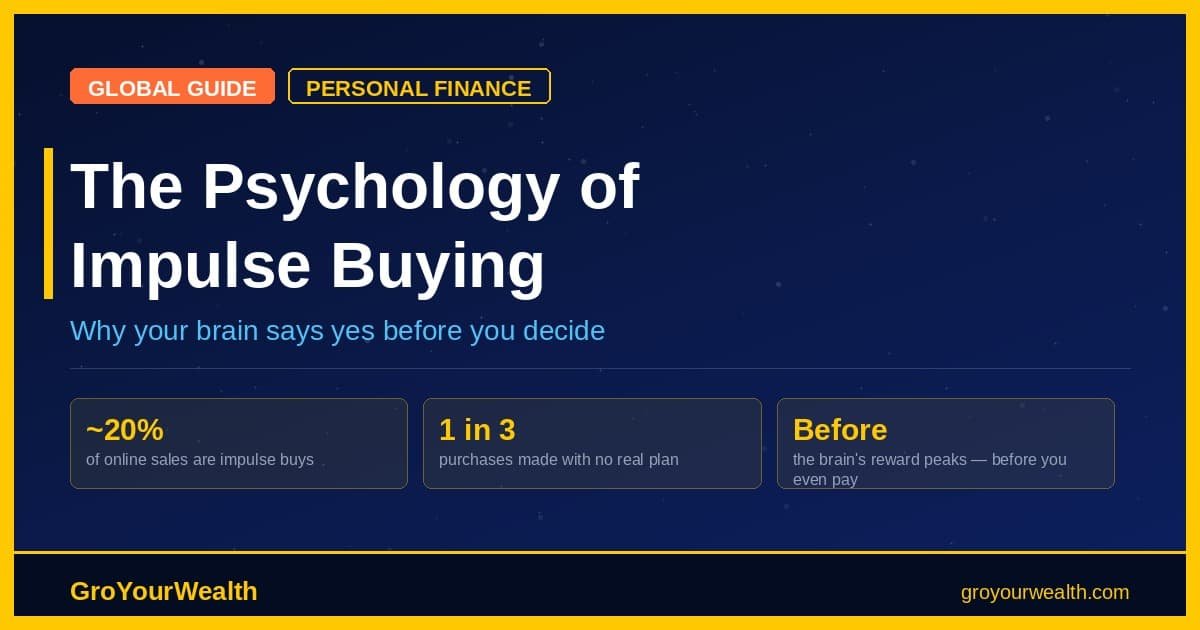
~20%
of online sales are made up of unplanned, impulse purchases
1 in 3
purchases in consumer surveys are described as unplanned
Before
the brain’s reward system peaks in anticipation — before you’ve even paid
What Actually Counts as an Impulse Buy
Not every unplanned purchase is a problem. Grabbing gum at the checkout counter and grabbing a course you’ll never finish are both “unplanned,” but they sit on very different ends of the spectrum. An impulse buy is a purchase made with little or no deliberation, triggered by an immediate stimulus — a display, a notification, a feeling — rather than a plan. The defining feature isn’t the price tag. It’s the absence of a pause between the urge and the action.
That pause is exactly what modern retail is engineered to remove. Every checkout aisle, countdown timer, and “only 2 left in stock” banner exists to shrink the gap between wanting and buying to as close to zero as possible. Understanding why that gap disappears so easily is the first step to rebuilding it.
It also helps to notice that impulse buying rarely feels like a single bad decision in the moment — it feels like a series of small, reasonable-sounding ones. A slightly-better-than-expected discount. A product that solves a problem you’d mentioned wanting to solve, even if not urgently. A checkout process so frictionless that stopping to think feels like more effort than finishing the purchase. None of these individually looks like a mistake, which is exactly why the pattern is so easy to repeat without ever noticing the total.
The Neuroscience: Why Your Brain Says Yes Before You Decide
Impulse buying isn’t a willpower failure — it’s a predictable outcome of how the brain’s reward system is wired. Neuroeconomics research has found that the brain’s reward circuitry fires most strongly during anticipation of a purchase, not at the moment of acquiring it. The dopamine hit happens when you spot the item and imagine having it, which is precisely why the “add to cart” moment feels so good regardless of whether you ever truly needed the product.
Working against that anticipatory rush is what researchers call the “pain of paying” — a distinct, measurable discomfort tied to spending money, associated with activity in the same brain region that processes physical pain. Retailers have spent decades finding ways to numb that pain: saved card details, one-click checkout, “buy now, pay later” splits, and contactless taps all exist to widen the gap between the dopamine rush of wanting and the discomfort of paying. When the pain of paying is anesthetized but the anticipation reward isn’t, impulse buying becomes the path of least resistance.
The Emotional Escape Hatch
Impulse spending is rarely about the object. Consumer psychology researchers have repeatedly linked unplanned purchases to short-term mood repair — buying as a response to stress, boredom, sadness, or loneliness rather than to genuine need. The purchase delivers a small, real mood lift, which is exactly why it works often enough to become a habit. The problem is that the lift is temporary and is frequently followed by a second, quieter emotional cost: buyer’s remorse, and for some, a feeling of having lost control over their own spending.
This is worth sitting with, because it reframes the entire problem. If impulse buying is functioning as emotional regulation, then a budgeting spreadsheet alone won’t fix it — the underlying feeling still needs somewhere to go. The most durable fixes in this guide work by giving that feeling a different, cheaper outlet, not by asking you to simply feel worse about spending.
The one sentence that explains impulse buying
You’re not making a financial decision — you’re resolving a feeling, and the receipt just happens to have a price on it.
The Cognitive Traps That Make It Worse
On top of the emotional trigger, several well-documented cognitive biases quietly tilt the odds toward buying:
Present bias — the pull of an immediate reward reliably outweighs a future consequence, even when you can do the math and know better in the moment.
Mental accounting — money gets treated differently depending on where it “came from.” A refund, a bonus, or cashback often feels like free money and gets spent more loosely than a regular paycheck, even though it’s identical in value.
Anchoring — a high “original price” next to a discounted one resets your sense of what’s reasonable, making the sale price feel like a win even when it’s still more than you’d otherwise spend.
Scarcity and urgency signals — countdown timers and low-stock warnings override deliberate thinking by making not deciding feel like the risky option.
None of these require you to be careless with money. They’re default settings in how every human brain processes a buying decision, which is why the fix has to work at the level of the environment and the habit, not just intention.
Why the Urge Hits Harder at Certain Times
Impulse buying isn’t evenly distributed across a day or a week. It clusters around specific states, often summarized with the shorthand HALT — hungry, angry, lonely, and tired. Each of these states drains the same limited pool of mental resources your brain uses for deliberate decision-making, a pattern researchers describe as decision fatigue. After a long day of choices — what to answer, what to prioritize, what to ignore — the part of the brain responsible for weighing a purchase against your longer-term goals is simply running on empty, while the anticipatory reward system runs at full strength regardless. This is exactly why late-evening scrolling, post-argument “treat yourself” purchases, and end-of-a-long-shift online orders are disproportionately impulsive compared to the same browsing done first thing in the morning.
Recognizing your own pattern matters more than any generic tip. Some people are most vulnerable right after payday, when the “pain of paying” feels smallest relative to a fresh balance. Others are most vulnerable at the end of a stressful day, when a purchase functions as a reward for having gotten through it. A five-minute audit of your last ten unplanned purchases — what time of day, what mood, what device — will usually reveal a clear pattern you can design around, rather than trying to build willpower against impulse buying in general.
The Real Cost Over Time
A single impulse buy rarely feels significant, and that’s the trap. The real damage isn’t any one purchase — it’s the pattern, compounded over years. Consumer research on unplanned spending consistently finds that a large share of shoppers say most of their purchases are unplanned, and that impulse purchases make up a meaningful share of total online sales. When you multiply even a modest, recurring impulse habit across a decade, and compare it to what that same money could have done if it had been invested instead, the gap is usually far larger than people expect. The calculator further down in this guide lets you run your own numbers.
Where Impulse Buying Actually Happens
Channel
Primary Trigger
Typical Share of Impulse Spending
Best Defense
In-store retail
Checkout-aisle placement, staff upselling, physical handling of the product
~80% of shoppers report impulse buys here
Shop from a written list; leave saved cards at home for cash-only runs
Disable in-app purchases; unfollow accounts that reliably trigger buying urges
A Practical System, Not Willpower
Willpower is a poor long-term strategy because it depends on the exact resource (mental energy, mood, time) that’s usually depleted right when the urge hits. What actually works, according to research on behavior change, is designing the decision in advance so there’s nothing to resist in the moment.
Implementation intentions — pre-commit to a specific “if-then” rule before you’re tempted: “If I want to buy something over a set amount, then I add it to a wishlist and revisit it in 48 hours.” Research on this technique consistently finds it outperforms relying on willpower alone, because the decision is already made before the urge shows up.
Add friction, don’t rely on restriction — remove saved card details from shopping apps and browsers. Every extra step (finding the card, typing the number) is a chance for the anticipation rush to fade and the rational brain to catch up.
Reframe the purchase as hours worked — convert the price into how many hours of your income it represents. “Is this worth three hours of my time” is a very different question than “can I afford this.”
Give the feeling a cheaper outlet — if you notice the urge shows up most when you’re stressed, bored, or scrolling late at night, build a specific, no-cost replacement habit for that exact moment rather than trying to white-knuckle through it.
Use a discretionary “fun money” allowance — a fixed, guilt-free amount each month for spontaneous purchases removes the all-or-nothing trap where one impulse buy feels like a total failure and triggers more of the same.
A short cooling-off window still helps — even a brief pause between wanting and buying meaningfully reduces follow-through on unplanned purchases, though it works best paired with the pre-commitment rule above rather than as a standalone fix.
When it’s more than a habit
Occasional impulse buying is normal. It’s worth a closer look — and possibly outside support — when you notice:
Making minimum payments on cards specifically because of unplanned purchases
Hiding purchases or receipts from a partner or family member
A repeating buy-and-return cycle that never actually resolves the urge
Using shopping specifically to escape a difficult emotion, on a regular basis
Run Your Own Numbers
The calculator below estimates two things side by side: what a recurring impulse-spending habit actually costs over time, and what that same money could have grown into if it had been redirected into long-term investing instead, using a conservative average return. For the mechanics behind that growth curve, see our step-by-step guide to compound interest.
Impulse Spending Opportunity Cost Calculator
Enter amounts in your own currency — the calculator works with whatever unit you use.
The Bottom Line
Impulse buying isn’t a character flaw, and it isn’t solved by feeling guiltier about it. It’s a predictable interaction between a reward system built to fire on anticipation, an emotional shortcut that offers real (if temporary) relief, and a retail environment specifically engineered to remove the pause between wanting and buying. Rebuild that pause deliberately — through pre-commitment, friction, and a guilt-free allowance for spontaneity — and the “willpower problem” mostly disappears on its own. For the retail-side tactics working against you specifically, see our related breakdown of advertising tricks designed to make you spend, and if “buy now, pay later” is part of your impulse pattern, our guide to its hidden long-term cost is worth reading next.
This article is for educational purposes only and does not constitute financial advice. The calculator above uses a fixed, illustrative average return and does not account for taxes, fees, inflation, or market volatility. Speak with a licensed financial professional before making decisions about your own spending or investing.