Personal Finance · Global Guide
You finally have a little money left over at the end of the month. One voice says: pay off that debt — the interest is eating you alive. Another says: save it — what happens if the car breaks down next week? Both voices are right, which is exactly why so many people freeze and do neither. The truth is that the answer is rarely “all of one, then all of the other”. In this guide you’ll learn why the pure math and real life point in different directions, the simple phased plan that settles the argument, and by the end you’ll know exactly how to split your spare cash between an emergency fund and your debt — based on your interest rates, your income and your situation.
Why This Question Is Harder Than It Looks
On paper, the decision looks simple. Debt costs you interest. Savings earn you interest. If your debt charges a higher rate than your savings account pays — and it almost always does — then every unit of money you send to the debt “earns” more than the same unit sitting in savings. A spreadsheet will tell you to throw everything at the debt.
But a spreadsheet doesn’t get a flat tyre. It doesn’t get a surprise medical bill, a broken phone, or a month where work hours are cut. Real life does — and when it does, someone with zero savings has only one option: borrow again. That is the trap hiding inside the “debt first, always” advice. You can spend six months aggressively paying down a balance, and then a single unexpected bill puts half of it straight back on the card.
So the honest answer isn’t “debt” or “savings”. It’s sequence and proportion — which comes first, how much goes to each, and when you switch. Once you see it that way, the decision stops being a tug-of-war and becomes a plan.
Debt payoff saves you interest. An emergency fund protects that progress. Without some cash cushion, debt payoff is like bailing water out of a boat with a hole in it — you need to patch the hole before bailing works.
The Case for Paying Off Debt First
Let’s give the debt-first argument its full weight, because it’s genuinely strong — especially for expensive debt.
Imagine you owe 5,000 on a credit card charging around 24% a year, and you also have 5,000 you could put in a savings account paying around 4% a year. (Use whatever currency you live in — the logic is identical.) Over one year, the card charges you roughly 1,200 in interest. The savings account pays you roughly 200. Keeping the cash in savings while the card balance sits there costs you about 1,000 a year for the comfort of having money available.
Paying down a debt that charges 24% is effectively a guaranteed, risk-free 24% return on that money. No savings account in the world matches that, and very few investments reliably do either. That’s why high-interest debt deserves urgency. Credit card balances, overdrafts, payday-style loans, store cards and buy now, pay later plans that have slipped into late fees all fall into this bucket. If you’ve ever been caught by that last one, our guide to the hidden cost trap in buy now, pay later explains how “interest-free” plans quietly turn expensive.
There’s also a psychological upside. Every balance you clear removes a monthly payment for good, which frees up cash flow for everything else — including, eventually, your emergency fund.
The Case for Building an Emergency Fund First
Now the other side. The single biggest reason debt payoff plans fail isn’t laziness or bad math. It’s re-borrowing. Here’s how the loop usually plays out:
- You put every spare unit of money toward the card and get the balance down from 5,000 to 3,000.
- The car needs an 800 repair. You have no savings, so it goes on the card.
- The balance is back to 3,800 — and you feel like the last few months were wasted.
- Motivation drops, payments slip back to the minimum, and the debt settles in for the long haul.
An emergency fund breaks that loop. When the repair bill arrives, you pay it from savings, the card balance keeps falling, and your plan survives contact with real life.
There’s a second, less obvious argument: money you send to a debt is gone; money in savings is still yours to use. Once you’ve paid down a loan, you usually can’t take that money back out when you need it. And you can’t count on credit being there either — lenders can reduce limits or close accounts, often at exactly the moment the economy (or your income) is under stress. Cash in your own account is the only cushion nobody else controls.
Finally, there’s stress. People with even a small cash buffer consistently make calmer, better money decisions than people living with zero margin. That calm is worth something real — it’s often the difference between sticking with a plan and abandoning it. We explore this in Build Your Safety Net — The Cash Buffer That Changes Everything.
The Answer: A Four-Phase Plan
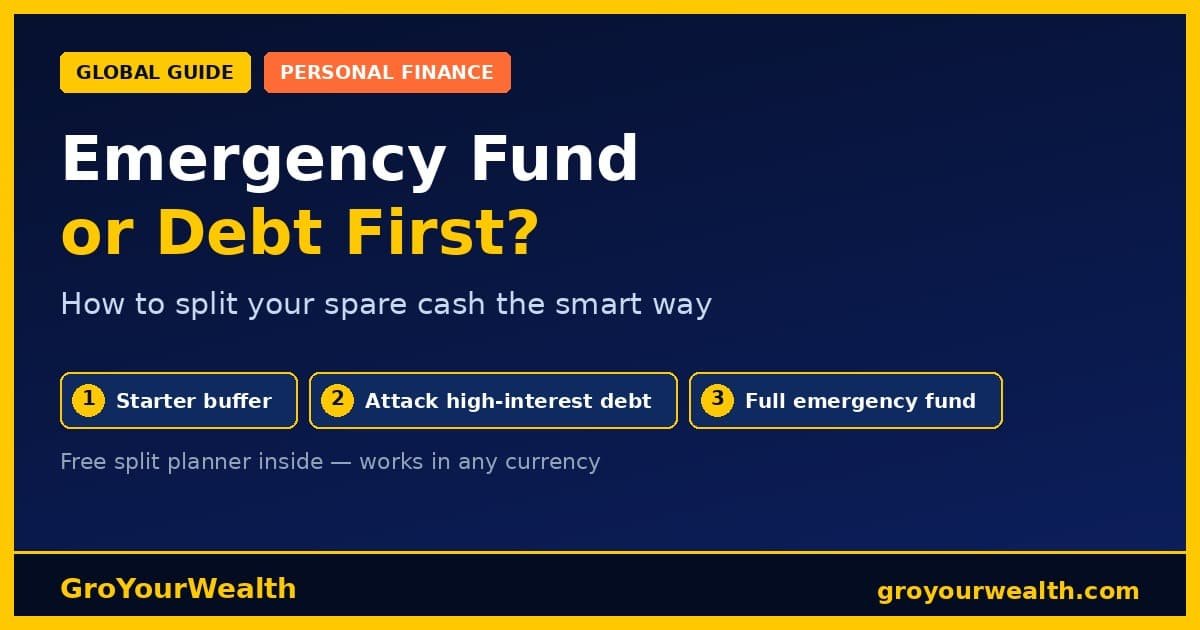
Instead of choosing one side, the most practical approach runs both goals in a deliberate order. Before any phase, one rule applies throughout: always pay at least the minimum on every debt, on time. Missed payments trigger fees, penalty rates and damage to your credit history that can cost far more than anything this plan saves.
Phase 1: Build a starter emergency fund
Your first target is a small buffer — roughly one month of essential expenses. Essentials means the costs you can’t pause: housing, utilities, food, transport, insurance and minimum debt payments. Not dining out, not subscriptions, not holidays.
During this phase, send most of your spare money (around 70–80%) to the buffer and the rest as extra debt payments. The goal is speed. A starter fund doesn’t need to cover a job loss — it needs to cover the car repair, the dental bill and the broken laptop that would otherwise go straight onto a card. For many people this phase takes a few months, not years.
Phase 2: Attack high-interest debt
Once the starter buffer is in place, flip the ratio. Now most of your spare cash — 70–85% — goes to your most expensive debt, with a small slice still going to savings so the buffer slowly grows and gets refilled after any withdrawals.
Which debt first? The mathematically cheapest approach is to target the highest interest rate first while paying minimums on the rest. Some people prefer to knock out the smallest balance first for a quick motivational win. Both work; the right choice depends on whether you’re driven more by numbers or by momentum. We compare them side by side in Debt Snowball vs Debt Avalanche: Best Repayment Method.
Phase 3: Complete your full emergency fund
With the expensive debt cleared, every payment you used to make is now free cash flow. Redirect it into finishing your emergency fund — typically three to six months of essential expenses, more if your income is irregular. Because you’re no longer paying high interest, there’s no rush to send money anywhere else first. For guidance on sizing and storing this fund, see Emergency Funds Explained: How Much You Really Need and Where to Keep It.
Phase 4: Low-interest debt vs long-term goals
Once your full fund is in place, what’s left is usually cheap, long-term debt — things like a home loan or a low-rate car or education loan. Here the urgency fades. Whether you overpay these or direct spare money toward long-term investing depends on the rate, your risk tolerance and your goals. The key is that you’re now making that choice from a position of stability rather than stress.
Small buffer first, then expensive debt, then a full emergency fund, then everything else — while never missing a minimum payment along the way.
How Your Interest Rate Changes the Split
The phases above give you the order. Your interest rate decides how hard to lean into each one. A useful way to think about it is in three tiers:
Very high-interest debt (roughly 15–20% a year or more). Credit cards, overdrafts, short-term loans and late-fee-laden payment plans. Here every month you wait is expensive. Build the starter buffer quickly, then put the large majority of spare cash on the debt. Don’t push your emergency fund beyond the starter level until this debt is gone.
Medium-interest debt (roughly 6–15%). Many personal loans and some vehicle loans. A more balanced split makes sense — something close to half-and-half after your starter fund — because the interest cost is real but no longer an emergency in itself.
Low-interest debt (roughly under 6%). Typically home loans and subsidised or secured loans. In most cases it makes sense to pay these on schedule and prioritise your full emergency fund first. The interest you’d save by overpaying is modest, and the security of a proper cushion is worth more.
These bands aren’t laws — interest rates vary widely by country and by year — but the principle travels everywhere: the more a debt costs you, the more of your spare money it deserves.
Personal Factors That Shift the Answer
Two people with identical debts can reasonably make different choices. These factors should push you toward a bigger cushion before going aggressive on debt:
- Irregular or commission-based income. Freelancers, contractors, gig workers and seasonal workers face lumpier months. A larger buffer smooths them out.
- People depending on you. Children, a partner who doesn’t earn, or parents you support all increase the cost of a financial shock.
- A single income household. If your pay stops, nothing else is coming in. Two incomes provide a natural backup that one doesn’t.
- An uncertain job or industry. If layoffs are in the news or your contract ends soon, cash matters more than interest savings right now.
- Health or ageing vehicles and appliances. If big repair or care costs are likely in the near future, a cushion is cheaper than borrowing for them.
And a few factors that point the other way — toward attacking debt sooner:
- A very stable job with a second household income. Lower risk means a smaller buffer can be enough.
- A promotional rate about to expire. If a 0% offer ends soon and the rate will jump sharply, clearing that balance before the deadline can save a lot.
- Debt that’s already overdue. If you’re behind on payments, catching up comes first — late payments compound into fees, penalty rates and lasting credit damage.
Whichever split you choose, these habits quietly sabotage it:
- Counting an unused credit limit as your “emergency fund” — it’s borrowed money, and it can be reduced or withdrawn without warning.
- Skipping or delaying minimum payments to save faster. The fees and penalty interest wipe out any benefit.
- Keeping the emergency fund in your everyday spending account, where it slowly gets spent on non-emergencies.
- Using the emergency fund for predictable costs like annual insurance or gifts — those belong in separate sinking funds.
- Investing your emergency money in shares or crypto. A market drop can shrink it right when you need it.
- Taking on new debt while paying off old debt. Progress on one side is cancelled by the other.
Where to Keep Your Emergency Money
Your emergency fund has one job: be there, in full, when something goes wrong. That means it should be safe, separate and quick to access — usually within a day or two. A dedicated savings account at a regulated bank, ideally paying a reasonable interest rate, is the standard choice almost everywhere. Many banking apps also let you create labelled “pots” or sub-accounts, which makes it easy to see your buffer at a glance without mixing it into everyday spending.
What it shouldn’t be is invested in anything whose value can fall, locked in a term deposit you can’t break without penalty, or sitting in your main account where it looks like spending money.
It’s also worth separating true emergencies from the predictable-but-irregular bills that people often mistake for emergencies — annual renewals, car servicing, festivals and birthdays. Those deserve their own pots so they don’t drain your safety net. Our guide to sinking funds shows how to set them up so your emergency fund only gets touched for real emergencies.
Making the Plan Stick
The best split in the world doesn’t help if it only happens in the months you remember. A few habits make the plan run on autopilot:
- Automate both transfers on payday. Set one automatic transfer to your emergency savings and one extra payment to your target debt, timed for the day your income arrives.
- Review the split once a quarter. As the buffer grows and balances fall, adjust the percentages so you move smoothly from one phase to the next.
- Refill before you resume. If you use the emergency fund, temporarily shift more money back to it until it’s restored, then return to debt payoff.
- Send windfalls to the current phase. Bonuses, tax refunds and gifts can shorten a phase by months. Split them deliberately rather than letting them disappear.
- Build a budget that survives real life. If your budget keeps breaking, the plan breaks with it. The Real Reason Budgets Fail covers three structural fixes that help.
Emergency Fund First vs Debt First vs Phased Plan
| Approach | Interest Cost | Risk of Re-Borrowing | Stress Level | Best For |
|---|---|---|---|---|
| Full emergency fund first | High — debt keeps charging interest for longer | Low | Low | Low-interest debt only, or very unstable income |
| All money to debt first | Lowest on paper | High — any surprise goes back on credit | High | Very stable income with a backup earner and family support |
| Phased plan (starter fund → debt → full fund) | Low — only slightly above debt-first | Low | Low to medium | Most people with any high-interest debt |
| Even 50/50 split throughout | Medium | Low | Medium | Medium-interest debt with steady income |
| Minimum payments only, no savings | Very high | Very high | Very high | Nobody — this is the trap to escape |
Emergency Fund vs Debt Split Planner
Answer four quick questions to see which phase you’re in and how to split your spare money each month. Works in any currency.
Open a separate savings pot, name it “Emergency Fund”, and set one automatic transfer for payday — even a small one. Then list your debts with their interest rates. Those two steps alone tell you which phase you’re in and where your next unit of money should go.
Get Smarter With Your Money Every Week
Short, practical personal finance videos for people anywhere in the world — budgeting, saving, debt and investing basics, explained simply.