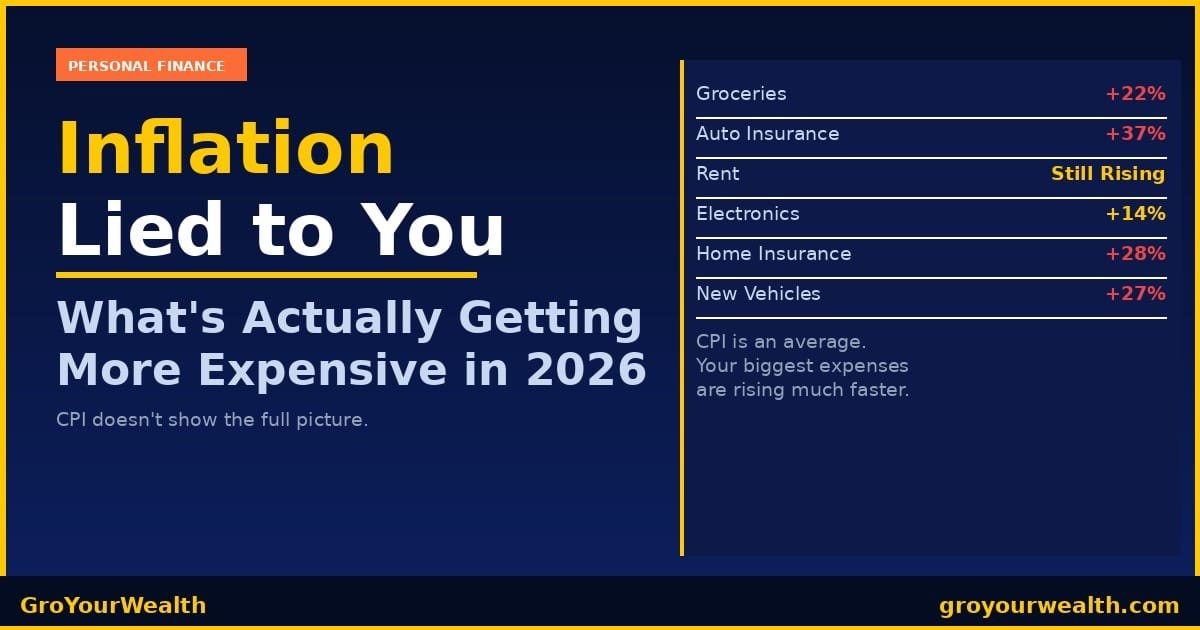
The official inflation number looks manageable. But your grocery bill, car insurance, and rent tell a completely different story. Here’s what’s actually getting more expensive in 2026 — and why the headline CPI figure isn’t showing you the full picture.
Watch on YouTube · GroYourWealth
+23%
Average grocery price rise since 2021
+38%
Auto insurance cost increase since 2022
+18%
Rent increase in major cities 2022–2025
Why the CPI Number Doesn’t Tell the Full Story
The Consumer Price Index (CPI) is the government’s official measure of inflation. When it reads 3%, most people assume prices are only going up by 3%. But CPI is an average across hundreds of categories — and the things you spend money on every day are often rising much faster than that average.
CPI also measures price changes from a fixed base year. It doesn’t capture the compounding effect of three or four years of consecutive increases. If groceries went up 7% in 2022, 6% in 2023, 4% in 2024, and 3% in 2025, your real food bill is dramatically higher — even though 2025 technically looks “under control.”
Key Insight
CPI measures the rate of increase — not the total accumulated cost. “Inflation is slowing” does not mean “prices are going down.” It means prices are still rising, just slightly more slowly. Your wallet is still losing ground every year.
What’s Actually Getting More Expensive in 2026
1. Groceries and Food at Home
Grocery prices have been one of the biggest sources of real-world cost pain since 2021. Tariffs introduced in 2025 on imported goods — including food products, packaging materials, and agricultural inputs — are keeping pressure on food costs even as broader CPI moderates.
Items like cooking oils, canned goods, coffee, and certain produce are among the most affected categories. Branded products have seen steeper rises than store-brand equivalents, which means switching to own-brand alternatives is one of the fastest ways to reduce your food spend without reducing your actual consumption.
2. New and Used Cars
Vehicle prices remain elevated in 2026. Tariffs on imported vehicles and auto parts have added thousands of dollars to the cost of new cars, while the supply of used vehicles remains constrained relative to demand. The average transaction price for a new vehicle in the US exceeded $48,000 in late 2025 — more than double what it was fifteen years ago.
If you’re planning a vehicle purchase, doing it sooner rather than later may work in your favour — trade tariff policies can shift, but waiting rarely results in lower prices in the current environment.
3. Auto Insurance
Even if you haven’t bought a new car, your auto insurance premium has almost certainly gone up — significantly. Insurers are pricing based on the cost to repair or replace vehicles at current elevated market values. Labour shortages in auto repair shops and the rising cost of parts have pushed claim costs higher, and those costs are being passed directly to policyholders.
The average US auto insurance premium rose by more than 38% between 2022 and 2025. Shopping your policy annually and raising your deductible are two of the most effective ways to push back against this trend.
4. Electronics and Appliances
Tariffs on goods imported from China and other manufacturing hubs have pushed up the retail prices of electronics, home appliances, and consumer tech. A washing machine that cost $700 two years ago may now retail for $900 or more. Smartphones, laptops, and tablets are also seeing price increases that are partially obscured by manufacturers quietly reducing specs rather than raising list prices.
The practical implication: delaying appliance replacements and running existing devices longer is one of the most financially rational choices you can make in 2026.
5. Rent and Home Insurance
Rental costs continue to rise in most major metro areas, driven by persistent housing undersupply. While the pace of rent increases has slowed from the 2022–2023 peak, rents have not come down — they’ve simply been increasing at a slower rate.
Home insurance is a separate but equally painful story. Insurers have pulled out of high-risk states entirely (California, Florida, Louisiana) and dramatically raised premiums in others. Climate-related claims, construction cost inflation, and reinsurance market stress are all contributing to premiums that have risen 20–40% in many markets over the past three years.
Watch Out For
Shrinkflation — the practice of reducing product size or quantity while keeping the price the same — is not captured by CPI. If your cereal box went from 500g to 430g at the same price, that’s a 14% effective price increase that doesn’t show up in any official inflation statistic. Check unit prices, not shelf prices, when comparing products.
What You Can Actually Do About It
Track your spending by category, not total. Knowing that your food spend is up 18% but your entertainment is down 5% tells you where the real pressure is and where to act.
Shop your insurance annually. Auto, home, and renters insurance are all highly competitive markets. Loyalty rarely pays — switching providers or negotiating at renewal can save $300–$800 per year.
Buy store brands on staples. For non-differentiated products like cooking oil, pasta, canned goods, and cleaning supplies, store-brand equivalents are often made by the same manufacturers and cost 20–40% less.
Delay big discretionary purchases. Electronics, appliances, and vehicles are all affected by tariff-driven inflation. Extending the life of what you have is one of the most powerful financial moves available right now.
Look at your subscription stack. Many subscription services have raised prices quietly in the past 12 months. A regular audit of what you’re paying monthly often surfaces $50–$150 in easy cuts. Learn more about financial habits that sound smart but quietly lose you money.
Increase your income faster than inflation. The most powerful long-term defence against rising prices is ensuring your income grows faster than your costs. Whether through salary negotiation, skill development, or side income — this matters more in an inflationary environment.
The Hidden Inflation You’re Not Measuring
Beyond the categories above, there’s a form of inflation most people never track: the rising cost of services. Plumbers, electricians, child care, medical co-pays, dentistry, and restaurant meals have all seen significant price increases driven by labour costs. These are often the hardest to reduce because they’re tied to essential needs.
The best approach here is prevention over cure — staying healthy, maintaining your home proactively, and building an emergency fund so you’re never forced to pay inflated service prices in a crisis. For a deeper look at building that financial buffer, read our guide on how to build financial resilience.
If you feel like you’re doing everything right and still falling behind, you’re not imagining it. Most people are losing hundreds per month without realising it — and the combination of inflation across multiple categories simultaneously makes it very hard to see where it’s all going.
Inflation Impact by Spending Category — 2026 Comparison
Category
Approx. Rise (2021–2026)
Key Driver
Your Best Response
Groceries
+20–25%
Supply chain + tariffs
Store brands, meal planning
Auto Insurance
+35–40%
Vehicle values + repair costs
Shop annually, raise deductible
New Vehicles
+25–30%
Tariffs + supply constraints
Delay purchase if possible
Electronics
+10–20%
Import tariffs
Extend device life cycles
Rent (major metros)
+15–20%
Housing undersupply
Negotiate lease, consider relocation
Home / Renters Insurance
+20–40%
Climate risk + reinsurance
Shop providers, bundle policies
Services (labour)
+15–25%
Wage growth + labour shortage
Preventive maintenance
Clothing
+5–10%
Moderate — some tariff impact
Buy less, buy better quality
Travel / Flights
+10–18%
Fuel + demand recovery
Book early, use points
Your Inflation Impact Calculator
Monthly Cost Increase Estimator
See how much more you’re likely paying annually in a specific spending category
This article is for educational and informational purposes only. It does not constitute financial advice. All figures and statistics are approximate and sourced from publicly available data. Individual circumstances vary — consult a qualified financial professional before making any financial decision.