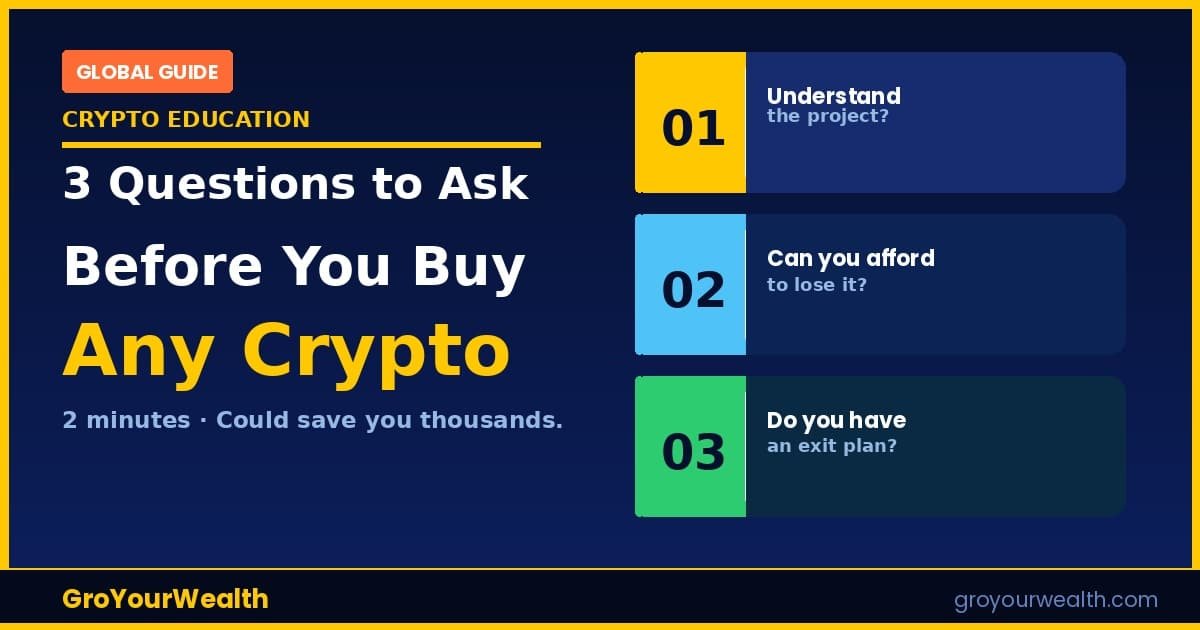
Most people buy crypto based on hype, green charts, and social media buzz — and most people lose money doing it. Before you put a single coin in your portfolio, there are three questions every smart investor asks first. Answer all three honestly, and you will invest with clarity. Skip them, and you are gambling.
▶ Watch the short — 3 Questions to Ask Before You Buy Any Crypto
80%
of retail crypto buyers never set an exit plan before entering
3
questions that separate smart investors from emotional gamblers
2 min
is all it takes to answer all three before buying
Why Most Crypto Buyers Lose
Crypto markets move fast. Prices double in days and collapse just as quickly. The investors who consistently come out ahead are not the ones who move fastest — they are the ones who think before they act. The three questions below take less than two minutes to answer but can save you from costly, emotional mistakes.
⚠ The Hype Trap
When everyone around you is buying and charts are flashing green, the pressure to act feels overwhelming. That urgency is exactly when most people make their worst decisions. Slow down. Answer the three questions first.
Question 1 — Do You Understand What This Project Actually Does?
Not the price. Not what your friend said. Not what a social media post promised. The actual use case — what problem does this project solve, and why does it need a blockchain to solve it?
If you cannot explain the project in one clear sentence, you do not understand it well enough to invest in it. This is not about being an expert. It is about having a basic anchor — a reason to believe in the project beyond the chart going up.
💡 The One-Sentence Test
Can you finish this sentence about any project you are considering? “This crypto solves [specific problem] by [specific method] for [specific group of people].” If you cannot, keep researching before buying.
Read the project’s own website — not a trading forum, not a price prediction article. The official source.
Look for a whitepaper — legitimate projects publish their technology and goals publicly.
Check who is building it — anonymous teams with no track record are a major risk signal.
Ask: would this work without a blockchain? — if yes, the crypto layer may be unnecessary hype.
Question 2 — Can You Afford to Lose This Money?
Crypto is one of the most volatile asset classes in existence. A project can drop 50%, 70%, even 90% in a matter of weeks — and still be considered a functioning project. This is not speculation. It has happened to projects that eventually collapsed and to projects that eventually recovered.
The question is not whether you can afford to invest. The question is whether you can afford to lose the entire amount without it affecting your rent, your food, your emergency fund, or your mental health.
⚠ Never Invest What You Cannot Lose
Do not invest your emergency fund — it must stay liquid and safe
Do not invest borrowed money — leverage amplifies losses in volatile markets
Do not invest money you need within 12 months — short-term needs and crypto do not mix
Do not invest under social pressure — your timeline and risk tolerance are yours alone
Smart investors decide their maximum loss tolerance before they buy. If a 70% drop would cause you to panic-sell and destroy your position, you are investing more than you can truly afford to lose.
Question 3 — Do You Have an Exit Plan?
This is the question most investors never ask — and it is the reason most investors never lock in profits. An exit plan means deciding in advance: at what point will you sell, take profits, or cut your losses?
Without a plan, emotions make the decision for you. Greed keeps you holding past your target. Fear makes you sell at the bottom. Both outcomes destroy returns that were rightfully yours.
📋 What an Exit Plan Looks Like
Before buying, decide: your profit target (e.g. sell 50% at 3x), your stop-loss level (e.g. exit if it drops 40% from entry), and your time horizon (e.g. hold for 18 months regardless of short-term volatility). Write it down before you buy.
Set a profit target before you enter — decide what return makes the investment worthwhile for you.
Set a stop-loss level — know the point at which you accept the loss and move on.
Consider partial exits — taking out your original investment when you are in profit removes pressure and risk.
Write your plan down — a written plan is far harder to abandon in a panic than a mental note.
Review regularly — market conditions change; revisit your plan every few months, not every few hours.
Comparing Investor Approaches
Here is how investors who ask these three questions tend to behave differently from those who skip them.
Behaviour
Skips the 3 Questions
Answers the 3 Questions
Buying decision
Based on hype or social media
Based on research and clarity
Position size
Often too large — driven by FOMO
Sized to what they can afford to lose
During a dip
Panic sells at the bottom
Holds or buys more if thesis is intact
During a rally
Holds too long — gives back profits
Takes partial profits at pre-set targets
After a loss
Chases losses with bigger bets
Reviews plan and learns from outcome
Overall outcome
Emotional, inconsistent, often losing
Disciplined, consistent, better long-term
Crypto Readiness Check — Quick Calculator
Use this tool to check whether you are ready to invest in a specific crypto project based on the three questions.
Am I Ready to Buy This Crypto?
Answer the three questions honestly to get your readiness score.
The Bottom Line
Three questions. Two minutes. That is the difference between investing with intention and gambling with emotion. Understanding what you are buying, sizing your position to what you can truly afford to lose, and deciding your exit before you enter — these are the foundations every consistent crypto investor builds on.
The market rewards preparation. It punishes impulse. Take the two minutes.
This article is for educational purposes only and does not constitute financial or investment advice. Cryptocurrency investments carry significant risk including the possible loss of all capital. Always conduct your own research and consult a qualified financial adviser before making any investment decisions.