Personal Finance
UK
CANADA
AUSTRALIA
INDIA
Watch the complete video guide above — 11 minutes, step-by-step walkthrough
Why Your First $1,000 Matters More Than You Think
Most people wait for the “perfect moment” to invest. They want to save $5,000 first. Then $10,000. By then, they’ve spent five years earning interest on $0 instead of growing their wealth.
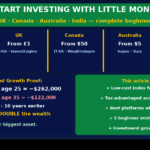
Here’s the truth: Your first $1,000 is your most powerful tool. Not because of the amount — but because of time. If you’re 25 years old, that $1,000 has 40 years to grow. Compound interest on your first dollar is worth more than your last dollar ever will be.
Let’s do the math. If you invest $1,000 today at 8% annual returns (a realistic average for diversified portfolios), here’s what happens:
- After 10 years: $2,158
- After 20 years: $4,660
- After 30 years: $10,062
- After 40 years: $21,724
Your first $1,000 became $21,000+ without you adding another penny. That’s the power of compound interest working for you while you sleep.
The 5-Step Framework: How to Invest Your First $1,000
Step 1: Choose Your Investment Vehicle (15 minutes)
Don’t overthink this. For your first $1,000, pick ONE of these three options:
- Index Fund / ETF — Own 500+ companies with one purchase. Lowest risk. Best for beginners.
- Robo-Advisor — Algorithm picks your investments. Completely hands-off. Good for set-it-and-forget-it investors.
- Individual Stocks — Pick specific companies. Highest risk, highest potential reward. Only if you want to research.
For absolute beginners: Start with an index fund or ETF. You’re diversified immediately, fees are low, and you don’t need to pick stocks.
Step 2: Open an Account with the Right Broker (10 minutes)
You need a brokerage account — think of it as your investing bank. The right broker for you depends on your country. See the country-specific sections below for exact step-by-step instructions.
When choosing a broker, check three things:
- Minimum deposit — Can you start with $1,000 or less?
- Fees — Are there flat fees or percentage-based fees? (Lower is better)
- Ease of use — Is the app/website beginner-friendly?
Step 3: Verify Your Identity & Funding (10 minutes)
All brokers require ID verification (online, takes 5 minutes) and a way to add money. You can usually:
- Transfer from your bank account (most common, 2–5 business days)
- Use a debit card (instant in many cases)
- Wire transfer (fastest but may have fees)
Add your $1,000 and wait for it to clear into your account.
Step 4: Pick Your Investment & Buy (5 minutes)
Once your money is in your account, search for one of these beginner-friendly investments:
US / Global Options: SPY, VOO, VTI (S&P 500 or total market index funds)
UK Options: VWRP, VUAG (world index)
Canada Options: VFV, XGRO (US/global index)
Australia Options: VAS, VGAD (Australian/global index)
India Options: Nifty 50 ETF, Sensex ETF (via NSE)
Buy one share or the amount that uses your full $1,000. Most brokers show you the current price instantly.
Step 5: Set & Forget (Ongoing)
You’ve done the hard part. Now the waiting starts. Don’t panic if the market drops 10%. That’s normal. Don’t get greedy if it rises 20%. Your job is to add more money over time.
The biggest wealth-killer is panic selling. If your $1,000 drops to $900 in a market crash, you haven’t “lost” money — you’ve just seen a temporary dip. If you sell here, you lock in the loss. If you hold (or add more), you’ll likely recover and profit. History shows market crashes last an average of 4–6 months. Long-term investors ignore them.
Country-by-Country: Exactly How to Invest Your First $1,000
United States
Best Platform: Fidelity · Vanguard · Charles Schwab
Minimum Deposit: $0 for most index funds (can buy fractional shares)
Best First Investment: VOO (Vanguard S&P 500 ETF) or VTI (Vanguard Total Stock Market)
How to Start:
- Go to Vanguard.com and click “Open an account”
- Choose “Brokerage account” (not retirement account yet)
- Complete identity verification (2 minutes)
- Link your bank account and deposit $1,000
- Wait 1–2 days for money to clear
- Search for VOO, buy 1 share (currently ~$550) or the full $1,000 with fractional shares
- Done. You now own a piece of 500 major US companies
Annual Fee: 0.03% ($0.30 per $1,000 per year) — Nearly free
Expected 30-Year Return: $10,000+ from your first $1,000
United Kingdom
Best Platform: Hargreaves Lansdown · Vanguard UK · Interactive Investor
Minimum Deposit: £500–£1,000 depending on platform
Best First Investment: VWRP (Vanguard World Index) — owns ~3,000 global companies
How to Start:
- Go to Vanguard UK
- Click “Stocks & Shares ISA” (ISA = tax-free wrapper in the UK)
- Complete verification (ID + address proof)
- Deposit £750 (approximately $1,000 USD)
- Search for VWRP and buy with your full amount
- Your investment grows tax-free in the ISA
Annual Fee: 0.22% (~£1.65 per £750) — Very low
Tax Benefit: No capital gains tax inside an ISA (government-approved savings wrapper)
Expected 30-Year Return: £7,500+ in your ISA
Canada
Best Platform: Questrade · Wealthsimple · Interactive Brokers
Minimum Deposit: $0 (Wealthsimple) to $1,000 (Questrade)
Best First Investment: XGRO (All-Equity ETF Portfolio) — automatically diversified
How to Start:
- Sign up at Wealthsimple.com (no minimum, easiest for beginners)
- Complete identity verification (SIN required)
- Choose “TFSA account” (Tax-Free Savings Account — best for your first investment)
- Deposit CAD $1,250 (approximately $1,000 USD)
- Wealthsimple’s algorithm picks your investment mix automatically
- Monthly: You can add more if you want (dollar-cost averaging)
Annual Fee: 0.50% (includes automatic rebalancing) — Reasonable for automation
Tax Benefit: TFSA = no tax on gains or withdrawals (government-sponsored account)
Expected 30-Year Return: CAD $10,000+ in your TFSA
Australia
Best Platform: CommSec · Vanguard Australia · eToro
Minimum Deposit: $500–$1,000 AUD
Best First Investment: VAS (Vanguard Australian Shares) or VGAD (Vanguard Global Aggregate)
How to Start:
- Open an account at Vanguard Australia
- Provide ABN or TFN (tax file number)
- Deposit AUD $1,250 (approximately $1,000 USD)
- If 70% Australian stocks / 30% international: Buy VAS ($850) + VGAD ($400)
- If 100% diversified: Buy VGAD only ($1,250)
- Contributions are deductible in some cases (check tax status)
Annual Fee: VAS 0.10%, VGAD 0.28% — Very low
Dividend Yield: ~3–4% per year (paid into your account)
Expected 30-Year Return: AUD $10,000+ with franking credits reinvested
India
Best Platform: Groww · Zerodha Coin · Upstox
Minimum Deposit: ₹500–₹1,000 per transaction
Best First Investment: Nifty 50 Index Fund or Sensex Index Fund (tracks India’s top 50 companies)
How to Start:
- Download Groww app (easiest for beginners in India)
- Complete KYC verification (PAN + Aadhaar, 2 minutes)
- Link your bank account (UPI or direct debit)
- Search for “Nifty 50” index funds
- Invest ₹75,000 (approximately $1,000 USD) in monthly installments
- Enable SIP (Systematic Investment Plan) for automatic monthly investing
Monthly SIP Advantage: Instead of ₹75,000 lump sum, invest ₹6,250 monthly for 12 months. This reduces market timing risk.
Annual Fee: 0.40–0.80% depending on fund — Low for India
Expected 30-Year Return: ₹9,00,000+ (assuming 12% Nifty returns)
Tax Note: Gains after 1 year = long-term capital gains (lower tax rate)
Comparison: Investment Platforms & Returns by Country
| Country | Platform | Min Deposit | Annual Fee | Expected 10-Yr Return | Expected 30-Yr Return |
|---|---|---|---|---|---|
| USA | Vanguard / Fidelity | $0 | 0.03% | $2,158 | $21,724 |
| UK | Vanguard ISA | £500 | 0.22% | £1,632 | £7,500+ |
| Canada | Wealthsimple TFSA | $0 | 0.50% | CAD $2,100 | CAD $10,000+ |
| Australia | Vanguard AU | AUD $500 | 0.10% | AUD $2,158 | AUD $10,000+ |
| India | Groww SIP | ₹500/mo | 0.60% | ₹1,90,000 | ₹9,00,000+ |
*Returns assume 8–12% annual growth (average stock market returns). Past performance ≠ future results. These are historical averages, not guarantees.
Interactive Calculator: See Your $1,000 Grow
Wealth Growth Calculator
See how your $1,000 investment grows over time
4 Critical Rules for Your First Year of Investing
Market prices fluctuate daily. If you check daily, you’ll experience emotional swings that lead to panic selling. Check your balance quarterly (every 3 months), not daily. This removes emotional decision-making.
Your first $1,000 is Step 1. If you can add another $100, $250, or $500 per month — do it. This is called dollar-cost averaging, and it’s proven to reduce your average cost per share over time. Consistency beats perfection.
Investing is for money you won’t touch for 5+ years. If you need this $1,000 for a car, house down payment, or emergency in 2 years, put it in a high-yield savings account instead (4–5% APY in most countries). Investing is for long-term wealth, not short-term needs.
After 12 months, check your allocation. If stocks are now 70% and bonds are 30% (when you wanted 60/40), rebalance. Sell some stocks, buy bonds. This keeps you on track and forces you to “sell high.”
What You Should NOT Do With Your First $1,000
- Don’t pick individual stocks — Unless you want to research for 10+ hours/week. Beginners should start with index funds.
- Don’t use leverage / margin — Borrowing to invest sounds smart but amplifies losses. Avoid it.
- Don’t chase crypto hype — Volatility at 50+% is normal. If your $1,000 becomes $500 overnight, you’ll panic sell. Start with boring index funds. Crypto comes later (if at all).
- Don’t try to time the market — “I’ll wait for a crash” has cost investors billions. Buy now and hold. Time in the market beats timing the market.
- Don’t keep it in savings — At 4% APY in a savings account, your $1,000 becomes $1,040 in 10 years. In index funds at 8%, it becomes $2,158. Opportunity cost = $1,118 lost.
Your First 12 Months: Action Plan
- Month 1: Open account, verify identity, deposit $1,000, buy your first index fund. Done.
- Month 2: Forget about it. Don’t check price daily. Let it sit.
- Month 3: If possible, add $100–$250 to your investment. Set this to auto-invest if your broker allows.
- Months 4–9: Continue adding $100–$250 monthly. Build the habit. This is where real wealth comes from — consistency over time.
- Month 10: Check your balance. You’re probably up. Don’t get overconfident.
- Month 12: Annual review. Did you stick to the plan? Rebalance if needed. Plan for Year 2.
Real Numbers: How Much Will You Actually Have?
Let’s be honest about what happens next:
- If you invest $1,000 once and add nothing: $10,062 in 30 years
- If you invest $1,000 + add $100/month: $48,220 in 30 years
- If you invest $1,000 + add $250/month: $108,675 in 30 years
- If you invest $1,000 + add $500/month: $218,940 in 30 years
The lesson? Your first $1,000 matters, but consistency matters more. $100–$250 per month beats $1,000 once.
Set & Forget Investment System
Step 1: Automate your monthly deposit. Most brokers let you set up automatic bank transfers on the 1st or 15th of each month.
Step 2: Set a yearly calendar reminder (Dec 31) to check your balance. That’s it. One check per year.
Step 3: If you get a bonus, tax refund, or inheritance — add it to your investment account immediately. Don’t wait.
This removes emotion and builds wealth automatically.
Related Articles: Your Complete Investment Path
Subscribe for More Investment Guides
Get step-by-step investing strategies for beginners — delivered to your inbox every week.