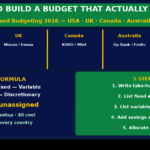
Most budgets fail within two weeks — not because you’re bad with money, but because the budget was built for a perfect month that never actually arrives. This guide shows you how to build a monthly budget that bends without breaking, using real numbers across the USA, UK, Canada, Australia, and India.
▶ Watch the full video on YouTube — How to Build a Monthly Budget That Survives Real Life (5 Countries)
78%
of budgeters have one that breaks by week three
4
buckets replace 30+ spending categories
15 min
per month is all a real-life budget needs
Why Most Monthly Budgets Fall Apart
Most budgets are built on averages — average income, average expenses, average behaviour. But life doesn’t arrive in averages. A car repair in January, a birthday dinner in March, a higher electricity bill in winter — these aren’t surprises, they’re predictable irregulars. The fix isn’t willpower. It’s a budget structure that already has room for them.
⚠️ The Three Reasons Budgets Break
Too many categories — tracking 30 line items is exhausting. You stop after two weeks.
Fixed numbers, not ranges — one expensive week and the whole plan feels broken.
No buffer — irregular but predictable costs (tyres, dentist, school fees) have nowhere to go, so they blow the budget every single time.
The Core Framework — Four Budget Buckets 🪣
Instead of tracking 30 spending categories, use four buckets. This structure works across all five countries and every income level:
Bucket 1 — Fixed Costs: Rent or mortgage, loan repayments, insurance premiums, phone plan, streaming subscriptions. These don’t change month to month.
Bucket 2 — Variable Needs: Groceries, fuel, utilities, public transport. These are essential but the amount shifts each month.
Bucket 3 — Flexible Spending: Dining out, entertainment, personal care, clothing, hobbies. Important for quality of life — but capped with a ceiling.
Bucket 4 — Buffer Fund: Car maintenance, medical co-pays, annual subscriptions, gifts, school supplies, travel. This is the bucket most people skip — and exactly why their budget collapses.
💡 The Buffer Fund Rule
Take all your irregular-but-predictable costs from the past year, add them up, divide by 12, and set that as your monthly Buffer contribution. Most people find this is between 5–10% of their take-home income. Fund it first — before flexible spending.
Setting Realistic Spending Ranges, Not Fixed Numbers 📊
Rather than saying “I’ll spend $300 on groceries,” set a range: $280–$340. Ranges are honest. They acknowledge that some months cost more. They also create a ceiling so you don’t overspend without noticing. Each bucket should have a minimum, a target, and a ceiling. If you land within your range, the budget is working — even if you didn’t hit the exact target.
The zero-based budgeting method is excellent for assigning every dollar a job, but it requires a different approach. The range-based system here is specifically designed for people whose income or expenses fluctuate, making it a stronger fit for freelancers, shift workers, and anyone managing variable pay.
The Monthly Reset — 15 Minutes, First of Every Month 🔄
A budget that survives real life needs a monthly reset. On the first of each month, spend 15 minutes doing three things:
Review last month’s actuals against your bucket ranges. Which buckets stayed within range? Which ones didn’t, and why?
Update your fixed costs if anything changed — a new subscription, a loan that finished, a rent increase.
Fund your Buffer first before allocating flexible spending. If last month’s Buffer took a hit from an unexpected cost, replenish it before anything else.
This isn’t a punishment session. It’s a 15-minute course correction. Research consistently shows that people who review their budget monthly report significantly less money anxiety within 60 days — not because they earn more, but because they stop being surprised.
Country-by-Country Monthly Budget Breakdown 🌍
Here’s how the four-bucket framework plays out in practice across all five countries, using realistic take-home income figures for a single adult in a major city.
USA
United States — Monthly Budget at a Glance
Sample take-home income: $4,500/month (after tax, single adult)
Fixed Costs ($1,600–$1,800): Rent ~$1,200–$1,400 depending on city, health insurance premium ~$150–$250, phone ~$60, streaming ~$30.
Variable Needs ($700–$900): Groceries $300–$400, fuel or transit $150–$250, utilities $150–$200. Use YNAB or Mint to track weekly.
Flexible Spending ($400–$550): Dining $150–$250, personal care $80–$120, entertainment $100–$150. Set a firm ceiling — this bucket is the first to creep.
Buffer Fund ($250–$350): Car maintenance, medical co-pays, annual fees. Set aside ~$300/month and let it accumulate. Most people need $2,000–$3,500/year from this bucket.
Savings/Investments ($500–$700): Contribute to your 401(k) first (especially to capture any employer match), then build a low-cost index fund position.
UK
United Kingdom — Monthly Budget at a Glance
Sample take-home income: £2,800/month (after tax and NI, single adult)
Fixed Costs (£900–£1,100): Rent £800–£1,000 in most cities (higher in London), council tax ~£150–£200 (often included), phone £20–£30.
Variable Needs (£450–£600): Groceries £200–£280 (Aldi and Lidl help significantly), rail or bus pass £100–£200, energy bills £100–£150.
Flexible Spending (£250–£350): Eating out £100–£150, personal care £60–£90, hobbies and leisure £80–£120. The UK’s pub culture can drain this bucket fast — set a weekly cash limit.
Buffer Fund (£150–£200): MOT costs, boiler servicing, GP prescriptions, annual insurance renewals. Often underestimated in the UK — factor in annual costs like TV licence (£174.50/year).
Savings/Investments (£300–£450): Max your ISA allowance (£20,000/year tax-free) before investing outside it. Workplace pension contributions should be automatic.
Canada
Canada — Monthly Budget at a Glance
Sample take-home income: CAD $4,200/month (after federal and provincial tax)
Fixed Costs (CAD $1,500–$1,800): Rent CAD $1,200–$1,600 in major cities (Toronto and Vancouver are significantly higher), phone CAD $60–$90 (some of the highest mobile costs globally), internet CAD $60–$80.
Variable Needs (CAD $700–$900): Groceries CAD $350–$450 (food inflation has been persistent), fuel or transit CAD $150–$250, utilities CAD $120–$180.
Flexible Spending (CAD $350–$500): Dining CAD $150–$200, personal care CAD $80–$120, entertainment CAD $100–$150.
Buffer Fund (CAD $250–$350): Car maintenance, dental costs (many Canadians lack full dental coverage), winter tyres, annual insurance renewals.
Savings/Investments (CAD $400–$600): Prioritise your TFSA (Tax-Free Savings Account) — one of the best savings vehicles in the world. RRSP contributions come next if your employer doesn’t match.
Fixed Costs (AUD $1,800–$2,100): Rent AUD $1,600–$1,900 in Sydney or Melbourne, phone AUD $40–$60, streaming AUD $25–$40. Mortgage holders add council rates and strata fees.
Variable Needs (AUD $750–$950): Groceries AUD $350–$450 (Woolworths and Coles Everyday Savings help), fuel AUD $150–$200, electricity AUD $150–$220.
Flexible Spending (AUD $400–$550): Cafes and dining AUD $200–$280 (Australia has a strong café culture — budget here or it disappears fast), entertainment AUD $100–$150, personal care AUD $80–$120.
Buffer Fund (AUD $300–$400): RACV/NRMA membership, car rego, private health insurance gap payments, annual home and contents renewal.
Savings/Investments (AUD $500–$700): Superannuation is compulsory (11.5% employer contribution in 2025–26), but voluntary contributions into your super fund are tax-effective. Consider a low-cost ETF via CommSec or Pearler for money outside super.
Fixed Costs (₹18,000–₹24,000): Rent ₹15,000–₹20,000 in metro cities (Mumbai and Bengaluru higher), EMI payments if any, mobile ₹300–₹500, broadband ₹500–₹800.
Variable Needs (₹8,000–₹12,000): Groceries ₹4,000–₹6,000, fuel or commute ₹2,000–₹4,000, electricity ₹800–₹1,500. Use apps like Groww or axio (formerly Walnut) to monitor spending automatically.
Flexible Spending (₹6,000–₹9,000): Dining and food delivery ₹3,000–₹5,000, personal care ₹1,500–₹2,500, entertainment ₹1,000–₹2,000. Zomato and Swiggy are the biggest budget leaks for urban Indians — track these weekly.
Buffer Fund (₹3,000–₹5,000): Medical expenses not covered by insurance, vehicle servicing, annual subscriptions, festival gifts (Diwali, Holi). Indian festive seasons are predictable — build up the Buffer 3 months ahead.
Savings/Investments (₹10,000–₹15,000): Start with PPF or NPS for tax benefits under Section 80C, then add a monthly SIP into a diversified index fund via Groww or Zerodha Coin. Aim for at least 15–20% of take-home.
Monthly Budget Comparison — All 5 Countries 📋
Country
Sample Take-Home
Fixed Costs
Variable Needs
Flexible Spending
Buffer Fund
Savings Target
🇺🇸 USA
$4,500
$1,600–1,800
$700–900
$400–550
$250–350
$500–700
🇬🇧 UK
£2,800
£900–1,100
£450–600
£250–350
£150–200
£300–450
🇨🇦 Canada
CAD $4,200
CAD $1,500–1,800
CAD $700–900
CAD $350–500
CAD $250–350
CAD $400–600
🇦🇺 Australia
AUD $5,000
AUD $1,800–2,100
AUD $750–950
AUD $400–550
AUD $300–400
AUD $500–700
🇮🇳 India
₹60,000
₹18,000–24,000
₹8,000–12,000
₹6,000–9,000
₹3,000–5,000
₹10,000–15,000
Monthly Budget Calculator 🧮
Real-Life Monthly Budget Planner
Select your country and monthly take-home income to get a personalised four-bucket budget split.
💡 Pro Tip — Automate Your Budget
Set up automatic transfers on payday: Fixed costs paid via direct debit, Buffer contribution moved to a separate savings pot, and Flexible Spending loaded onto a prepaid card or a separate bank account. When the flexible account is empty, spending stops. No app required.
Disclaimer: This article is for educational purposes only and does not constitute financial advice. Budget figures are illustrative estimates based on publicly available cost-of-living data and may vary significantly by city, lifestyle, and individual circumstances. Always consult a qualified financial adviser for advice tailored to your situation.