
Danny FullbrookBedfordshire, Hertfordshire and Buckinghamshire
 Danny Fullbrook/BBC
At 82, Dave Robinson’s lifelong commitment to music shows no sign of slowing down as he helps bring live music to war-torn Ukraine.
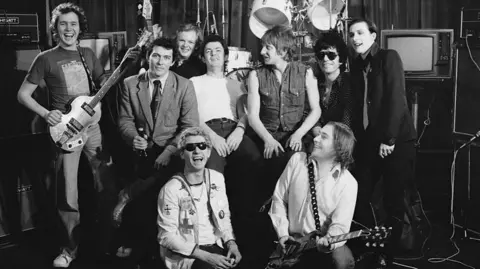
As one of the co-founders of Stiff Records, he signed acts such as Elvis Costello, The Pogues, Madness, Motörhead, The Damned, and Kirsty MacColl.
Now living in Bedfordshire, he has had a long career that has seen him trek across America with Jimi Hendrix and photograph The Beatles in Liverpool.
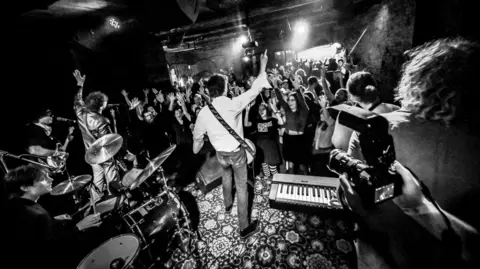
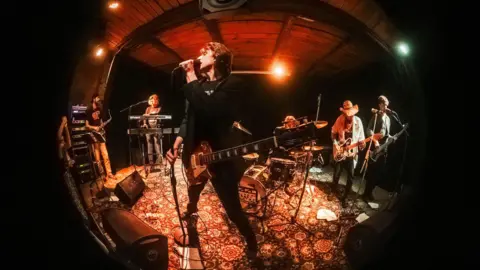
Just weeks ago, he was in Ukraine, “12km from the front line”, touring with Carlisle band Hardwicke Circus.
Despite being struck down with pneumonia, he has no plans to slow down; the music must continue.
Touring makes the band

 Getty Images
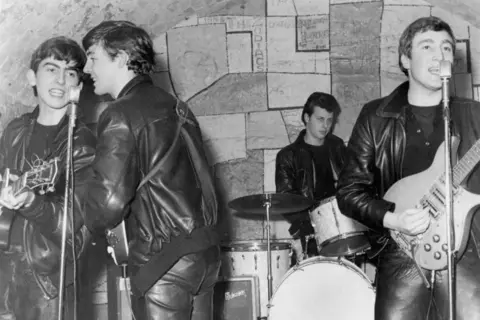
For Mr Robinson, touring is fundamental to being a good musician.
All the bands that were part of Stiff Records were encouraged to keep playing live -he notes that “all the ones that are above ground now are still touring”, meaning they “obviously hooked onto the idea”.
He explained: “It’s a very hard life because you will do up to four or five hours to get there, you’ll set up, you’ll do a sound check, then you’ll do an hour set, and then you’ll pack it all down and move to the next one”.
Robinson’s journey began in the early 1960s when he moved from Ireland to the UK as a photographer.
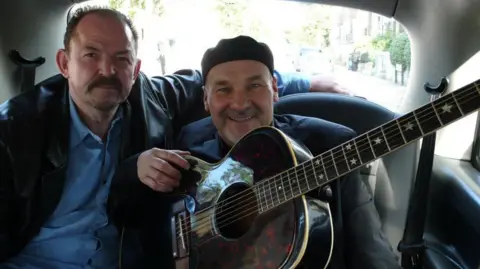
One lunchtime assignment in the 1960s took him to Liverpool’s Cavern Club, where he photographed a string of bands, including The Beatles
While he did not initially think they were “anything special,” he recalled that Paul McCartney was friendly while John Lennon was not.
He said: “I was just taking the pictures and trying to remember left to right. So, you try to get the names correct… I don’t remember them very much.
“I photographed about 11 bands, and four of them did Long Tall Sally… They’re all copying that kind of era of music, including The Beatles.”
 Getty Images
For him, The Beatles are a perfect example of how bands improve from touring.
Years later, watching footage of The Beatles after the years they spent doing back-to-back shows in Hamburg, Robinson saw how touring had transformed them.
He said: “I like touring. I think touring makes the band. Hamburg, that’s what made the Beatles.
“When I took their pictures, they hadn’t been to Hamburg, insofar as I knew… They were a different band.
“Touring every night, practising, getting the show together, tightening it up, making it really interesting for the public coming to see it… All of that I’ve specialised in with Stiff Records.
Hendrix
 A. N. Other
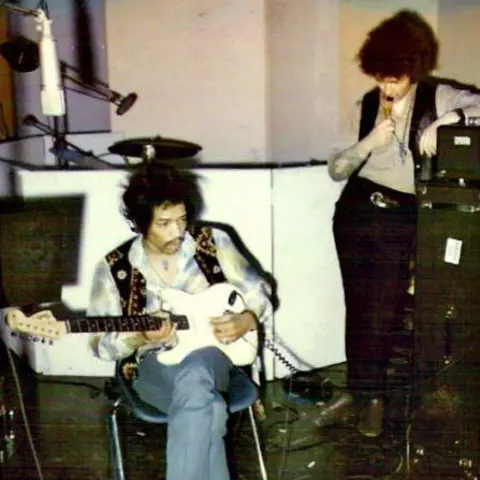
In 1968, Mr Robinson managed Eire Apparent on a U.S. tour with Soft Machine and Jimi Hendrix.
When lead tour manager Gerry Stickells fell ill, he stepped in for three months, a period he calls “character forming.”
He said: “You don’t gain any experience from success. You gain experience from disasters”.
Logistics were a challenge, particularly the necessity of carrying money.
Because “it was all cash, there were no credit cards”, he was given “a briefcase and a Beretta” as “you had to have a gun if you were carrying money”.
 Getty Images
He remembers that Hendrix’s audience was overwhelmingly “very, very white” college students.
He recalled they were young people who had “avoided the draft or evaded the draft” during the Vietnam War.
He said: “Black people didn’t get on planes, remarkably, at that time. They didn’t fly a lot.
“So, you’d get to an airport, and you’d have a lot of people giving you abuse… It was a very different time.”
There were other challenges in the airport too: “When we first went to America, all our gear went down the slides in the luggage thing, and it was all ripped to pieces. All the gear looked appalling coming down the chutes”.
Sometimes luggage was thrown off the plane before the flight took off, so Mr Robinson learnt to hold a wad of $20 bills in his hand so porters treated the gear more carefully in hopes of a tip.
Ukraine
 Veronika Zolotoverkha
Now in his eighties, Mr Robinson is using decades of experience to support new bands in the toughest conditions.
In November, he completed his second tour of Ukraine with Carlisle band Hardwicke Circus.
The most recent tour started in the west at Lviv near the Polish border and continued to Kyiv, Ternopil and beyond
Having taken bands into jails and toured Northern Ireland during the Troubles, Robinson believes Ukraine needs music more than anywhere else.
He said: “People in the UK may or may not need the music, but Ukraine needs the music. So we’ll go”.
The response in Ukraine had been overwhelmingly positive, with all the shows being packed.
He observed that the crowds were largely composed of young people, primarily girls, with many local men fighting on the front line.
Between gigs he saw wrecked cars, bombed buildings and heard sirens and explosions.
The band visited schools and hospitals to run music workshops, often performing in underground venues for safety.
He said: “It seemed to me we would leave a town and the town would be bombed the following day.
“It wasn’t that they were following us or anything, it’s just coincidence, but that was the way it seemed.”
 Yuri Gryaznov
While on the road, Mr Robinson fell seriously ill with pneumonia, leaving him unconscious for three days.
Despite this, he is keen to return as soon as possible and organise more tours of the region.
He explained: “I have toured with everybody, I like touring, I like logistically planning it, I like working it all out. The music is what it’s about; it’s the music that is very important.
“It’s not masochistic. It’s not there to be suffering. It’s not there as punishment. It’s there to bring the music to people who seem to need it more than the people at the festivals
“I told the band: ‘I can’t guarantee the safety, we’ll be doing everything we can obviously, but the reason we’re going is because it’s there, because they need the music’.
“People in the UK may or may not need the music, but Ukraine needs the music. So we’ll go.”