
India Focus
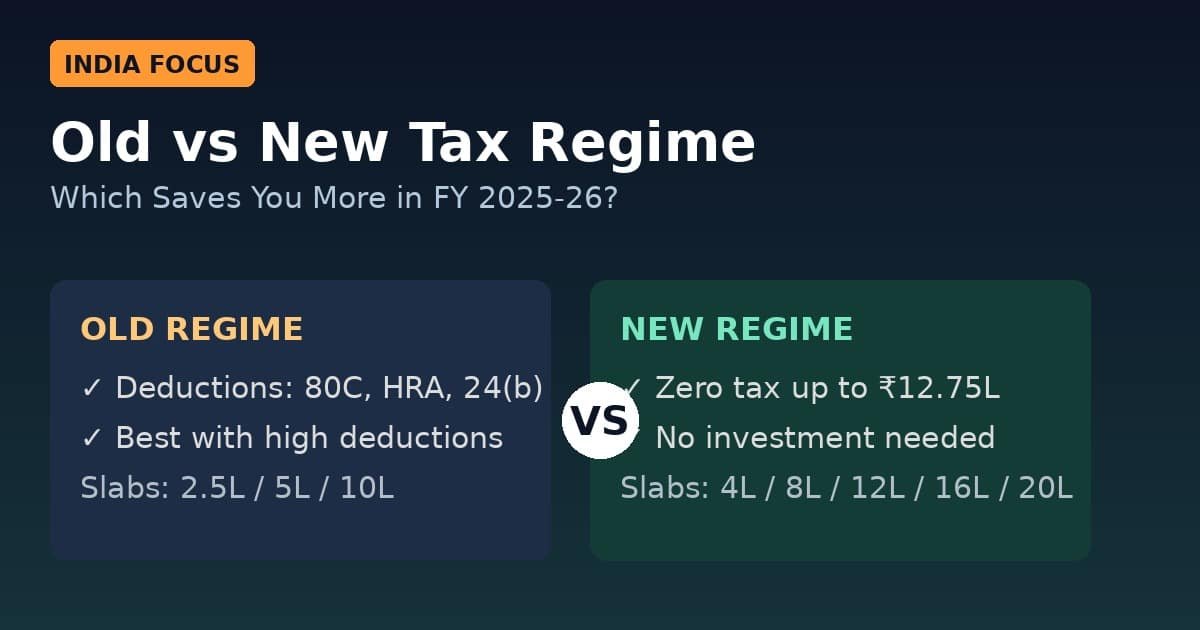
Every year around July, millions of Indian taxpayers face the same question while filing their ITR: old tax regime or new tax regime — which one actually saves more money? Since the new regime became the default option and Budget 2025 pushed the zero-tax threshold up to ₹12.75 lakh for salaried individuals, the answer has changed for a lot of people. This guide breaks down both regimes with real numbers for FY 2025-26 (AY 2026-27), so you can make the decision with confidence instead of guessing.
New Tax Regime Slabs — FY 2025-26
| Income Slab | Tax Rate |
|---|---|
| Up to ₹4,00,000 | Nil |
| ₹4,00,001 – ₹8,00,000 | 5% |
| ₹8,00,001 – ₹12,00,000 | 10% |
| ₹12,00,001 – ₹16,00,000 | 15% |
| ₹16,00,001 – ₹20,00,000 | 20% |
| ₹20,00,001 – ₹24,00,000 | 25% |
| Above ₹24,00,000 | 30% |
Salaried individuals also get a flat ₹75,000 standard deduction under the new regime. Thanks to the Section 87A rebate of up to ₹60,000, anyone with net taxable income up to ₹12 lakh pays zero income tax — roughly a ₹12.75 lakh gross salary once the standard deduction applies.
Old Tax Regime Slabs — FY 2025-26
| Income Slab | Tax Rate |
|---|---|
| Up to ₹2,50,000 | Nil |
| ₹2,50,001 – ₹5,00,000 | 5% |
| ₹5,00,001 – ₹10,00,000 | 20% |
| Above ₹10,00,000 | 30% |
The old regime keeps a lower ₹50,000 standard deduction, but lets you claim deductions the new regime doesn’t allow — Section 80C (up to ₹1.5 lakh), 80D health insurance premiums, HRA exemption, home loan interest under Section 24(b) (up to ₹2 lakh), and NPS contributions under 80CCD(1B), among others.
Real Numbers: Three Income Levels Compared
₹7 Lakh Salary
New regime taxable income after the standard deduction is ₹6.25 lakh — inside the ₹12 lakh rebate window, so tax payable is ₹0. Old regime without any 80C investment works out to roughly ₹44,200. Invest the full ₹1.5 lakh under 80C, and taxable income drops to ₹5 lakh — bringing the old regime’s own rebate into play, also landing at ₹0.
₹12 Lakh Salary
New regime taxable income comes to ₹11.25 lakh — still under the rebate threshold, so tax stays at ₹0. Old regime, even with 80C + 80D + NPS (~₹2.25 lakh in deductions), still results in tax of roughly ₹1,01,400.
₹20 Lakh Salary
New regime tax comes to approximately ₹1,92,400. Old regime without deductions is considerably higher at roughly ₹4,13,400. Even with a strong deduction package — full 80C, 80D, NPS, and ₹2 lakh in home loan interest — old regime tax still lands near ₹2,80,800, higher than the new regime.
For most salaried individuals below ₹15 lakh without major loan or rent deductions, the new regime now wins with zero planning required — no investment proof, no paperwork, no effort.
Who Should Actually Choose the Old Regime?
- You’re paying substantial home loan interest (Section 24(b)) on a self-occupied property
- You pay high rent in a metro city and can claim a large HRA exemption
- You already max out 80C, 80D, and NPS contributions every year and your income is well above ₹15–20 lakh
- You’re a senior citizen relying on the old regime’s higher basic exemption limits
Common Mistakes People Make
- Assuming old regime deductions still apply automatically — the new regime is default since FY 2023-24; you must actively opt for the old regime.
- Counting gross salary instead of taxable income — always compare post-deduction numbers.
- Ignoring the 87A rebate cliff — going even slightly over ₹12 lakh taxable income means losing the rebate entirely and being taxed on the full slab structure.
- Not recalculating every year — slabs and rebates have changed twice in three budgets.
Quick Tax Estimator
Frequently Asked Questions
Is the new tax regime compulsory now?
It’s the default regime, but you can still opt for the old regime when filing your ITR if it works out better for you.
Can I switch between regimes every year?
Salaried individuals with no business income can switch each financial year. Those with business or professional income have restrictions once they opt out of the new regime.
Does the ₹12 lakh rebate mean my income is tax-free?
Your tax liability is fully offset by the rebate — you still need to file a return and report the income, but no tax is payable.
Bottom Line
For most salaried taxpayers earning up to ₹15 lakh with limited deductions, the new regime is now the simpler and cheaper option. The old regime still makes sense if you’re carrying significant home loan interest, claim large HRA, or consistently max out your 80C/80D/NPS investments. Run your own numbers using the calculator above before deciding, and check both regimes fresh every filing year — a small change in salary or deductions can flip which one wins. For more guides like this, visit our India Finance section, and always verify your final numbers on the official Income Tax Department portal before filing.
Want More India Finance Guides?
New tax planning, credit, insurance, and investing breakdowns published regularly.