GroYourWealth Personal Finance & Crypto Education for Everyone
Crypto Education Crypto for Beginners — C-03
How to Read a Crypto Chart — The Very Basics (Complete Beginner’s Guide 2026)
📅 22 March 2026 ⏱ 11 min read 🌎 Global — All Countries
4
Key chart concepts explained
3
Free charting tools covered
5
Step beginner framework
0
Trading experience needed
If you have ever opened a crypto chart and felt completely lost — you are not alone. Most beginners see a screen full of red and green candles, zigzag lines, and numbers and have no idea what any of it means. The good news is that you do not need to become a professional trader to understand the basics. This guide — episode three of our Crypto for Beginners series — walks you through exactly what a crypto chart is showing you, what the most important elements mean, and the three key things every beginner should check before making any decision.
▶ Watch the full video — How to Read a Crypto Chart: The Very Basics (C-03)
What a Crypto Chart Actually Shows
A crypto chart is simply a visual record of price over time. The horizontal axis shows time. The vertical axis shows price. Every point on the chart represents what the market agreed the asset was worth at that moment.
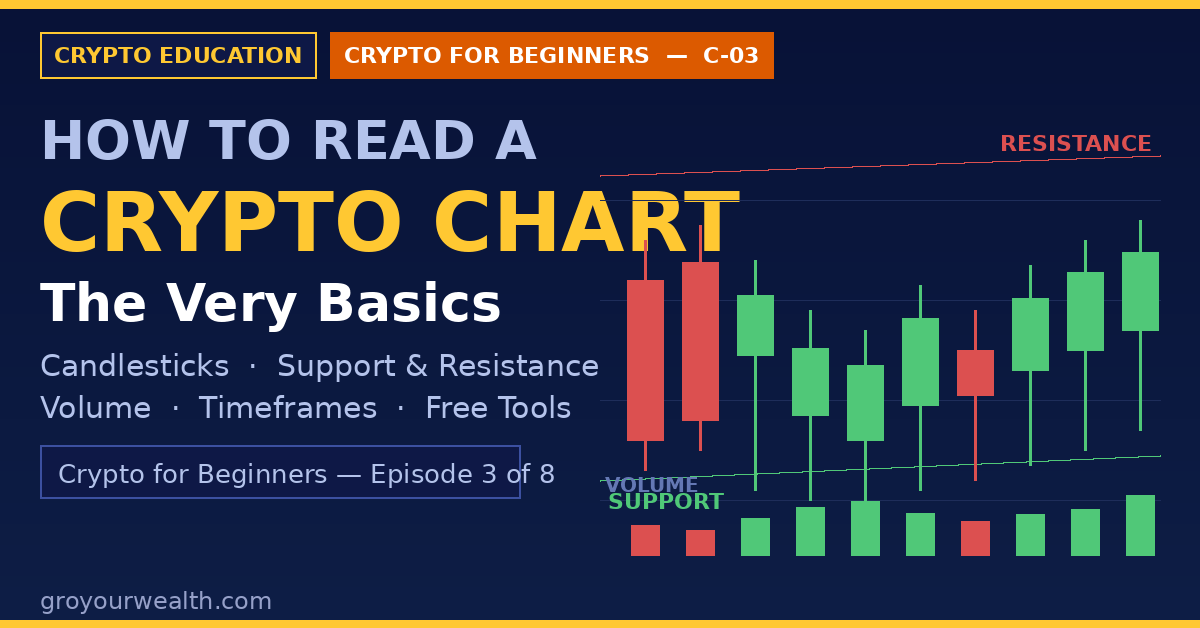
The most common chart type you will see is the candlestick chart. Each candle represents a specific time period — it could be 1 minute, 1 hour, 1 day, or 1 week depending on your settings. The daily chart — where each candle represents one full day — is the most useful for beginners because it filters out the short-term noise of minute-to-minute price movements. When you first open a crypto chart on TradingView, CoinGecko, or Binance, switch to the daily view.
How to Read a Single Candle
Each candlestick tells you four pieces of information about that time period: the open (where price started), the close (where price ended), the high (highest point reached), and the low (lowest point reached).
▲ Green Candle
Close price was HIGHER than open price. The price went UP during this period. The body shows the distance from open to close. Wicks show how high and low price reached.
▼ Red Candle
Close price was LOWER than open price. The price went DOWN during this period. A long upper wick on a red candle means price tried to go higher but was rejected back down.
💡 What Are Wicks?
The thin lines above and below the candle body are called wicks or shadows. They show the extremes the price reached during that period. A long wick below a green candle means buyers stepped in and pushed the price back up from a low — a bullish signal.
Support and Resistance
Support is a price level where the asset has repeatedly stopped falling and bounced back up. Think of it as a floor — buyers tend to step in here because they see value. Resistance is the opposite — a price ceiling where the asset has repeatedly struggled to break above. Sellers tend to step in at resistance and push price back down.
You identify these levels by looking for prices where the chart has bounced multiple times. When a price breaks through resistance and holds above it, that resistance often becomes the new support — this is called a role reversal.
📌 Why These Levels Matter
Large traders and institutions pay close attention to support and resistance levels. This means price tends to react at these levels more often than at random points on the chart. They are not magic — but they concentrate market attention.
Volume — The Most Underused Beginner Tool
Below most crypto charts you will see a bar chart called the volume indicator. Volume shows how many units of the asset were bought and sold during each period.
High volume on a green candle — a lot of buyers were active. The upward move was genuine and supported by real demand.
High volume on a red candle — a lot of sellers were active. The downward move was genuine and driven by real selling pressure.
Low volume on any candle — the price move was weak and not well supported. Big price moves on low volume are often reversed quickly.
A price breakout above resistance on high volume is considered much more significant than the same breakout on low volume. Volume gives context for whether a price move is meaningful or just noise.
The 3 Most Important Things to Check Before Any Decision
The trend. Is the price making higher highs and higher lows over time? That is an uptrend. Lower highs and lower lows? Downtrend. Sideways with no clear direction? Ranging market. Knowing the trend tells you whether momentum is with you or against you.
Price relative to support and resistance. If the price is sitting right at a strong resistance level that has held multiple times, buying there carries significant risk. If it has just bounced off a strong support level, the risk profile is different. Context matters enormously.
What volume says about recent moves. A breakout above resistance on strong volume is very different from the same breakout on thin volume. These three checks take under two minutes and give you far more information than any social media post about the coin.
Free Crypto Charting Tools
You do not need to pay for charting software. Three completely free platforms give you everything a beginner needs.
For beginners: start with CoinGecko for a quick overview, then use TradingView for any deeper chart analysis. TradingView is the industry standard for a reason.
Understanding Timeframes
Every chart can be viewed across different timeframes. The timeframe you choose dramatically changes what the chart looks like and what information you get from it. A coin that looks like it is crashing on a 1-hour chart might look perfectly healthy on a weekly chart — it is simply going through a normal pullback within a larger uptrend.
⚠ Avoid Short Timeframes as a Beginner
Do not use 1-minute or 5-minute charts to make decisions. Short timeframes are full of noise with no meaningful signal for long-term investors. Stick to the daily chart for trend direction and the weekly chart for the big picture.
What NOT to Do When Reading Charts
Do not buy because a chart has gone up a lot and assume it will keep going. Past price action never guarantees future performance.
Do not panic sell because of a single red candle. Bitcoin has had many 20–50% corrections within larger bull markets. One red day means very little on its own.
Do not use short timeframes to make long-term decisions. A 1-minute chart of any major asset looks chaotic even during healthy conditions.
Do not confuse a chart pattern with certainty. Patterns like head and shoulders, triangles, or flags are probabilistic — not predictive. Charts are one tool for context. They are not a crystal ball.
The 5-Step Beginner Chart Reading Framework
📊 Chart Reading Checklist
Work through the 5-step framework before making any crypto decision. Select your answers below.
* For educational purposes only. Not financial advice. Always do your own research.
Key Takeaways
A crypto chart is simply price over time — nothing mysterious
Green candle = price went up that period · Red candle = price went down
Wicks show the extremes the price reached — long wicks are significant signals
Support = price floor where buyers repeatedly step in
Resistance = price ceiling where sellers repeatedly step in
Volume tells you whether a price move is genuine or weak
Use daily and weekly timeframes — ignore the noise of 1-minute charts
Always check: trend direction · price vs support/resistance · volume context
Most financial advisers recommend index funds as the core of any beginner portfolio — before adding higher-risk assets like crypto.
📈 Crypto for Beginners — Every Weekend
GroYourWealth publishes a new Crypto for Beginners episode every Saturday and Sunday. Next up: Not Your Keys, Not Your Coins — the most important security rule every crypto holder must know.
Disclaimer: This article is for educational purposes only and does not constitute financial or investment advice. Cryptocurrency is a highly volatile asset class. The value of crypto can go up or down significantly and you could lose all of your investment. Always do your own research and consult a qualified financial adviser before making any investment decisions. Chart patterns and technical analysis are not guarantees of future performance.