Crypto staking is one of the most straightforward ways to make your idle digital assets work for you — earning rewards simply by holding and participating in a blockchain network. In this complete 2026 guide, you’ll learn exactly how staking works, which assets offer the best yields, what risks to watch for, and how to get started step by step — no trading required.
▶ Watch the full video on YouTube — NS-09: Bitcoin & Crypto Investing 2026 Series
4%–20%+
Typical annual staking yields by asset
$50B+
Total value locked in staking globally (2026)
3 Methods
Native wallet, exchange staking, and liquid staking
What Is Crypto Staking — And Why Does It Pay You?
When you stake cryptocurrency, you are locking up your holdings to help validate transactions on a Proof of Stake (PoS) blockchain. In return, the network rewards you with newly minted coins or a share of transaction fees. Think of it as earning interest — except the bank is a decentralised network, not a financial institution.
Unlike Bitcoin’s Proof of Work system (which requires energy-intensive mining), Proof of Stake blockchains choose validators based on the amount of crypto they “stake” as collateral. Ethereum, Solana, Cardano, Polkadot, and dozens of others use this model. The more tokens staked, the more secure the network — and the more rewards flow to participants.
💡 Key Insight
Staking rewards are not guaranteed and fluctuate based on network activity, the total amount staked, and token inflation rates. Always understand what drives the yield before committing funds.
The 3 Main Ways to Stake in 2026
1. Native / Direct Staking (Self-Custody)
You connect a compatible wallet (such as MetaMask, Eternl for Cardano, or Phantom for Solana) directly to the network’s staking interface. You retain full control of your private keys. This is the most trustless and transparent approach, and typically offers the highest yields since there are no middleman fees.
Pros: Full custody, maximum yields, no counterparty risk
Cons: Technical setup required, lock-up periods vary, minimum amounts may apply (e.g., 32 ETH for solo Ethereum validation)
Best for: Experienced users comfortable managing their own wallets
2. Exchange Staking (Custodial)
Exchanges like Binance, Coinbase, Kraken, and others offer staking directly from your exchange account. You simply choose the asset, select a duration (flexible or locked), and start earning. The exchange handles all technical complexity on your behalf.
Pros: No technical knowledge needed, low or no minimum requirements, easy to start
Cons: You don’t control the keys (“not your keys, not your coins”), exchange fees reduce yields, counterparty risk if exchange fails
Best for: Beginners who want simplicity and convenience
3. Liquid Staking (DeFi Approach)
Liquid staking protocols such as Lido Finance and Rocket Pool allow you to stake assets while receiving a liquid token (e.g., stETH for staked ETH) that can still be used across DeFi applications. You earn staking rewards AND maintain liquidity — the best of both worlds, but with added smart contract risk.
Pros: No lock-up period, liquid token usable in DeFi, no minimum for Ethereum staking
Cons: Smart contract risk, liquid token may trade at a small discount to underlying asset
Best for: Intermediate users already active in DeFi who want to put staked assets to work
Top Proof of Stake Assets and Expected Yields in 2026
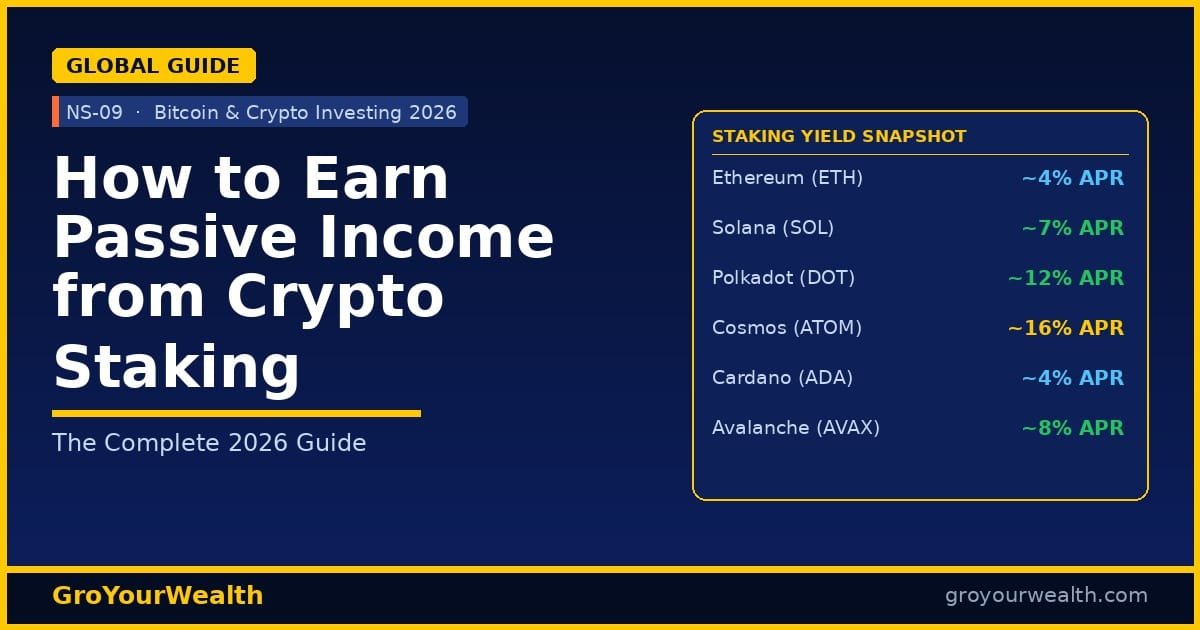
Staking yields vary significantly by asset and are subject to change as more participants join the network. The figures below reflect approximate 2026 annual percentage rates (APR) — always check live rates on StakingRewards.com before committing.
Asset
Staking Method
Est. APR (2026)
Lock-Up
Difficulty
Ethereum (ETH)
Native / Liquid (Lido)
3%–5%
Flexible (via Lido)
Beginner (via Lido)
Solana (SOL)
Native wallet / Exchange
6%–8%
~2–3 day unstaking
Beginner–Intermediate
Cardano (ADA)
Native wallet (delegation)
3%–5%
None — fully liquid
Beginner
Polkadot (DOT)
Native / Exchange
10%–14%
28-day unbonding
Intermediate
Cosmos (ATOM)
Native wallet / Exchange
14%–18%
21-day unbonding
Intermediate
Tron (TRX)
Native / Exchange
4%–6%
3–14 days
Beginner
Avalanche (AVAX)
Native / Exchange
7%–9%
2-week minimum lock
Intermediate
Exchange Earn (BNB, USDT, etc.)
Exchange (Binance, Kraken)
2%–8% variable
Flexible or 30/60/90 day
Beginner
Risks Every Staker Must Understand
Staking is not risk-free. Understanding what can go wrong is as important as knowing the potential rewards.
⚠️ Key Risks to Know Before Staking
Price volatility: A 10% APR means nothing if the token drops 40% in value. Your rewards are denominated in the token — not in fiat currency.
Lock-up risk: Many assets require an unbonding period of days to weeks. If the market moves sharply, you cannot exit immediately.
Slashing: On some networks, validators that act dishonestly or go offline can lose a portion of their staked funds. Delegating to reputable validators reduces this risk.
Smart contract risk: Liquid staking protocols rely on smart contracts. Bugs or exploits can result in loss of funds — always use audited, well-established protocols.
Exchange risk: Exchange staking means the exchange holds your funds. If the exchange is hacked, halts withdrawals, or goes insolvent, your staked assets could be at risk.
Inflationary yields: Some staking rewards come from token inflation, not genuine network revenue. High APRs can sometimes reflect a diluting token rather than real value creation.
How to Get Started with Staking — Step by Step
Step 1 — Choose your asset: Start with a well-established, liquid Proof of Stake asset like ETH, SOL, or ADA. Avoid staking assets purely because of high yields — research the project first.
Step 2 — Choose your method: Beginners should start with exchange staking for simplicity. As your confidence grows, consider native wallet staking or liquid staking for better control and yields.
Step 3 — Set up or use an existing account: For exchange staking, log in to a reputable exchange like Binance or Coinbase. Navigate to their “Earn” or “Staking” section and select your asset.
Step 4 — Understand the lock-up and terms: Check the unbonding period, the current APR, and whether the yield is fixed or variable before committing.
Step 5 — Start small and compound: Begin with a portion of your holdings. Many platforms allow you to reinvest staking rewards automatically — this compound growth effect accelerates over time.
Step 6 — Track and review: Monitor your staking positions monthly. If better opportunities arise — or risks change — be prepared to move your stake.
💎 The Compound Staking Strategy
Rather than withdrawing staking rewards, reinvesting them each period compounds your position. At 8% APR, $5,000 staked grows to approximately $5,400 after 12 months without reinvestment — but to $5,469 with quarterly compounding. Over 3 years, the gap widens significantly.
Staking vs Other Crypto Passive Income Methods
Staking is just one of several ways to earn passive income from crypto. Understanding how it compares helps you build the right strategy for your situation.
Method
Typical Yield
Risk Level
Liquidity
Complexity
Proof of Stake Staking
3%–18%
Medium
Low–Medium
Low–Medium
Liquidity Provision (DeFi)
5%–50%+
High
High
High
Lending (e.g. Aave, Compound)
2%–12%
Medium
High
Medium
Exchange Earn (Flexible)
2%–8%
Medium
High
Low
Yield Farming
Variable — can be very high
Very High
Medium
Very High
Bitcoin Holding (no yield)
0%
Medium
High
Low
Tax Considerations for Staking Rewards
Tax treatment of staking rewards varies by jurisdiction and is an evolving area of law. In many countries, staking rewards are treated as ordinary income at the time they are received, based on the fair market value of the tokens at that moment. When you later sell or exchange those tokens, any gain or loss is treated as a capital gain.
Always consult a qualified tax professional in your jurisdiction before staking significant sums. Keeping accurate records of the date, quantity, and value of rewards received is essential for accurate reporting. Tools like Koinly and CoinTracker can help automate this process across exchanges and wallets.
How Much Can You Realistically Earn?
Use the calculator below to estimate your potential staking returns based on your chosen asset, amount, and holding period. Results are for educational illustration only and do not account for price movements.
🏦 Crypto Staking Earnings Estimator
Estimate your potential annual staking rewards by asset and amount
Disclaimer: This article is for educational purposes only and does not constitute financial or investment advice. Cryptocurrency investments involve significant risk, including the possible loss of your entire investment. Staking yields are variable and not guaranteed. Always conduct your own research and consult a qualified financial professional before making any investment decision. GroYourWealth is not a licensed financial advisor.