Most Americans believe investing requires thousands of dollars and years of financial experience. That belief is wrong — and it’s costing them. In this MF-05 guide, you’ll learn exactly how to start investing with whatever you have right now: $10, $50, or $100. No excuses. No gatekeeping. Just a clear, actionable plan built for real people in 2026.
▶ Watch the full video on YouTube — MF-05: Money Fundamentals Series
56%
of Americans own no stocks or investments (Gallup 2025)
$5
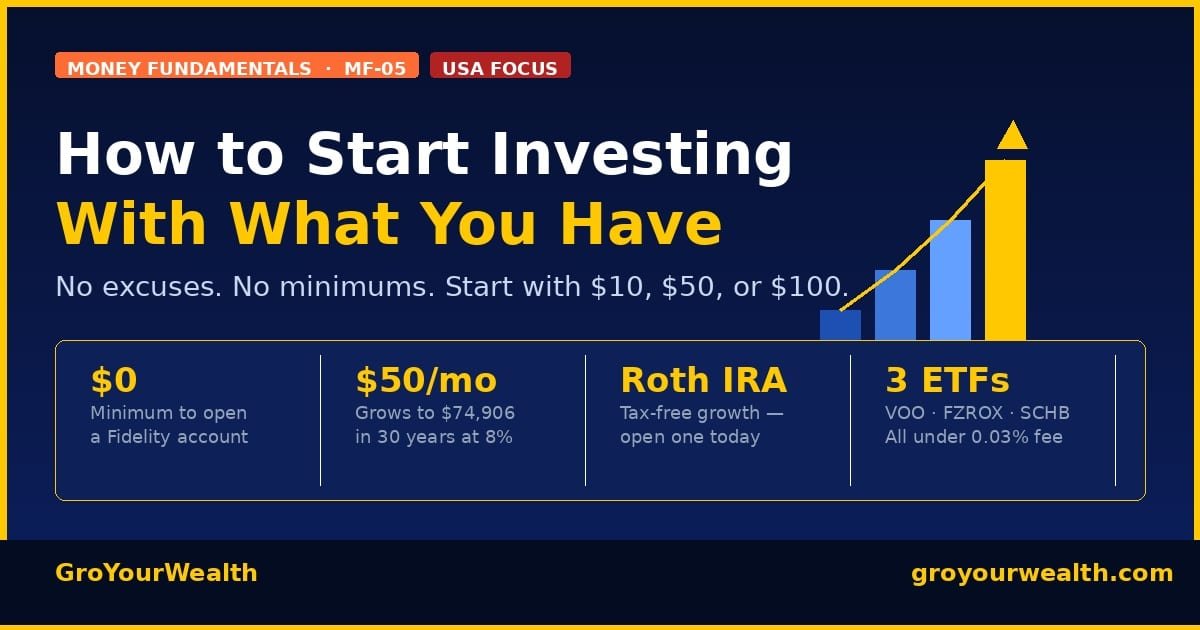
Minimum to start on Fidelity and several major brokerage apps in 2026
10×
Potential growth of $50/month over 30 years at 8% average annual return
The Myth That’s Keeping You Out of the Market
The most damaging investing myth in America is this: you need a lot of money to start. Brokerage minimums, complex jargon, and confusing platforms have convinced millions of Americans that investing is for the wealthy. The data tells a completely different story.
In 2026, you can open a brokerage account with zero minimum balance, buy a fractional share of an S&P 500 ETF for as little as $1, and automate contributions on any schedule. The technology barrier has collapsed. The only barrier left is the one in your head.
According to a Gallup survey, more than half of Americans currently own no investments. Yet over the same period, the S&P 500 has delivered average annual returns of roughly 10% before inflation. Every year you delay is a year of compound growth you cannot get back.
💡 MF-05 Core Principle
Time in the market beats timing the market — and it also beats the amount you start with. $50 invested today is worth more than $500 invested five years from now. Start small. Start now.
Step 1 — Know Your Starting Number
Before choosing a platform or an investment, you need one honest number: how much can you invest this month without touching it for at least three years? This is not your savings. It’s not your emergency fund. It’s money you are genuinely prepared to leave alone.
For most Americans just starting out, this number is somewhere between $10 and $100 per month. That is completely fine. Your income is not your wealth — your investing habit is. A consistent $50/month started today will outperform a lump sum of $1,000 deposited two years from now in most market scenarios.
If you haven’t yet identified your cash flow clearly, read the MF-01 net worth guide first. Understanding what flows in and out of your life every month is the foundation of every investing decision.
Step 2 — Choose the Right Platform for Your Starting Amount
The platform you choose matters more when you have a small starting amount. Fees that look tiny on a large portfolio can be devastating on a $50 balance. Here’s what to look for:
Zero account minimums — platforms like Fidelity, Charles Schwab, and Robinhood require $0 to open and maintain an account in 2026.
Fractional shares — allows you to buy a portion of expensive stocks or ETFs for as little as $1. Fidelity, Schwab, and SoFi Invest all support this.
No trading commissions — commission-free stock and ETF trades are now the industry standard. Never pay a per-trade fee on a beginner account.
Automatic investing tools — look for platforms that let you set a recurring weekly or monthly purchase. Automation removes the temptation to time the market.
Micro-investing apps — Acorns rounds up your purchases and invests the difference. Stash lets you start with $5. These are good training-wheel platforms but watch the monthly fees relative to your balance.
⚠️ Watch Out For These Fee Traps
Micro-investing apps charging $1–$3/month — on a $50 balance, that’s up to 72% annual fee equivalent.
Managed account fees above 0.5% annually — these erode compound growth over decades.
Inactivity fees on dormant accounts — switch to a zero-fee broker if charged for doing nothing.
Step 3 — What to Actually Invest In
This is the question most beginners agonize over — and it has a simple, evidence-backed answer. For most Americans starting out, a low-cost S&P 500 index ETF is the right first investment. Full stop.
An S&P 500 ETF gives you exposure to 500 of the largest US companies in a single purchase. It’s instantly diversified, historically strong, and costs almost nothing to hold. ETF investing for beginners covers this in detail, but the short version is: pick one, automate contributions, don’t touch it.
Three Beginner-Friendly Options for 2026
VOO (Vanguard S&P 500 ETF) — expense ratio 0.03%. Industry benchmark for low-cost passive investing. Available on all major brokerages with fractional shares.
FZROX (Fidelity ZERO Total Market Index Fund) — 0.00% expense ratio. Only available on Fidelity. Covers the entire US market. Genuinely free to hold.
SCHB (Schwab US Broad Market ETF) — expense ratio 0.03%. Similar to VOO but covers more of the US market. Great choice for Schwab account holders.
Avoid individual stocks, options, crypto, and any investment promoted on social media until your portfolio exceeds $10,000 and you have a solid emergency fund. The goal at this stage is one thing: build the habit of investing consistently.
Step 4 — Set Up Automation
The single most powerful investing decision you will ever make is automating your contributions. This removes emotion, removes timing decisions, and removes the temptation to spend that money on something else. It also harnesses dollar-cost averaging — buying more shares when prices are low and fewer when they’re high, automatically.
Here’s how to set it up on the three most popular platforms:
Fidelity: Go to Accounts → Transact → Automatic Investments. Set a recurring weekly or monthly transfer from your bank account directly into your chosen ETF or fund.
Schwab: Use Schwab Automatic Investment Plan (SAIP). Go to Trade → Automatic Investing. Select your ETF and schedule frequency.
Robinhood: Navigate to your chosen stock or ETF → Recurring Investment → set amount and frequency. Works with fractional shares.
📌 The Automation Rule
Set up the automation the same day you open your account. Don’t wait until you “have more money.” The entire point is that it grows the money you already have. Treat it like a bill you pay to your future self.
Step 5 — Use a Roth IRA If You’re Eligible
If you earn income and you’re under the income limits (~$161,000 single / ~$240,000 married filing jointly in 2026), a Roth IRA should be your first investing account — not a taxable brokerage account. Here’s why: every dollar that grows inside a Roth IRA is tax-free when you withdraw it in retirement. That means no capital gains tax, no dividend tax, nothing.
You can contribute up to $7,000 per year in 2026 ($8,000 if you’re 50+). Open one at Fidelity, Schwab, or Vanguard and invest in the same index ETFs described above. The difference in after-tax wealth over 30 years between a Roth IRA and a taxable account is often six figures.
If your employer offers a 401(k) with a match, contribute enough to get the full match first — that’s an immediate 50–100% return on your money. Then fund your Roth IRA. Then invest in a taxable brokerage account if money remains. This is the correct order.
Common Mistakes to Avoid in Your First 12 Months
The biggest threat to a beginning investor isn’t a market crash. It’s behavior. These are the mistakes that derail most people before compounding has time to work:
Checking your account daily — short-term market noise will tempt you to sell. Set a review schedule of once per quarter, maximum.
Stopping contributions when markets drop — a market dip is the best time to buy. Your automatic investment plan buys more shares at lower prices. Don’t interfere.
Withdrawing early — Roth IRA contributions (not earnings) can be withdrawn penalty-free, but doing so resets the compound growth clock. Leave it alone.
Chasing performance — last year’s best-performing fund is rarely this year’s winner. Stick with broad-market index funds.
Waiting for the “right time” — the best time to start was 10 years ago. The second best time is today. The cost of waiting compounds just like returns do — but in reverse.
How Much Will Your Investment Grow? (Real Numbers)
Let’s look at what consistent small investing actually produces. These figures assume an 8% average annual return, which is below the S&P 500’s historical average of approximately 10% before inflation, making it a conservative estimate.
Monthly Contribution
After 10 Years
After 20 Years
After 30 Years
Total Invested
$25/month
$4,573
$14,726
$37,453
$9,000
$50/month
$9,147
$29,451
$74,906
$18,000
$100/month
$18,294
$58,902
$149,812
$36,000
$200/month
$36,589
$117,804
$299,624
$72,000
$500/month
$91,473
$294,510
$749,060
$180,000
Notice the pattern: the amount you contribute matters less than the time you give it. $50/month for 30 years produces $74,906 from $18,000 invested — more than 4x your money. At $500/month, that same 30 years produces $749,060 from $180,000 invested. In both cases, time is the multiplier. Start now.
Investment Growth Calculator
📈 Small Investment Growth Calculator
See how your monthly investment grows over time at 8% average annual return
Platform Comparison — Best for Small Investors in 2026
This article is for educational purposes only and does not constitute financial, investment, or tax advice. All investment projections shown are illustrative estimates based on historical averages and are not guaranteed. Past performance of the S&P 500 or any index does not guarantee future results. Consult a qualified financial advisor before making investment decisions. GroYourWealth is not a registered investment advisor.