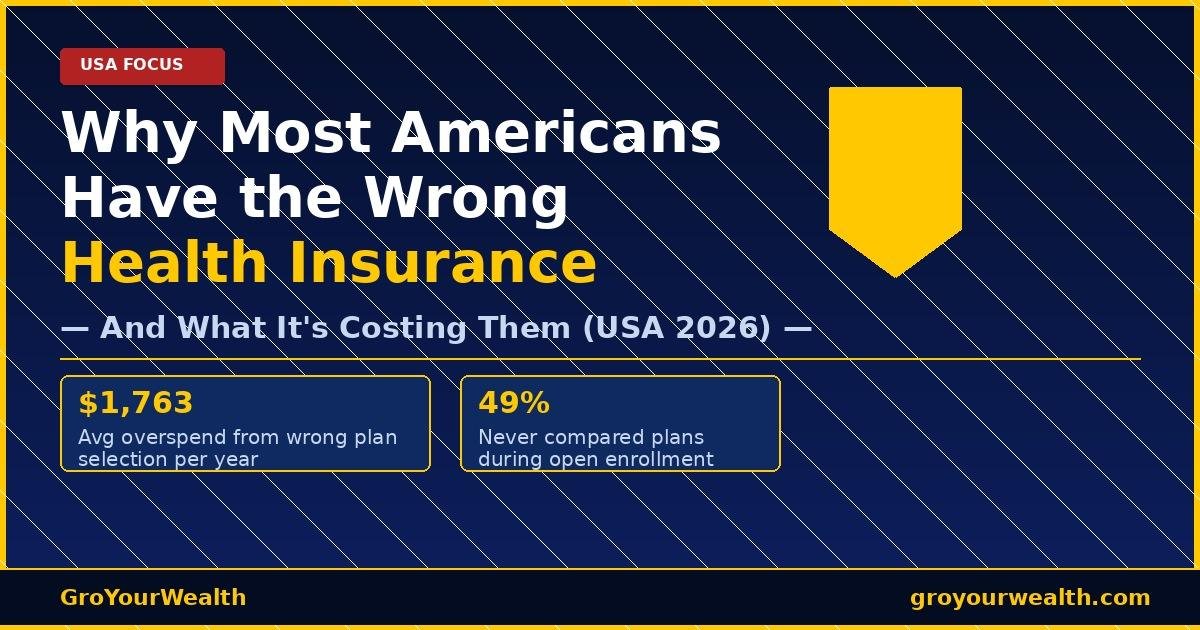
Most Americans don’t realize their health insurance plan is quietly costing them thousands of dollars a year — not in premiums, but in coverage gaps, wrong plan types, and network mismatches. This guide breaks down exactly why so many Americans are on the wrong health plan in 2026, and what you can do today to fix it.
▶ Watch the full video on GroYourWealth — YouTube
$1,763
Average annual out-of-pocket overspend from wrong plan selection
49%
Americans who have never compared their plan during open enrollment
$8,700
Average individual out-of-pocket maximum on ACA marketplace plans in 2026
The Real Problem: Most Americans Choose Health Insurance on Autopilot
Every year during open enrollment, millions of Americans simply re-enroll in whatever plan they had the year before. It feels safe. It feels easy. But it is one of the most expensive financial decisions you can make on autopilot.
Your health needs change. Plan structures change. Premiums shift. Deductibles rise. The network of doctors your plan covers can quietly shrink — and if you don’t re-evaluate, you end up paying for coverage that no longer fits your life.
According to the Kaiser Family Foundation, nearly half of insured Americans have never actively compared health plans during open enrollment. That passive approach is costing families hundreds — sometimes thousands — of dollars per year.
Key Insight
Choosing the wrong health plan type — such as a high-deductible plan when you have regular medical needs — can cost you more than $2,000 more per year than the right plan, even if your premium looks cheaper on the surface.
The Four Main Plan Types — And Why the Wrong One Wrecks Your Budget
The US health insurance system offers four primary plan structures. Understanding the difference is the single most important step you can take to stop overpaying.
HMO — Health Maintenance Organization
HMOs require you to choose a primary care physician (PCP) who acts as your gatekeeper for all specialist referrals. They typically have the lowest premiums but the strictest network rules. Go out of network and you pay the full cost yourself — the plan pays nothing. Best for: people who rarely need specialists and want predictable, low monthly costs.
PPO — Preferred Provider Organization
PPOs give you far more flexibility. You can see any doctor — in-network or out — without a referral. In-network care costs less; out-of-network care is covered but at a higher cost-sharing rate. PPOs carry higher premiums than HMOs but suit people who see multiple specialists or want maximum flexibility. Many Americans on PPOs don’t use that flexibility — and overpay for it every month.
HDHP — High-Deductible Health Plan
HDHPs have very low premiums and very high deductibles — often $1,500 to $3,000 for individuals. The key benefit: HDHPs are the only plan type eligible for a Health Savings Account (HSA). If you are young, healthy, and rarely use medical care, an HDHP plus HSA can be a powerful wealth-building tool. But if you have a chronic condition or regular prescriptions, you can end up paying your entire deductible every single year — wiping out the premium savings entirely.
EPO — Exclusive Provider Organization
EPOs combine elements of HMOs and PPOs. Like a PPO, you don’t need a referral for specialists. Like an HMO, you must stay strictly in-network — out-of-network care (except emergencies) is not covered at all. EPOs often have moderate premiums and are increasingly common on ACA marketplace plans. Many buyers don’t realise how rigid the network restriction is until they receive a surprise bill.
The 5 Costliest Health Insurance Mistakes Americans Make in 2026
Choosing the cheapest premium without checking the deductible. A plan with a $180/month premium and a $6,000 deductible will cost you far more than a $240/month plan with a $1,500 deductible — the moment you actually need care.
Not checking whether your doctor is in-network. Network changes happen every year. Your doctor may have left your plan’s network without any notification. Always verify before January 1st of the new plan year.
Skipping the HSA opportunity. Americans enrolled in an eligible HDHP can contribute up to $4,300 (individual) or $8,550 (family) to an HSA in 2026 — all pre-tax. That is free money sitting on the table. See our guide on why most Americans can’t retire at 65 to understand how missed savings vehicles like HSAs compound the problem.
Not checking formulary for prescriptions. Every insurance plan has a drug formulary — a list of covered medications. A medication that was covered last year at Tier 2 (low cost) may shift to Tier 3 or Tier 4 in the new plan year, doubling or tripling your monthly drug costs.
Ignoring out-of-pocket maximums. The out-of-pocket maximum is the most important number on your plan — the most you will ever pay in a single year. In 2026, ACA plans cap this at $9,450 for individuals. But some plans (particularly employer-sponsored ones) have higher limits. If you or a family member faces a major health event, the out-of-pocket maximum is what protects you from financial ruin.
Employer-Sponsored Plans: The Hidden Traps
More than 160 million Americans get health insurance through their employer. Many assume that because their employer chose the plan, it must be a good one. That assumption costs real money.
Employers typically offer 2–4 plan options during open enrollment. The cheapest option your employer heavily subsidises may look attractive — but if it’s an HDHP and you visit the doctor six times a year, you’ll hit your deductible in the first quarter and pay full price for every visit after that until your deductible resets.
Common Employer Plan Traps
Automatic re-enrollment in last year’s plan — even if a better option was added this year
Family coverage costs that are fully employee-funded (employers often only subsidise employee-only coverage)
Narrow networks that exclude major regional hospital systems
No vision or dental bundling — leaving employees to buy those separately at much higher individual rates
ACA Marketplace Plans: What Most Americans Get Wrong
If you are self-employed, a freelancer, or your employer doesn’t offer coverage, you’re shopping on the Healthcare.gov marketplace. The ACA marketplace uses a metal tier system: Bronze, Silver, Gold, and Platinum. Here’s the mistake most people make: they go straight for Bronze because the premium is lowest.
Bronze plans have the cheapest monthly premiums but the highest deductibles and cost-sharing. They make sense only if you are young, healthy, and genuinely won’t use your insurance much. For anyone with regular medical needs, a Silver plan — especially one with Cost Sharing Reductions (CSR) — often provides dramatically better value. CSR subsidies are only available on Silver plans, and they can slash your deductible from $5,000 to under $500 if your income qualifies.
2026 ACA Subsidy Update
The enhanced ACA subsidies introduced under the Inflation Reduction Act have been extended through 2025, but their status beyond that is subject to Congressional action. If you are currently receiving premium tax credits, verify your subsidy status for 2026 at healthcare.gov before your plan year begins.
How to Choose the Right Health Plan: A Step-by-Step Framework
Calculate your total annual cost — not just premium. Multiply your monthly premium by 12. Add your estimated deductible spending based on last year’s usage. Add expected copays and coinsurance. Compare this total across every plan option.
Check your doctors and prescriptions first. Before you compare premiums, verify that your preferred doctors and medications are covered under the plan you’re considering. Use the provider directory on each insurer’s website — not the broker’s summary sheet.
Run two scenarios: healthy year vs. bad year. How much would you pay under each plan if you used only preventive care? How much if you had a major illness or surgery? The right plan performs well in both scenarios — or at least doesn’t catastrophically fail in either.
Evaluate HSA eligibility if you choose an HDHP. If you go with a high-deductible plan, open and fund an HSA immediately. The triple tax advantage (pre-tax contributions, tax-free growth, tax-free withdrawals for medical expenses) makes the HDHP far more competitive than its raw premium number suggests.
Set a reminder for next open enrollment. Don’t let autopilot enroll you again next year. Set a calendar reminder 30 days before your open enrollment window. Read every plan comparison document. It takes 90 minutes. It can save you thousands.
Comparison Table: Health Plan Types at a Glance (USA 2026)
Plan Type
Monthly Premium
Network Flexibility
Referral Required?
HSA Eligible?
Best For
HMO
Lowest
In-network only
Yes
No
Healthy, low usage, cost-conscious
PPO
Highest
In + Out of network
No
No
Frequent specialist users, max flexibility
HDHP
Low
Varies
No
Yes
Healthy savers, HSA builders
EPO
Moderate
In-network only
No
No
Those wanting PPO freedom at lower cost
ACA Bronze
Lowest
Varies
Plan-specific
If HDHP
Young, healthy, rarely uses care
ACA Silver
Moderate
Varies
Plan-specific
If HDHP
CSR-eligible households, moderate usage
ACA Gold
High
Varies
Plan-specific
No
High usage, frequent care, chronic conditions
Health Insurance True Cost Calculator
Annual Health Insurance True Cost Estimator
Compare the real annual cost of different plan types based on your expected usage level — not just the monthly premium.
What You Should Do Before Your Next Open Enrollment
Open enrollment in the US typically runs from November 1 to January 15 for ACA marketplace plans, and varies by employer for workplace plans. Here’s a simple action plan to make sure you’re on the right plan next year:
Pull your last year’s Explanation of Benefits (EOB). This document, available from your insurer’s online portal, shows exactly what you paid versus what the plan paid. It tells you whether you hit your deductible, what you spent on prescriptions, and whether you stayed in-network.
Use your insurer’s plan comparison tool during open enrollment. Most insurers — including those on Healthcare.gov — now offer side-by-side plan comparisons that calculate estimated total annual costs based on your usage profile. Use them. They take 15 minutes and can save you $1,000+.
Check if you qualify for ACA subsidies. If your income is between 100% and 400% of the federal poverty level (or higher, under current subsidy rules), you may qualify for premium tax credits. Many Americans who could claim these subsidies don’t, because they assume they earn too much.
Consider a Health Savings Account as an investment account. An HSA isn’t just for medical expenses. Funds not used this year roll over indefinitely — and after age 65, HSA funds can be withdrawn for any purpose (subject to income tax, like a traditional IRA). Our guide on how to pay less tax legally covers HSA strategy in depth.
If you want to take a deeper look at what your health insurance costs are doing to your overall financial plan, read our guide on why most Americans are one emergency away from broke — and how insurance and savings strategy work together.
This article is for educational and informational purposes only. It does not constitute financial, insurance, or legal advice. Health insurance rules, subsidies, and plan structures change annually. Always verify plan details, network coverage, and subsidy eligibility directly with your insurer or a licensed insurance broker before making any decisions. GroYourWealth is not a licensed insurance advisor.