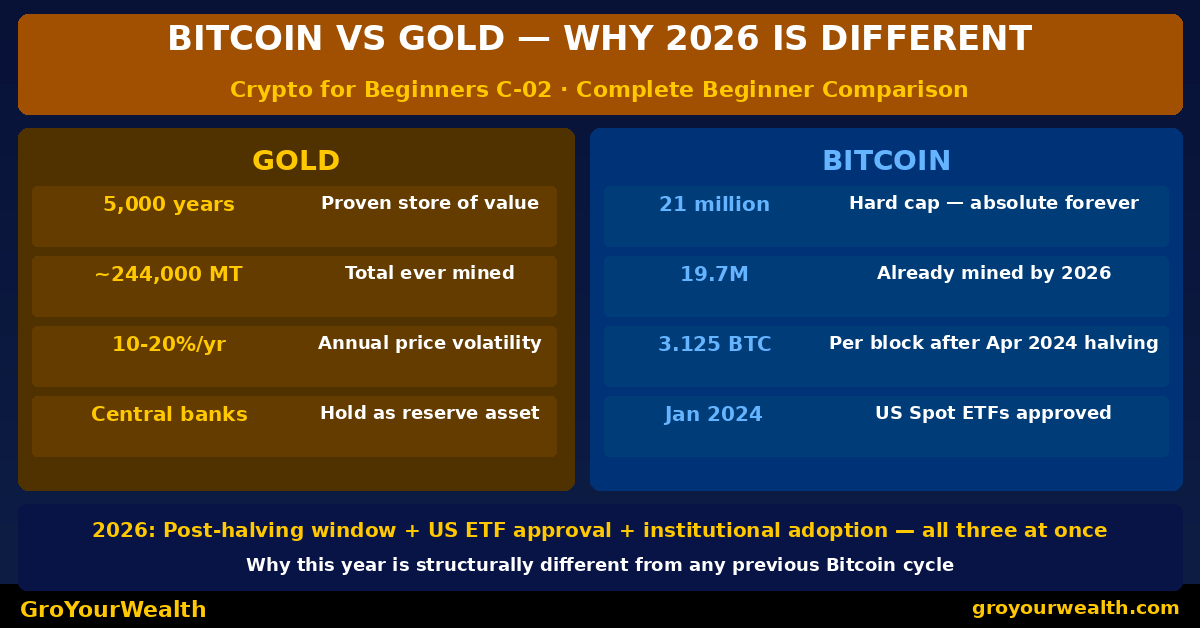
Bitcoin vs Gold — Why 2026 Is Different | Crypto for Beginners
📅 21 March 2026 ⏰ 12 min read 🌐 Global Coverage
21M
Bitcoin hard cap — forever
5,000
Years gold proven
Jan 2024
US Bitcoin ETFs approved
3.125
BTC per block after 2024 halving
Gold has been humanity’s store of value for over 5,000 years. Bitcoin has existed for just 16. Yet in 2026, serious investors, central banks, and financial institutions are actively debating whether Bitcoin has earned a place alongside gold — or whether it is on track to redefine what a store of value means in the digital age.
This is episode two of our Crypto for Beginners series. If you missed episode one, read our complete guide on what cryptocurrency actually is before continuing. This guide compares Bitcoin and gold across every dimension that matters to a beginner investor — scarcity, portability, divisibility, transparency, risk, and the specific reasons why 2026 is structurally different from any previous year in this debate.
⚠ Important Disclaimer
This article is for educational purposes only. Bitcoin and all cryptocurrencies are high-risk, highly volatile assets. Past performance does not guarantee future results. Never invest more than you can afford to lose entirely. Always consult a qualified financial adviser before making investment decisions.
▶ Watch the full guide — Bitcoin vs Gold: Why 2026 Is Different — Crypto for Beginners Episode 2
What Makes Something a Store of Value?
Before comparing Bitcoin and gold, we need to understand what makes an asset a store of value. A store of value holds purchasing power over time — it does not rot, corrode, or disappear. Gold has satisfied this requirement better than almost anything else for thousands of years. It does not rust. It cannot be cheaply manufactured. Governments and central banks hold it as a reserve asset precisely because no government can create more of it.
A good store of value needs four properties. Scarcity — difficult or impossible to increase supply significantly. Durability — lasts without degrading. Portability — transferable without excessive difficulty. Verifiability — you can confirm it is genuine. Gold has satisfied all four for millennia. The question is whether Bitcoin now does too — and whether it does so better in a digital world.
Scarcity — Bitcoin’s Strongest Argument
Gold has a finite supply on Earth — but that supply is not perfectly fixed. Mining technology improves. New deposits are discovered. Estimates suggest approximately 244,000 metric tonnes of gold have been mined in total, with perhaps 50,000 to 60,000 metric tonnes remaining underground. We do not know the exact figure.
Bitcoin’s scarcity is mathematically absolute. The maximum supply is 21 million Bitcoin — hard-coded into the protocol and impossible to change without consensus from the entire network. As of 2026, approximately 19.7 million Bitcoin have already been mined, leaving fewer than 1.3 million left to be issued through the mining process until approximately the year 2140.
💡 Key Distinction
Gold’s scarcity is geological — more can always theoretically be found or extracted. Bitcoin’s scarcity is mathematical — 21 million is the absolute maximum, written into the code since 2009. This is the single most important distinction for any beginner to understand.
The Halving — Why 2026 Is Different
The Bitcoin halving is the built-in mechanism that controls supply. Every 210,000 blocks — approximately every four years — the reward paid to Bitcoin miners is cut in half. In 2009, miners received 50 Bitcoin per block. Following the fourth halving in April 2024, that reward fell to 3.125 Bitcoin per block. The next halving is expected around 2028.
We are currently in the post-halving window — the 12 to 24 months following the April 2024 halving. This coincided with two other significant developments: the approval of Bitcoin spot ETFs in the United States in January 2024, and growing institutional adoption by major corporations and sovereign wealth funds. The combination of reduced new supply and increased institutional demand is why 2026 is structurally different from any previous post-halving cycle.
Bitcoin vs Gold — Side by Side
🎉 Gold
Track record
5,000+ years proven store of value
Total mined
~244,000 metric tonnes
Supply certainty
Large but imprecise — more can be found
Portability
Physical transport required — high cost
Divisibility
Impractical in very small amounts
Volatility
10–20% annual moves — relatively stable
Regulatory risk
Minimal — held by central banks globally
₿ Bitcoin
Track record
16 years — untested in major global crisis
Max supply
21 million — mathematically fixed forever
Supply certainty
Absolute — hard-coded since 2009
Portability
Smartphone + internet — minutes globally
Divisibility
100 million Satoshis — any budget
Volatility
50–80%+ moves in a single year possible
Regulatory risk
Ongoing uncertainty in multiple countries
Complete Comparison Table
Dimension
Gold
Bitcoin
Winner
Supply Certainty
Geological limit — imprecise
21 million — mathematically absolute
Bitcoin
Portability
Physical transport — high cost and time
Smartphone — minutes — low cost
Bitcoin
Divisibility
Impractical below a few grams
100 million Satoshis — any budget
Bitcoin
Verifiability
Physical testing required — can be faked
Blockchain — mathematically impossible to fake
Bitcoin
Track Record
5,000 years proven through crises
16 years — untested at scale
Gold
Volatility
10–20% annual — relatively stable
50–80%+ possible — very high risk
Gold
Regulatory Risk
Minimal — central bank reserve asset
Ongoing uncertainty — banned in some countries
Gold
Accessibility
Physical storage or intermediary needed
Smartphone — anyone anywhere — 24/7
Bitcoin
What Changed in 2024 — The Institutional Shift
In January 2024, the United States Securities and Exchange Commission approved the first spot Bitcoin Exchange Traded Funds. Within months, these ETFs attracted billions of dollars from pension funds, wealth managers, and retail investors who previously had no easy way to hold Bitcoin within traditional financial accounts.
Companies including Strategy (formerly MicroStrategy) hold billions of dollars of Bitcoin on their corporate balance sheets as a treasury reserve asset. El Salvador made Bitcoin legal tender. Several other nations have explored similar frameworks. Bitcoin is no longer solely the territory of retail crypto enthusiasts — it is now accessible through the same brokerage accounts, ETFs, and pension fund structures that traditional investors use for stocks and bonds.
⚠ The Real Risks — Do Not Skip This
Gold has 5,000 years of proven track record. Bitcoin has 16. Gold is a physical asset — it cannot be hacked, needs no electricity, and survives digital infrastructure failure. Bitcoin carries significant regulatory risk — China banned it outright. Bitcoin also moves 50–80%+ in either direction within a single year. For investors who cannot tolerate large drawdowns, this volatility is a genuine concern, not just a number.
How Much Bitcoin for a Beginner Portfolio?
The majority view among financial advisers in 2026 is that Bitcoin allocation for most retail investors should be treated like any other high-risk asset. Many suggest limiting Bitcoin to 1% to 5% of a total investment portfolio — enough to participate in potential upside without catastrophic impact if it falls significantly. Compare this with gold where 5% to 10% is more common given its lower volatility.
📌 The Foundation Rule
Keep the majority of your portfolio in diversified, low-cost index funds as the foundation. Bitcoin is a small, optional, high-risk allocation — not the foundation itself. Never borrow to buy Bitcoin. Never invest money you need in the next 1 to 3 years.
Bitcoin Allocation Calculator
📈 Bitcoin Portfolio Allocation Guide
Select your total investable portfolio size and risk tolerance to see a suggested maximum Bitcoin allocation.
Select your portfolio size and risk tolerance above then click Calculate
* Educational guide only. Not financial advice. Consult a qualified adviser before investing.
Disclaimer: This article is for educational purposes only and does not constitute financial or investment advice. Bitcoin and all cryptocurrencies are high-risk assets. Past performance does not predict future results. All figures are accurate as of March 2026. Always conduct your own research and consult a qualified financial adviser before making any investment decision.