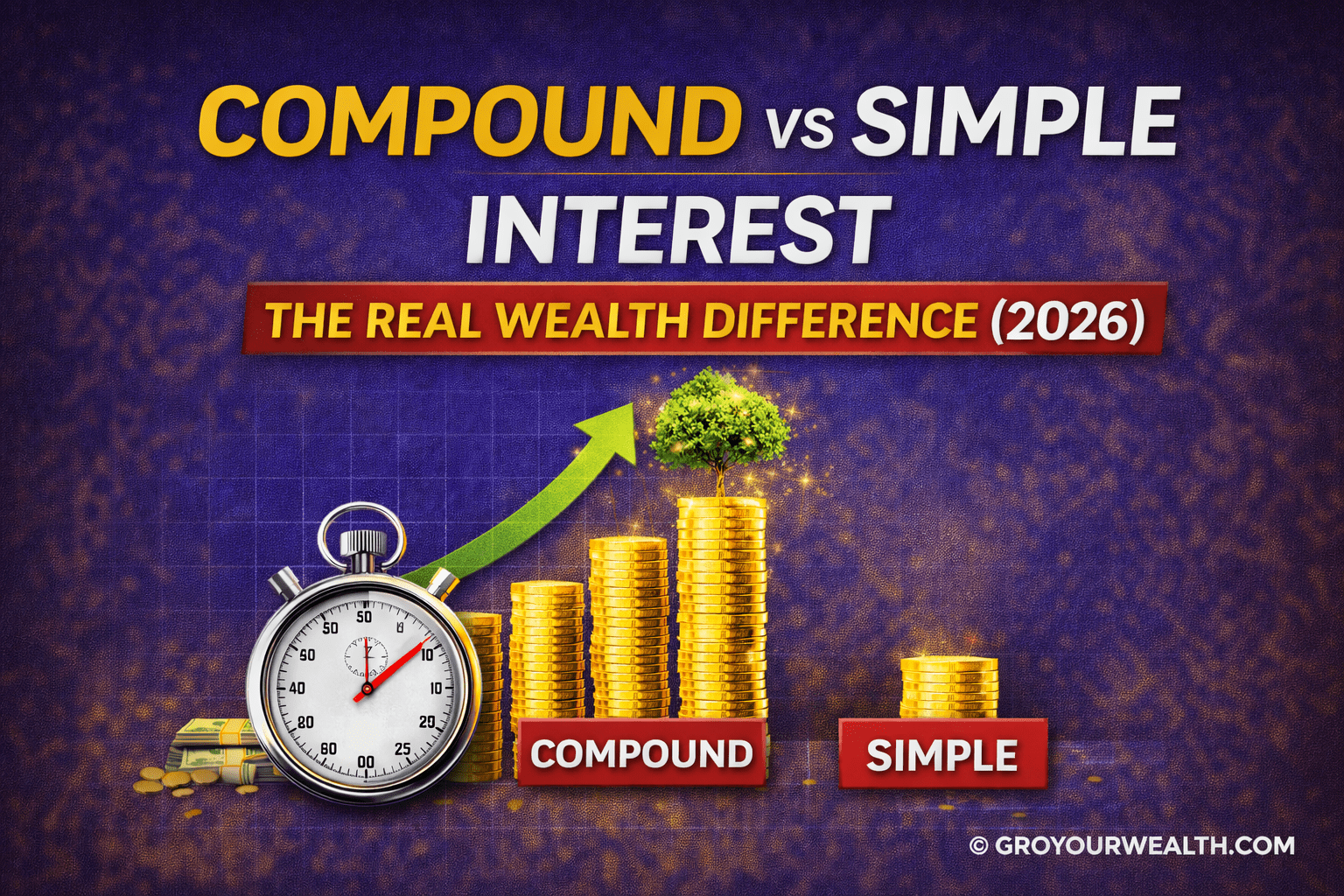
Most people hear the phrase compound interest and assume it’s just “interest on interest.”
That’s technically true — but it dramatically understates its power.
The difference between compound and simple interest is not small. Over decades, it can mean the difference between financial comfort and financial struggle.
Understanding this difference is foundational to long-term wealth building.
If you prefer a visual breakdown, we explain this step-by-step in our video guide here:
What Is Simple Interest?
Simple interest is calculated only on the original principal amount.
Formula:
Simple Interest = Principal × Rate × Time
If you invest $10,000 at 5% simple interest for 10 years:
The growth is linear. It increases at the same rate every year.
There is no acceleration.
What Is Compound Interest?
Compound interest calculates interest on:
• The original principal • Plus previously earned interest
This creates exponential growth.
Formula:
Compound Interest = Principal × (1 + Rate)^Time
Using the same example:
$10,000 at 5% compounded annually for 10 years:
Total ≈ $16,289
That’s $1,289 more than simple interest — over just 10 years.
Now extend that to 20 or 30 years.
The gap becomes massive.
Why Compound Interest Wins Long-Term
Compound interest rewards three things:
1️⃣ Time 2️⃣ Consistency 3️⃣ Reinvestment
The longer your money stays invested, the more powerful the acceleration becomes.
This is why starting early matters more than investing larger amounts later.
As explained in our guide on long-term strategy , consistency and structured investing matter more than trying to time the market.
The Acceleration Effect
In the early years, compound growth looks slow.
But around years 15–20, growth begins to accelerate dramatically.
This happens because the interest earned each year becomes larger than your original yearly contributions.
Your money begins working harder than you do.
That is the turning point.
Real-World Example: 25 vs 35
Person A invests $500 per month starting at age 25.
Person B invests $500 per month starting at age 35.
Assuming the same annual return, Person A could end up with nearly double the wealth by retirement — even though both invested the same monthly amount.