GroYourWealth Personal Finance Education for Everyone
Personal Finance Essentials
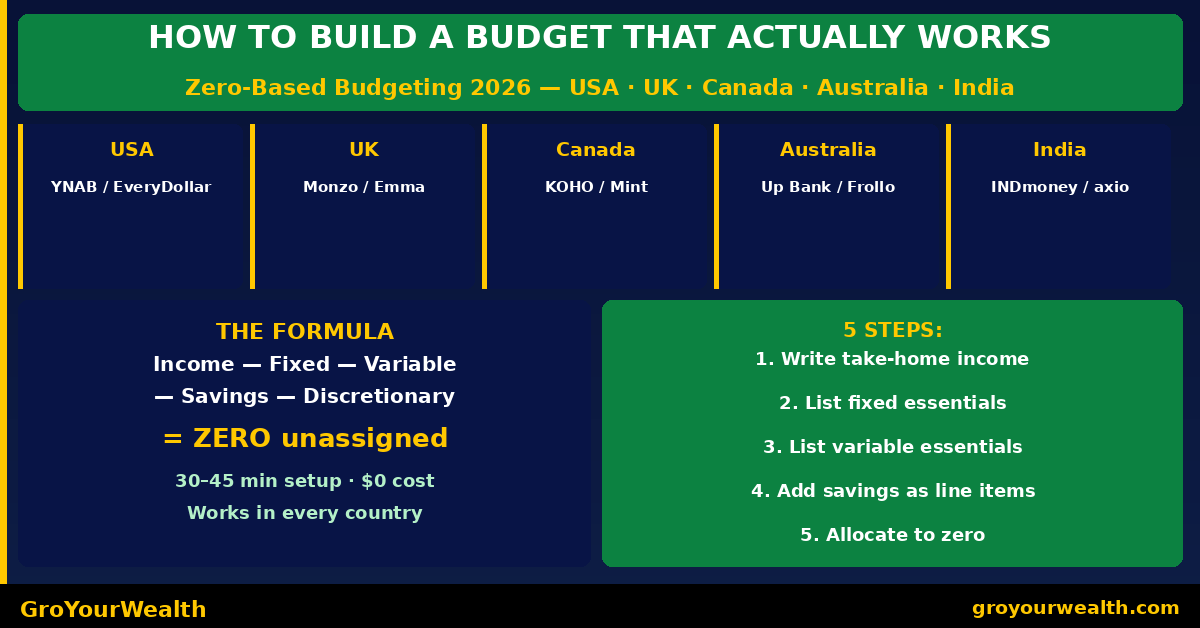
How to Build a Budget That Actually Works — Zero-Based Budgeting 2026 (USA, UK, Canada, Australia & India)
📅 20 March 2026 ⏰ 11 min read 🌐 5 Countries Covered
30–45
Minutes to set up
$0
Cost to start
5
Steps to complete budget
Zero
Money left unassigned
Most budgets fail — not because people spend too much, but because the system does not work. Tracking spending after the fact, using vague categories like “miscellaneous”, and cutting everything to zero fun are the three reasons budgets get abandoned within weeks. Zero-based budgeting solves all three.
Zero-based budgeting assigns every dollar, pound, rupee, or dollar Canadian a specific job before the month begins. Income minus all allocations equals exactly zero — not zero in your bank account, but zero left unassigned. This guide covers the complete setup for all five countries with the right tools for each. If you are also looking to start investing once your budget is in order, see our guide on how to start investing with little money — all 5 countries.
💡 The Formula
Total income — fixed expenses — variable expenses — savings — discretionary = ZERO. Money without a job gets spent without a plan. Assigning every unit before the month starts changes everything.
▶ Watch the full guide — Zero-Based Budgeting 2026 — USA, UK, Canada, Australia & India
Why Most Budgets Fail — 3 Root Causes
Failure 1 — Tracking after spending. Checking your bank statement at month-end is record-keeping, not budgeting. You discover what happened instead of controlling what happens.
Failure 2 — The category trap. Vague categories like “miscellaneous” or “entertainment” are too broad to control. When everything fits in miscellaneous, nothing gets managed.
Failure 3 — Over-restriction. Cutting everything to zero — no coffee, no dining, no subscriptions — creates a budget that is mathematically perfect and psychologically impossible to follow for more than a few weeks.
📌 Zero-Based Budgeting Solves All Three
Money is allocated before you spend it. Every unit has a specific job. Realistic amounts for enjoyment are built in — so the system is actually sustainable long-term.
5-Step Setup — Works in Any Country
The setup takes 30 to 45 minutes the first time. Use YNAB, EveryDollar, Frollo, INDmoney, or a simple spreadsheet.
Write down your total take-home income. After tax, after super (Australia), after PF (India), after National Insurance (UK). Only money that actually arrives in your account — never gross income.
List all fixed essential expenses. Rent or mortgage, utilities, loan repayments, insurance premiums, subscriptions. Same or similar amount every month.
List all variable essential expenses. Groceries, transport, petrol, medical. Use your 3-month average as your starting estimate — adjust as you learn your patterns.
List savings and investments as line items. Treat these exactly like bills — non-negotiable monthly obligations. SIP contributions, index fund payments, extra debt repayments — all allocated before discretionary spending.
Allocate discretionary spending until you reach zero. Dining, entertainment, clothing, hobbies — realistic amounts that reflect how you actually live, not aspirational restrictions.
Car service, annual renewals, birthday gifts, appliance replacement
Even $20 / £20 / ₹500 per month prevents surprises
5 Mistakes That Make People Quit Their Budget
Building a perfect budget instead of a realistic one. Buffer amounts for categories that tend to overspend make the system sustainable. Perfection fails every time.
Leaving money unassigned. If $200 is left after allocating all categories, it will be spent on nothing in particular. Assign every remaining unit to savings or a goal.
Treating an overage as failure and quitting. When you overspend a category in month one — and you will — adjust the amount for next month. Accuracy over time is the goal.
Not reviewing mid-month. Check category balances weekly — not to feel guilty, but to make informed decisions before it is too late to adjust.
Setting budgets based on what you wish you spent. Start with your real numbers then reduce gradually. A realistic budget beats a perfect spreadsheet every time.
📈 Monthly Budget Allocator
Select your monthly take-home income and country framework to see your zero-based budget split.
Your Results — Select Options Above
Select your income and framework above then click Calculate
* Starting guide only. Adjust each category to match your real spending patterns.
Disclaimer: This article is for educational purposes only and does not constitute financial advice. App availability, features and platform terms may change. Always verify current details directly with the relevant platform before use.