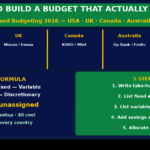

Budgeting is often presented as a rigid formula, yet real life is rarely predictable.
Income levels vary, expenses fluctuate, and financial priorities evolve over time.
Among all budgeting systems, the 50/30/20 rule remains one of the most widely recommended because of its simplicity, flexibility, and long-term effectiveness.
But the traditional version does not fully address the realities of:
- very low incomes struggling with essentials
- high earners facing lifestyle inflation
- global cost-of-living differences
- modern digital spending habits
This guide revisits the rule with practical adjustments for every income level, helping you build sustainable financial stability.
What the 50/30/20 Rule Really Means
The classic structure divides after-tax income into:
- 50% Needs → housing, food, utilities, insurance, transport
- 30% Wants → lifestyle, entertainment, travel, subscriptions
- 20% Savings & Debt Repayment → emergency fund, investments, extra loan payments
Its power lies in clear boundaries that prevent overspending while ensuring consistent saving.
For broader consumer budgeting guidance and financial protection principles, see the
official financial education resources provided by the U.S. Consumer Financial Protection Bureau:
Why This Rule Still Works Globally
Despite economic differences between countries, three financial truths remain universal:
- Spending expands to match income without limits.
- Savings must be intentional, not accidental.
- Simple systems outperform complex plans over long periods.
Because of this, percentage-based budgeting adapts better than fixed-amount budgets.
The Biggest Limitation of the Traditional Rule
The original formula assumes:
- stable middle income
- moderate living costs
- manageable debt levels
But today many households face:
- high housing costs
- irregular freelance income
- rising healthcare expenses
- digital impulse spending
So the rule must be adjusted, not abandoned.
Adapting the Rule for Low-Income Households
When income barely covers essentials, saving 20% may feel impossible.
Practical modified structure:
- 70–80% Needs
- 10–20% Wants
- 5–10% Savings
Key priorities:
- build a small emergency buffer first
- reduce high-interest debt aggressively
- increase income through skills or side work
Even tiny consistent savings create long-term security.
You can explore step-by-step emergency saving strategies in our guide on
how to build a strong emergency fund step by step:
Adapting the Rule for High-Income Earners
High earners often struggle not with income—but lifestyle inflation.
Common pattern:
- luxury housing upgrades
- premium subscriptions
- frequent travel spending
- under-saving despite strong income
Smarter structure for high income:
- 40% Needs
- 20% Wants
- 40% Saving & Investing
Why this matters:
Higher income creates a rare opportunity to accelerate wealth building dramatically.
Without disciplined allocation, that opportunity disappears.
The Psychology Behind Percentage Budgeting
Budget success depends more on behavior than math.
The 50/30/20 rule works because it:
- reduces decision fatigue
- creates automatic limits
- balances enjoyment with responsibility
- prevents guilt-driven oversaving or overspending
This psychological simplicity explains why consistent budgeters outperform irregular savers over decades.
How Inflation Changes Budget Planning
Rising prices silently shift spending ratios.
Essentials such as:
- housing
- groceries
- transportation
- insurance
can expand beyond 50%.
Instead of abandoning budgeting, adjust by:
- reducing discretionary spending first
- improving income sources
- maintaining minimum saving percentage
Long-term wealth depends on protecting the saving habit, not perfect percentages.
Digital Spending: The Modern Budget Destroyer
Subscriptions, one-click payments, and invisible transactions make overspending easier than ever.
Hidden risks include:
- multiple unused subscriptions
- impulse online shopping
- small recurring charges adding up
Monthly subscription audits can instantly improve savings without reducing lifestyle quality.
The Role of Automation in Budget Success
Automation removes emotional decision-making.
Best practices:
- automatic transfers to savings on payday
- scheduled investment contributions
- bill auto-payments to avoid penalties
Automation turns budgeting into a system rather than a struggle.
For a complete automated money management framework, read our guide on
the complete monthly budget system that builds wealth automatically:
When to Break the 50/30/20 Rule
Rigid budgeting can sometimes harm progress.
Temporary adjustments make sense during:
- job loss or income drop
- aggressive debt payoff phase
- major life transitions
- relocation to high-cost cities
The goal is long-term stability, not perfect monthly ratios.
A Simple Step-by-Step Implementation Plan
Step 1: Calculate real after-tax income
Use consistent monthly averages for accuracy.
Step 2: Track current spending honestly
Awareness alone often reduces expenses.
Step 3: Apply percentage targets gradually
Sudden extreme cuts rarely last.
Step 4: Automate savings first
Saving early prevents accidental overspending.
Step 5: Review every 3–6 months
Budgets must evolve with life changes.
Long-Term Impact of Consistent Budgeting
Over decades, disciplined budgeting enables:
- strong emergency reserves
- growing investment portfolios
- reduced financial stress
- earlier retirement flexibility
Small monthly decisions ultimately determine lifetime financial outcomes.
Final Thoughts
The 50/30/20 rule remains powerful not because it is perfect—
but because it is simple enough to follow for life.
By adjusting percentages based on:
- income level
- living costs
- financial goals
- economic conditions
any household can transform budgeting from a restriction into a tool for long-term freedom.
True financial security does not begin with complex investing.
It begins with consistent control over everyday money decisions.