Most people try to save what is left over at the end of the month. The problem is that nothing is ever left over. Rent, groceries, subscriptions, social plans — the money disappears before the month ends, and the savings account stays empty.
This is not a willpower problem. It is a system problem.
The Pay Yourself First method flips the entire approach. Instead of saving what is left over after spending, you move your savings the moment your salary arrives — before you pay a single bill, buy a single coffee, or spend a single dollar on anything else. What is left after saving is what you spend. Not the other way around.
This guide explains exactly how the method works, why it is so effective, how to set it up in three steps on any salary, and the real numbers that show what it builds over time.
What Is the Pay Yourself First Method?
Pay Yourself First is a savings strategy where a fixed percentage or amount of your income is automatically transferred to savings or investments the moment you get paid — before any bills, expenses, or discretionary spending.
The name comes from treating your future self as the most important financial obligation you have. Your landlord gets paid. Your utility company gets paid. Your subscriptions get paid. With Pay Yourself First, you get paid first — and your future wealth is funded before anyone else takes a claim on your income.
Key principle: Your savings rate becomes non-negotiable — just like rent. You do not decide each month whether to save. The system decides for you, automatically.
The method was popularised by financial educator David Bach, who described it as the single most important financial habit anyone can build. Decades of behavioural economics research supports the idea: when saving is automatic, people save consistently. When it requires a manual decision each month, most people do not save at all.
Why Most Savings Strategies Fail — And Why This One Works
Traditional budgeting tells you to track every expense, cut spending, and save whatever is left. The approach sounds logical but fails in practice for a simple reason: it relies entirely on willpower every single day.
Every time you consider buying something, you have to consciously decide to save instead. Across hundreds of small decisions each month, willpower runs out. Something unexpected comes up — a dinner with friends, a sale on something you wanted, a car repair — and the savings plan collapses for the month.
Pay Yourself First eliminates the decision entirely. The money is gone before you can spend it. You only ever see and manage what is left over. Your brain adapts to the smaller available balance within a few weeks, and spending naturally adjusts downward to match.
According to national savings research automatic savings programs increase savings rates by 81% compared to voluntary programs where people must actively choose to save each month.
How to Set Up Pay Yourself First in 3 Steps
Setting this up takes less than 30 minutes. Once done, it runs automatically every month without any effort.
Step 1 — Decide Your Savings Percentage
Before you automate anything, decide what percentage of your take-home income you will save each month. Here are three starting points based on your current situation:
Your Situation
Recommended Starting Rate
Just starting out, tight budget
5% of take-home pay
Some flexibility in monthly spending
10% of take-home pay
Focused on wealth building
15-20% of take-home pay
Start where you can. A 5% savings rate that runs automatically every month for 20 years builds more wealth than a 20% rate that gets abandoned after three months. Consistency beats perfection every time.
Step 2 — Open a Separate Savings Account
Your savings must go into a completely separate account from your everyday spending account. This is non-negotiable. When savings and spending sit in the same account, the savings get spent.
Use a high-yield savings account at a different bank from your main account. Recommended options include:
Marcus by Goldman Sachs — consistently strong APY, no fees
Ally Bank — easy setup, competitive rates, no minimums
Capital One 360 — reliable, widely used, beginner-friendly
The slight inconvenience of transferring money between banks works in your favour — it adds a small barrier that prevents impulsive withdrawals from your savings.
Step 3 — Automate the Transfer
Log into your bank account and set up an automatic transfer on the same day your salary arrives — or the day after. Most banks allow you to schedule recurring transfers in under five minutes.
Set the transfer date: your salary deposit date or the next day
Set the amount: your chosen percentage of your net monthly income
Set it to repeat: monthly, every time
Confirm and leave it alone
That is the entire setup. From this point, your savings system runs without any further effort or decision-making. Every month, you pay yourself first.
The Real Numbers — What Pay Yourself First Actually Builds
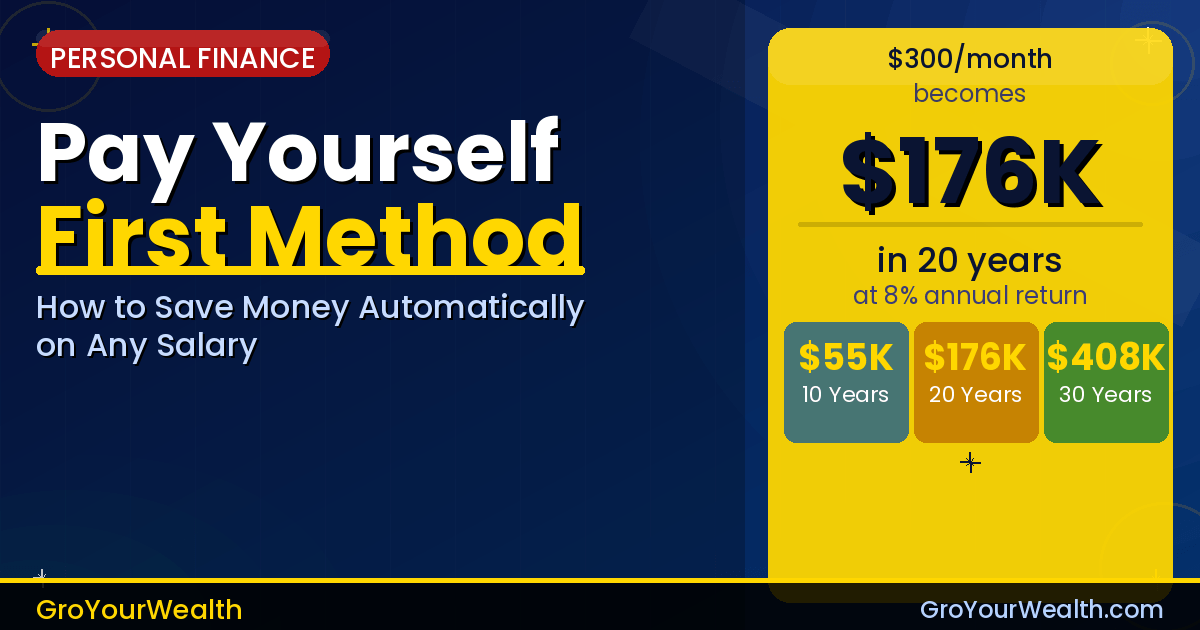
Here is what saving $300 per month — 10% of a $3,000 take-home salary — looks like over time when invested in a low-cost index fund averaging 8% annual return:
Time Period
Portfolio Value
5 Years
$21,979
10 Years
$54,914
20 Years
$176,000
30 Years
$408,000
$300 per month becomes $176,000 in 20 years. Not because of extraordinary investment returns or massive contributions. Simply because the money moved automatically before it could be spent, month after month, without interruption.
Now consider what happens if you increase your savings rate by just 5% when you get a raise — rather than increasing your lifestyle to match. The compounding effect accelerates significantly with every additional dollar saved early.
Where to Put Your Pay Yourself First Savings
Where the money goes depends on your current financial situation. Use this priority order:
Build a $1,000 emergency buffer first — this prevents debt when unexpected expenses occur
If your employer offers a retirement match, contribute enough to get the full match — this is an immediate 50-100% return
Grow your emergency fund to 3-6 months of expenses in a high-yield savings account
Once the emergency fund is complete, direct ongoing savings into a low-cost index fund account
For a deeper look at structuring your full income allocation, read our guide on the income allocation framework — which covers exactly how to split your salary across savings, expenses, and investments for maximum long-term wealth.
The Most Common Objections — Answered
“I cannot afford to save anything right now”
Start with 1%. On a $3,000 salary, that is $30 per month — one dollar per day. You will not notice $30 missing from your spending. But $30 per month automatically invested for 30 years at 8% return grows to $40,000. Start where you can. The habit matters far more than the amount in the beginning.
“What if I have an emergency and need the money?”
This is exactly why Step 2 is to build a $1,000 emergency buffer first. Once that buffer exists, your Pay Yourself First savings can move into investments untouched. The emergency fund handles life’s surprises so your savings plan is never interrupted.
“I already budget carefully — is this still useful?”
Absolutely. Budgeting tells you where your money goes. Pay Yourself First ensures wealth is built before the budgeting process even begins. For the most powerful system, combine both: use Pay Yourself First for savings and a complete monthly budget system to manage what remains.
Your Pay Yourself First Action Plan — Start Today
You do not need more income to start building wealth. You need a system that moves money before it can be spent. Pay Yourself First is that system.
Here is your complete action plan for today:
Decide your starting savings rate — even 5% is a strong start
Open a separate high-yield savings account today (Marcus, Ally, or Capital One)
Set up an automatic transfer for your next pay date
Do not touch it — let the system work
Increase your savings rate by 1% every time you receive a raise
The most important step is the first transfer. Once the system is in motion, wealth builds automatically — not because of discipline or sacrifice, but because the system was designed to make it inevitable.
The Bottom Line
The Pay Yourself First method is not a complex financial strategy. It is a simple decision to change the order of operations: savings before spending, not savings from whatever is left over.
People who implement this system consistently — regardless of income level — build significantly more wealth over their lifetimes than those who rely on budgeting alone. The research is clear. The only question is when you start.
For more daily financial education, visit GroYourWealth.com and subscribe to the GroYourWealth YouTube channel for new videos every day.