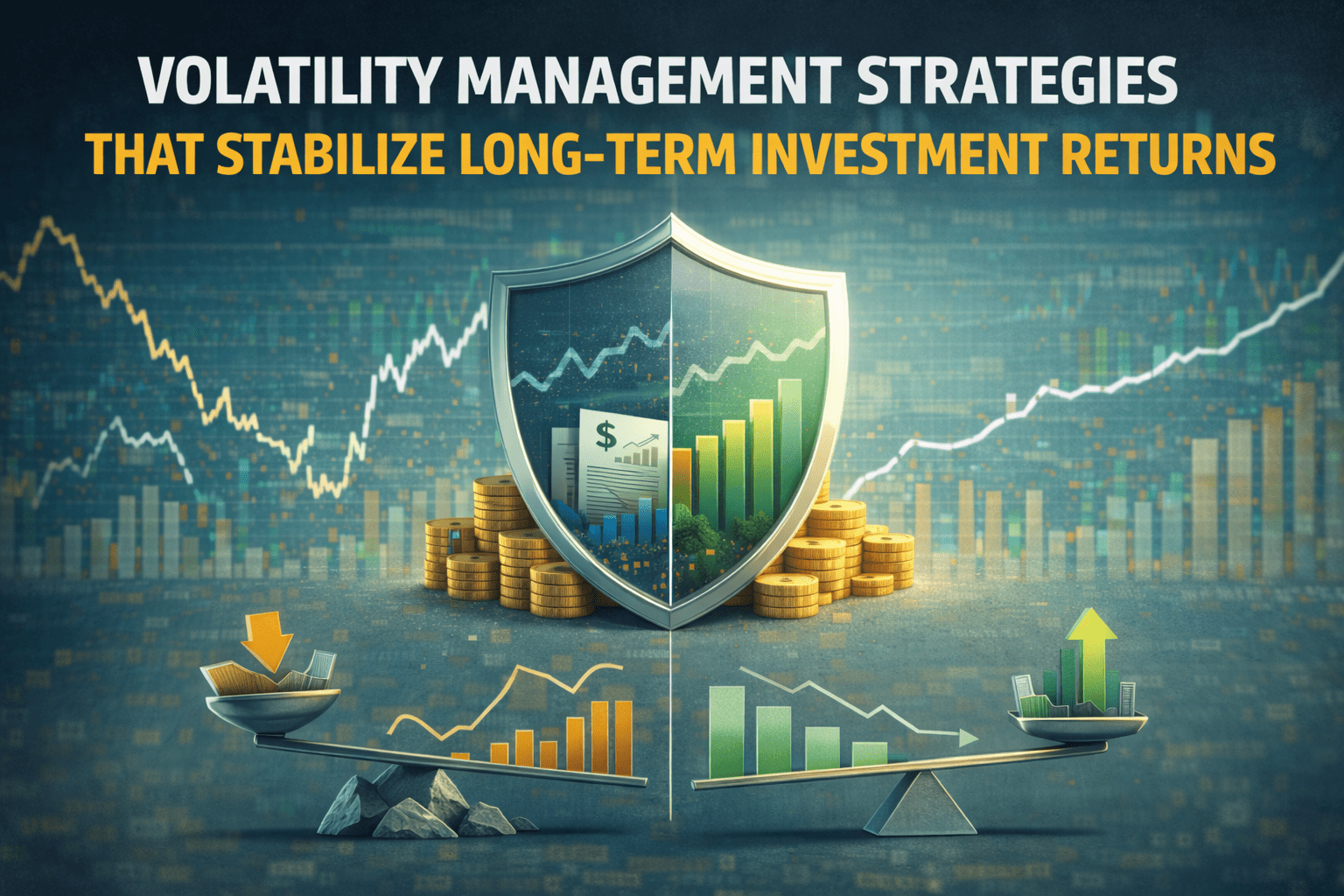
Volatility Management Strategies That Stabilize Long-Term Investment Returns

Successful long-term investing is not only about achieving high returns,
but also about controlling the ups and downs that occur along the way.

Frequent and extreme market swings—known as volatility—can:

  • Increase emotional stress
  • Trigger poor financial decisions
  • Delay long-term wealth creation

Investors who learn to manage volatility effectively build portfolios that grow more steadily, predictably, and sustainably across market cycles.

This guide explains the most practical, globally relevant volatility-management strategies every long-term investor should understand.


What Market Volatility Really Means

Volatility refers to the degree of price fluctuation in an investment or portfolio over time.

High volatility:

  • Large and rapid price movements
  • Greater uncertainty
  • Higher emotional pressure

Low volatility:

  • Smaller price swings
  • More predictable performance
  • Easier long-term discipline

Volatility itself is not always negative,
but uncontrolled volatility can damage long-term financial outcomes.


Why Volatility Control Matters for Wealth Building

Managing volatility provides several powerful advantages:

  • Smoother long-term compounding
  • Reduced likelihood of panic selling
  • Improved risk-adjusted returns
  • Greater confidence in staying invested

This principle builds on earlier foundations of investment risk management and capital preservation, which focus on protecting portfolios from major losses:

Investment Risk Management Strategies

Capital Preservation Strategies

Together, these form the core defense system of long-term investing.


Asset Allocation Is the Primary Volatility-Control Tool

The most effective way to reduce volatility is through balanced asset allocation.

A diversified portfolio typically includes:

  • Growth assets such as equities
  • Stabilizing assets such as bonds
  • Liquidity reserves such as cash equivalents

Well-designed allocation reduces extreme swings while still allowing long-term growth.

Strategic allocation discipline is proven to lower portfolio instability over time:

Asset Allocation Strategies


Diversification Reduces Sudden Portfolio Swings

Volatility increases when investments are too concentrated in:

  • One sector
  • One country
  • One asset class

Diversification spreads risk across multiple areas,
reducing the impact of any single market movement.

Official investor education from Investor.gov confirms diversification as a key method for reducing investment risk and instability:


Defensive Assets Help Smooth Market Fluctuations

Certain investments historically reduce volatility:

  • High-quality government bonds
  • Treasury securities
  • Short-term fixed income
  • Cash or money-market instruments

These assets typically:

  • Fall less during market stress
  • Provide liquidity for rebalancing
  • Stabilize total portfolio value

Volatility management therefore focuses on balance, not eliminating growth.


Rebalancing Maintains Stable Risk Levels

Market movements naturally change portfolio weightings.

Without periodic rebalancing:

  • Risk exposure increases silently
  • Volatility becomes higher than intended
  • Downturn damage grows larger

Regular rebalancing:

  • Restores original allocation
  • Locks in gains from outperforming assets
  • Maintains consistent risk levels

This simple discipline is one of the most powerful long-term stability tools.


Position Sizing Prevents Extreme Swings

Limiting exposure to individual investments reduces volatility risk.

Common professional guidelines include:

  • Keeping single-stock exposure below 5–10%
  • Avoiding excessive leverage
  • Entering positions gradually instead of lump-sum speculation

These rules prevent large portfolio swings caused by one mistake.


Emotional Discipline Is Critical During Volatile Markets

Many investors suffer losses not because of markets,
but because of behavior during volatility:

  • Panic selling during declines
  • Chasing rapid price increases
  • Abandoning long-term strategy

Emotional control is often the most effective volatility-management strategy.


Creating a Personal Volatility-Management Plan

Every long-term investor should define:

  • Target asset allocation
  • Acceptable volatility range
  • Rebalancing schedule
  • Liquidity reserves
  • Investment time horizon

This converts investing from reaction-based decisions
into a structured, disciplined financial system.


Final Thoughts

Market volatility is unavoidable,
but uncontrolled volatility is not.

Investors who actively manage volatility gain:

  • Smoother long-term returns
  • Greater emotional confidence
  • Stronger compounding stability
  • Higher probability of reaching financial independence

In long-term investing,
stability often matters more than speed.

Leave a comment