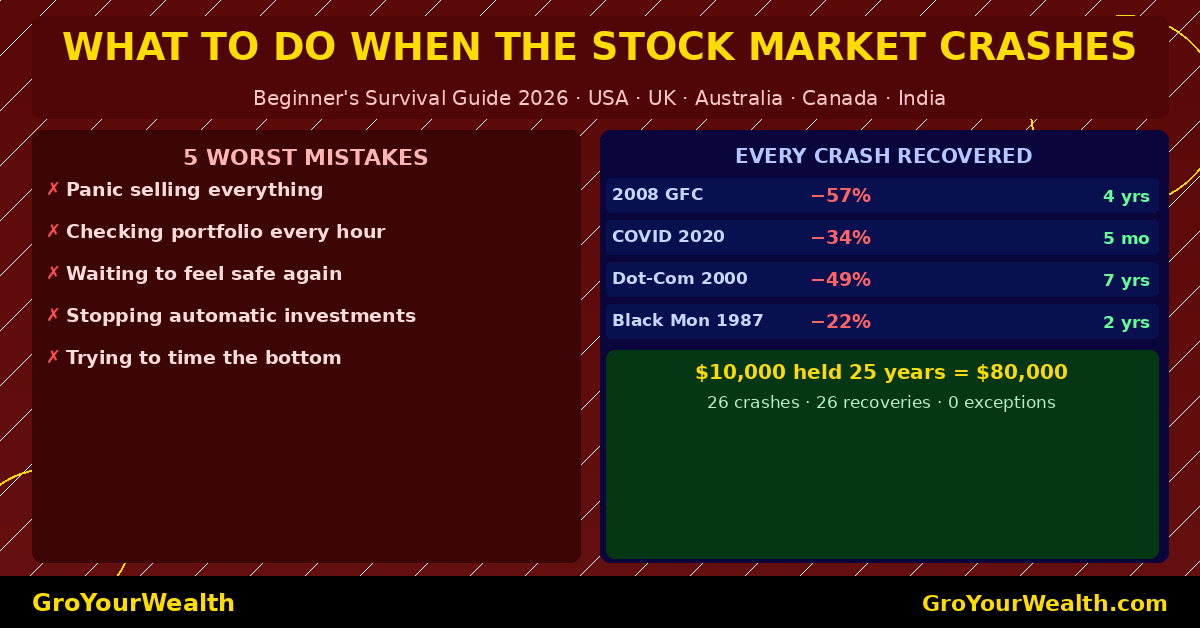
The market just dropped 20%. Your portfolio is red. Every instinct tells you to sell. That instinct has cost investors more money than any market crash in history. In this guide, you will learn exactly what to do — and what not to do — when stock markets crash, backed by 100 years of data across the S&P 500, FTSE 100, ASX 200, and Nifty 50.
Watch the full video: What to Do When the Stock Market Crashes — Beginner’s Survival Guide 2026
What Is a Stock Market Crash?
A stock market crash is when prices fall sharply and rapidly — officially defined as a drop of 20% or more from a recent peak. That level of decline is called a bear market. Anything between 10% and 20% is called a correction.
Here is what most beginners do not know: crashes are completely normal. Since 1928, the S&P 500 has experienced a bear market roughly every 3 to 5 years. Markets have crashed during wars, recessions, pandemics, banking collapses, and political crises. After every single one, the market has recovered and gone on to reach new highs.
Crashes feel like disasters. Historically, they have been opportunities.
What Actually Happens to Your Money in a Crash?
When the market falls, your investment value drops on paper. If you had $10,000 invested and the market falls 30%, your portfolio shows $7,000. That critical word is shows — you have not lost that money. You only lock in a loss the moment you sell.
Think of it like property. If house prices fall 20% in your city, you have not lost money unless you sell right now. Stay put, the value recovers, no loss is realised. Stock markets work the same way — with one important advantage: stocks have recovered from every crash in recorded history. No exceptions.
This distinction between a paper loss and a real loss is the single most important concept in crash investing. A paper loss is temporary. A real loss is permanent. You choose which one it becomes.
Every Major Crash — What Happened After
The historical record is unambiguous. Here is what happened after the five biggest crashes in modern investing history:
2008 Global Financial Crisis — The S&P 500 fell 57%. It felt like the end of capitalism. Banks were failing. Governments were intervening. Investors who held their index funds through the entire period are sitting on enormous gains today. Recovery time: 4 years.
COVID Crash 2020 — Markets fell 34% in just 33 days — the fastest crash in history. Then came the fastest recovery: just 5 months. Investors who panic-sold in March 2020 missed one of the greatest bull runs ever recorded.
Dot-Com Crash 2000 — Down 49% and it took 7 years to recover. This is the crash that most tests investor patience — and the one that most clearly demonstrates why diversification across sectors matters.
Black Monday 1987 — The market dropped 22% in a single day. It remains the largest single-day percentage drop in history. Recovery: within 2 years.
Nifty 50 and global markets — The same pattern applies. Every major market index globally has experienced severe crashes and recovered from all of them. The principle is universal.
The pattern is unmistakable: every crash ended. Every recovery happened. Not some of them — all of them.
The 5 Worst Things You Can Do During a Crash
1. Sell Everything in a Panic
This is how you convert a temporary paper loss into a permanent real loss. Once you sell, the loss is locked in. You cannot un-sell. And you now face the impossible question of when to buy back in — which leads directly to mistake number three.
2. Check Your Portfolio Every Hour
Constant monitoring during a crash almost guarantees an emotional, irrational decision. Research consistently shows that investors who check their portfolios less frequently during downturns make better long-term decisions. During a crash, set a rule: check once a week at most.
3. Wait for the Market to Settle Before Investing Again
By the time the market feels safe again, the recovery has already happened without you. The COVID crash is the perfect example: the market felt terrifying in March 2020. By August, it had fully recovered. Investors who waited for certainty missed the entire rebound.
4. Stop Your Automatic Investments
Pausing your monthly SIP or automatic investment plan means missing the exact months when you buy at the lowest prices. This is when dollar-cost averaging works hardest for you — when prices are low, your fixed monthly amount buys significantly more units. Stopping is the opposite of what the data recommends.
5. Try to Time the Bottom
Nobody — not professional fund managers, not economists, not central banks — can consistently identify the exact bottom of a market crash. Trying to time the market has destroyed more long-term wealth than any crash ever has. The data from 25 years of S&P 500 returns shows that missing just the 10 best trading days cuts your final return by more than 50%. Most of those best days happen during or immediately after a crash.
The 5 Right Things to Do During a Crash
1. Do Nothing
The hardest and most profitable action in a market crash is inaction. If your portfolio is built for your time horizon and your financial goals, the crash is just noise. Close the app. Let time work.
2. Keep Your Automatic Investments Running
Your monthly investment now buys more units at lower prices — this is dollar-cost averaging (DCA) working exactly as designed. The investors who kept their automatic plans running during 2008 and March 2020 came out significantly ahead of those who paused. Not because they were brave. Because their system removed the emotional decision entirely.
3. Rebalance If You Are Overdue
If your target allocation was 80% equity and 20% bonds, and equities have fallen significantly, your allocation may have shifted to 70/30. A crash is a legitimate time to top up your equity position to restore your target — effectively buying more at lower prices with intention.
4. Read Your Investment Thesis, Not the News
Financial media profits from fear and urgency. During a crash, every headline amplifies panic. Instead, revisit why you invested. The companies inside the S&P 500, FTSE 100, and Nifty 50 still exist. They still generate revenue. A crash is a price event — not a business event.
5. Consider Investing More If You Have Extra Cash
Warren Buffett put $5 billion into Goldman Sachs during the 2008 crisis at terms he described as extraordinary. The principle he has repeated publicly for decades: be fearful when others are greedy, and greedy when others are fearful. Crashes are when long-term wealth is built — for those with the patience to act on that knowledge.
The Real Cost of Panic Selling — The Numbers
$10,000 invested in the S&P 500 in January 2000 — held through every crash, every crisis, every terrifying headline for 25 years — would be worth approximately $80,000 today. That is an 8x return over a quarter century.
The same $10,000, if sold during the 2008 crash and only reinvested once it felt safe again, would be worth less than half that amount.
Miss just the 10 best trading days over 25 years: your $10,000 becomes $36,000 instead of $80,000. Miss the 20 best days: $18,000. Miss the 30 best days: you have barely kept up with inflation.
Most of those best days happened during crashes — or in the days immediately following them. The people who sold to avoid the worst days also missed the best days. Every time.
How to Build a Crash-Proof Portfolio
The right asset allocation for your age means a 40% market crash only affects part of your portfolio — not all of it. Here is a globally applicable age-based framework:
Under 35: 80–100% equity index funds. With 30 or more years ahead of you, short-term crashes are completely irrelevant to your long-term outcome. Time is your greatest asset.
Age 35–50: 70% equity, 30% bonds or debt funds. You are still primarily in growth mode, but beginning to introduce stability.
Age 50–60: 50% equity, 50% bonds or stable assets. Capital preservation becomes more important as retirement approaches.
Over 60: 30–40% equity, 60–70% stable income assets. Your priority shifts from growth to protecting what you have built.
The right allocation is the one you can stick to during a crash without panic-selling. A more conservative allocation that you hold through a crash is infinitely better than an aggressive one that you abandon at the bottom.
For a complete guide on how to choose index funds for each of these allocations, read our guide on index fund investing in depth.
Your Pre-Crash Action Plan
The time to prepare for a crash is before it happens — not during. Here is your five-step action plan:
Know your allocation and write it down. Having your target allocation on paper prevents panic decisions when markets fall. If you know you are 80% equity by design, a 30% market drop means your portfolio is down 24% — which is within your plan.
Automate your investments. If your investment plan runs automatically, there is no decision to make during a crash. Your system invests regardless of headlines, emotions, or portfolio value.
Build your emergency fund first. Three to six months of living expenses saved separately — in a high-yield savings account, not invested — means you will never be forced to sell investments at the worst possible time. This is the single most important protection against panic selling. Read more in our guide on SIP investing and building wealth automatically.
Stop watching financial news during crashes. The media profits from fear and urgency. Their incentive is your attention — not your financial wellbeing. During a crash, information is not your friend. Your pre-written plan is.
Remember the data. Every crash in history has ended. The S&P 500 has never had a 20-year period that ended in a loss for a diversified investor. Your job is simply to still be invested when the recovery happens.
Market Crashes in Different Countries — Same Principle
USA (S&P 500): The most studied index in the world. 26 bear markets since 1928, recovered from all 26. Use platforms like Fidelity, Vanguard, or Charles Schwab to automate investments into low-cost S&P 500 index funds.
UK (FTSE 100 / FTSE All-World): The same pattern applies. Use a Stocks and Shares ISA through Vanguard UK or Hargreaves Lansdown to automate monthly contributions.
Australia (ASX 200): Broad market ETFs like VAS (Vanguard Australian Shares) and VGS (Vanguard International Shares) through Pearler or CommSec.
India (Nifty 50): Nifty 50 index funds through Zerodha Coin, Groww, or Kuvera. Keep your SIP running through every crash — rupee cost averaging works identically to dollar-cost averaging.
Frequently Asked Questions
How long does a market crash last?
It varies significantly. The COVID crash of 2020 lasted just 33 days from peak to trough and recovered in 5 months — the fastest in history. The 2008 GFC took the market 4 years to fully recover. The dot-com crash of 2000 took 7 years. On average, bear markets last around 9 to 18 months. Bull markets — periods of growth — last significantly longer, which is why long-term investors always come out ahead.
Should I buy more during a market crash?
If you have extra cash beyond your emergency fund, and your time horizon is 10 or more years, history strongly supports buying during crashes. Every major crash has been followed by a recovery that exceeded the previous peak. However, the most important action is simply to continue your existing automatic investments — not to try timing a bottom purchase.
Is my money safe in an index fund during a crash?
Your money is subject to market risk — the value of your investment will fall during a crash. However, a diversified index fund (S&P 500, FTSE All-World, Nifty 50) holds hundreds or thousands of companies, so no single company’s collapse can destroy your portfolio. The risk of a broad market index fund permanently going to zero is effectively zero — it would require every major economy and company in the world to fail simultaneously.
What is the difference between a market crash and a correction?
A correction is a drop of 10–20% from a recent peak. A bear market (crash) is a drop of 20% or more. Corrections happen roughly once a year. Bear markets happen every 3–5 years on average. Both are temporary. Both have always been followed by recovery.
Should I move to cash during a crash?
The data says no — for most investors with a long time horizon. Moving to cash locks in your loss and introduces timing risk: you now need to decide when to reinvest, and history shows that most investors reinvest too late — after the recovery has already occurred. The exception: if you are within 2–3 years of needing the money (retirement, major purchase), having that portion in stable assets makes sense. That is why age-appropriate allocation matters.