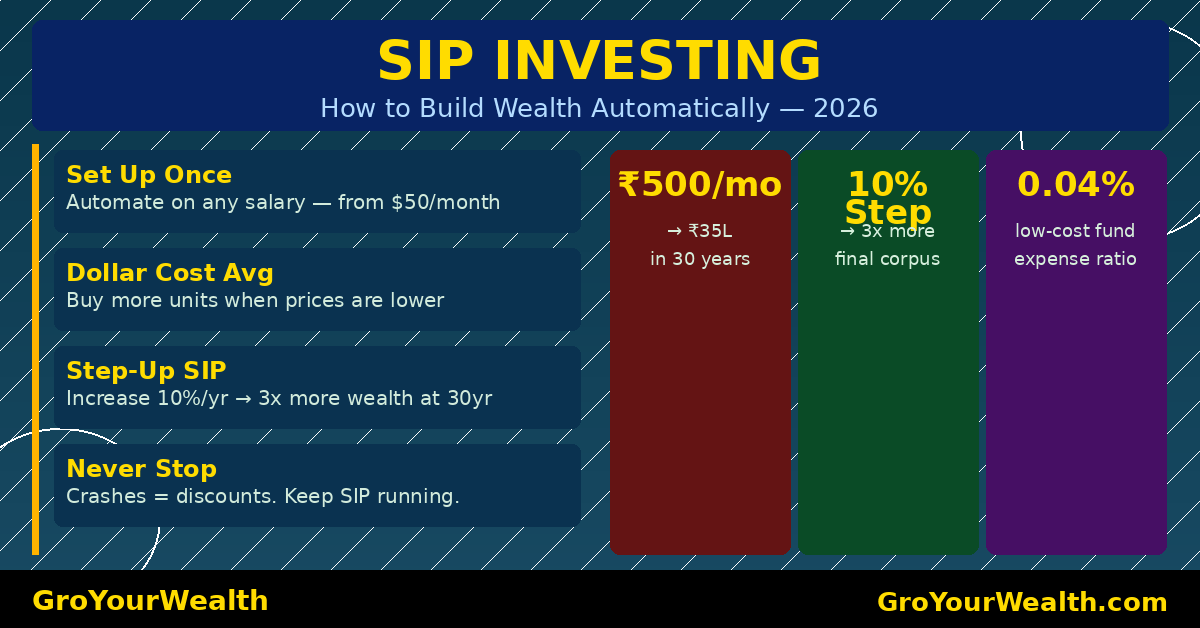
What if you could build real, long-term wealth without watching the market every day, without picking stocks, and without needing a large lump sum to start? That’s exactly what a Systematic Investment Plan — or SIP — makes possible. In this guide, you’ll learn everything you need to know about SIP investing, how it works in the USA, UK, Australia, Canada, and India, and how to set one up starting today.
Watch the full video here: SIP Investing — How to Build Wealth Automatically 2026
What Is SIP Investing?
A Systematic Investment Plan (SIP) is a method of investing a fixed amount of money at regular intervals — typically monthly — into a mutual fund, index fund, or ETF. Instead of trying to time the market with one large lump sum, you invest consistently regardless of whether markets are up or down.
In the USA and UK, this is most commonly known as dollar-cost averaging (DCA) or an automatic investment plan. In India, the term SIP is widely used and refers to the same principle applied through mutual fund platforms.
The core idea is simple: invest a set amount every month, on the same date, automatically. You don’t need to think about it. You don’t need to watch the market. You just let time and consistency do the work.
How Does SIP Work? A Simple Example
Let’s say you invest $500 every month into an S&P 500 index fund. Some months, the price per unit is high. Other months, after a market dip, the price is lower. Because you’re investing the same amount each time, you automatically buy more units when prices are low and fewer units when prices are high.
This is called rupee cost averaging (in India) or dollar cost averaging (globally), and it’s one of the most powerful forces in long-term investing.
Month
Investment
Price Per Unit
Units Purchased
January
$500
$50
10 units
February
$500
$40 (market dip)
12.5 units
March
$500
$55
9.1 units
Over three months you invested $1,500 and purchased 31.6 units. Your average cost per unit: $47.47 — lower than the average price of $48.33. That difference compounds significantly over decades.
The Power of Starting Small: ₹500 / $100 a Month
One of the biggest myths in investing is that you need a large sum to get started. SIP completely destroys that myth.
Here’s what happens when you invest just ₹500 per month (roughly $6 USD) into a Nifty 50 index fund in India at a historical average return of 12% per year:
After 10 years: ₹1,16,170 invested → portfolio value ~₹2,32,339
After 20 years: ₹2,40,000 invested → portfolio value ~₹9,99,148
After 30 years: ₹3,60,000 invested → portfolio value ~₹35,29,914
You invested ₹3.6 lakhs and ended up with over ₹35 lakhs. That’s the power of compounding over time — and it starts with just ₹500 a month.
For US investors: $100 per month into an S&P 500 index fund at a historical average of 10% per year grows to approximately $226,000 in 30 years. You invested $36,000. The market and compounding did the rest.
Step-Up SIP: The Wealth-Multiplier Strategy
A regular SIP is powerful. But a Step-Up SIP — where you increase your monthly investment by a small percentage each year — is extraordinary.
Here’s why: as your income grows, your investments should grow with it. Most people increase their lifestyle spending with every pay rise. A Step-Up SIP routes some of that raise directly into wealth-building instead.
Example: Starting with ₹5,000/month, increasing by 10% each year:
Regular SIP (₹5,000 flat for 20 years at 12%): ~₹49.96 lakhs
Step-Up SIP (10% annual increase for 20 years at 12%): ~₹1.22 crore
The difference is ₹72 lakhs — just from increasing your SIP by 10% a year. This is the single most impactful financial habit you can build in your 20s and 30s.
For US and UK investors: this is the equivalent of increasing your automatic investment by 10% each January — matching or slightly exceeding your annual pay increase and directing it straight to your index fund.
SIP vs Lump Sum: Which Is Better?
This is one of the most common questions in personal finance. The honest answer: for most people, SIP wins — not because the maths always favours it, but because of human behaviour.
SIP
Lump Sum
Requires large capital upfront
No
Yes
Removes timing risk
Yes
No
Works on any salary
Yes
No
Emotionally easier
Yes
No
Maximises returns in bull markets
No
Yes
Academic research, including studies by Vanguard, shows that lump sum investing outperforms dollar-cost averaging roughly two-thirds of the time in markets that trend upward. However, the emotional difficulty of investing a large lump sum — and the risk of investing at a peak — makes SIP the more practical and reliable strategy for most everyday investors.
The verdict: if you have a lump sum, invest it all at once. If you’re investing from monthly income, SIP every time.
How to Set Up a SIP — Global Guide
In India
Setting up a SIP in India is straightforward through any of the major platforms:
Zerodha Coin — direct mutual fund SIPs, zero commission
Best funds for beginners: Nifty 50 index funds such as UTI Nifty 50 Index Fund or Nippon India Index Fund – Nifty 50 Plan. Look for funds with an expense ratio below 0.10%.
In the USA
Automatic investing (the US equivalent of SIP) is available on:
Fidelity — automatic investment into index funds, no minimums
Vanguard — automatic monthly contributions to ETFs and funds
Best funds: Vanguard FTSE Global All Cap Index Fund, or Vanguard LifeStrategy funds for a one-fund portfolio.
In Australia
Use a brokerage with auto-invest features:
Pearler — built specifically for long-term automatic investing in ETFs
Spaceship — low-cost automatic investing for beginners
Best ETFs: VAS (Vanguard Australian Shares), VGS (Vanguard International Shares).
In Canada
Use a discount brokerage or robo-advisor:
Wealthsimple — automatic recurring investments, zero commission ETF trading
Questrade — set up pre-authorized contributions into ETFs
Best ETFs: XEQT or VEQT — all-in-one global equity ETFs, ideal for long-term SIP-style investing.
5 SIP Mistakes to Avoid
1. Stopping Your SIP During a Market Crash
This is the most expensive mistake. When markets fall, your SIP buys MORE units for the same money. Stopping means you miss the cheapest buying opportunity of the year. A crash is when your SIP works hardest for you.
2. Choosing a High-Expense-Ratio Fund
A 1% expense ratio vs a 0.05% expense ratio may look small. Over 30 years on a ₹10,000/month SIP, that difference costs you over ₹1 crore in lost returns. Always choose direct plans or low-cost index funds. Read more in our guide on ETF investing for beginners.
3. Starting Too Late
The single most powerful variable in SIP is time — not the amount. Starting at 25 vs 35 can mean a difference of 3–4x in final corpus due to compounding. See our guide on the best age to start investing.
4. Investing Without an Emergency Fund
If you don’t have 3–6 months of expenses saved separately, a job loss or emergency could force you to redeem your SIP at the worst possible time. Always build your emergency fund first.
5. Picking Thematic or Sectoral Funds
Beginners often chase last year’s top-performing fund — technology funds, pharma funds, small-cap funds. These carry far higher risk. For SIP, broad market index funds (Nifty 50, S&P 500, FTSE All-World) are the safest and most reliable long-term choice.
SIP and Tax: What You Need to Know
India
Each SIP instalment is treated as a separate investment for tax purposes. Gains held for more than 12 months qualify as Long Term Capital Gains (LTCG) and are taxed at 12.5% above ₹1.25 lakh per year (as per Finance Act 2024). ELSS funds offer tax deduction under Section 80C with a 3-year lock-in. Consult a tax professional for your specific situation.
USA
Investing through a Roth IRA or 401(k) lets your SIP grow tax-free or tax-deferred. If investing in a taxable account, gains held over one year qualify as long-term capital gains at preferential rates (0%, 15%, or 20% depending on income). Learn more at IRS.gov — Roth IRAs.
UK
Investing through a Stocks and Shares ISA means all gains and income are tax-free. The annual ISA allowance is £20,000 (2025–26). Learn more at GOV.UK — ISA guidance.
Australia
Investing through superannuation provides significant tax advantages. Outside super, a 50% CGT discount applies to assets held more than 12 months. See ATO.gov.au — Capital Gains Tax for details.
Canada
Use a TFSA (Tax-Free Savings Account) for completely tax-free investment growth. RRSP contributions provide an upfront tax deduction. See Canada.ca — TFSA guide.
Your SIP Action Plan: Start Today
Here’s your complete step-by-step action plan:
Set your monthly amount. Start with whatever you can — even $50 or ₹500. The habit matters more than the amount at first.
Choose a low-cost index fund. S&P 500, Nifty 50, FTSE All-World — broad market, expense ratio below 0.20%.
Set up automatic investing. Link your bank account and set the date — ideally the day after your salary arrives.
Enable Step-Up SIP. Commit to increasing by 10% every January.
Never stop during a crash. Crashes are discounts. Keep your SIP running through every market condition.
Review once a year. Check your portfolio annually, not monthly. Long-term investing rewards patience.
The best time to start a SIP was 10 years ago. The second best time is today.
Frequently Asked Questions
Can I pause a SIP?
Yes, most platforms allow you to pause a SIP for 1–3 months. However, pausing during a market crash is almost always a mistake — you’d miss buying at lower prices. Only pause if absolutely necessary due to financial hardship.
What happens if I miss a SIP payment?
In India, missing 3 consecutive SIP instalments typically results in automatic cancellation. In the USA/UK/AU, your automatic investment will simply not process — restart it as soon as possible.
Is SIP safe?
SIP in a broad market index fund (Nifty 50, S&P 500, FTSE All-World) carries market risk — your portfolio value will fluctuate. However, historical data shows that holding a diversified index fund SIP for 10+ years has never resulted in a loss across any major market. See our guide on index fund investing in depth for more.
How much SIP do I need to retire?
A common rule: you need 25x your annual expenses saved to retire (the 4% rule). Work backwards from that number to determine your monthly SIP amount. Our retirement planning guides will cover this in depth in future videos.
SIP vs RD (Recurring Deposit)?
A Recurring Deposit in India offers fixed, guaranteed returns (currently 6–7% per year). A Nifty 50 SIP has historically returned 12–14% per year over long periods, but with market volatility. For wealth creation over 10+ years, SIP in index funds significantly outperforms RD. For short-term goals (under 3 years), RD is safer.