GroYourWealth Personal Finance Education for Everyone
Beginner Investing
How to Start Investing With Little Money — $50, $100 or $500 (USA, UK, Canada, Australia & India 2026)
📅 19 March 2026 ⏰ 11 min read 🌐 5 Countries Covered
$1
Min to start in USA
£1
Min to start in UK
₹100
SIP minimum in India
700+
% more wealth starting at 25 vs 35
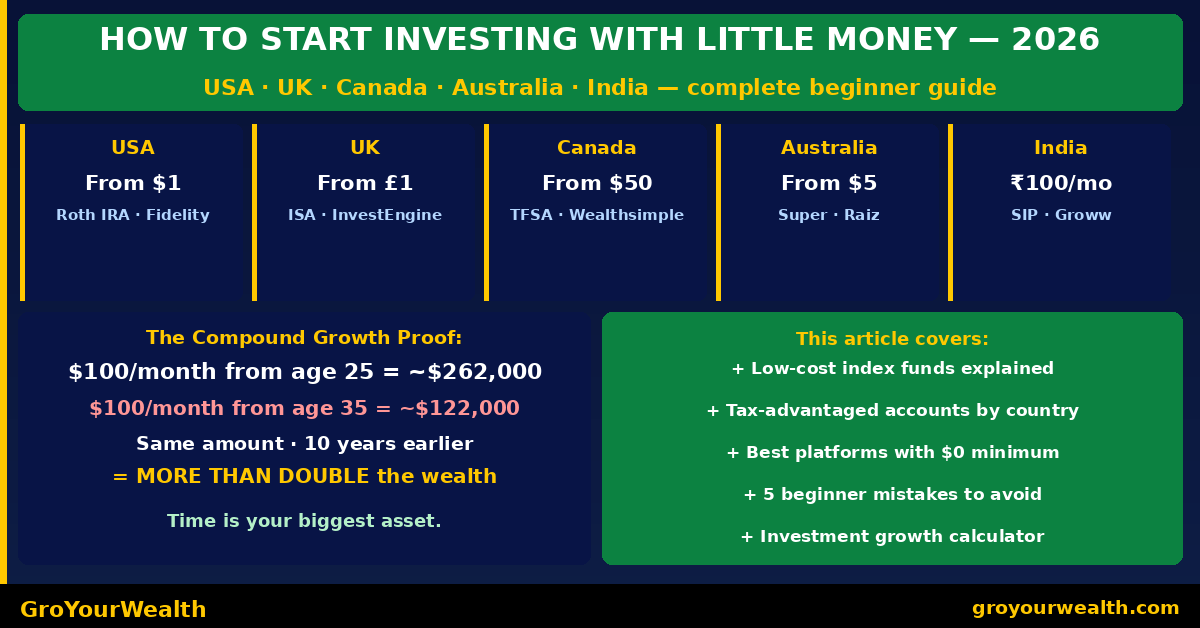
One of the most common reasons people give for not investing is that they do not have enough money to start. In 2026, that barrier has effectively disappeared. You can start investing in the United States with as little as $1, in the United Kingdom with as little as £1, in Canada with $50, in Australia with $5, and in India with a Systematic Investment Plan starting at just ₹100 per month.
The real barrier to investing is not money. It is the belief that you need a large sum before you can begin. This guide covers the right accounts, the right platforms, and the exact investment types for each of the five countries — with real figures throughout. If you are also working on building a budget to free up money for investing, see our guide on zero-based budgeting for all five countries.
💡 Key Point
The right investment for beginners in virtually every country is the same — a low-cost index fund or ETF. Instant diversification, fees as low as 0.03%, and no stock-picking required. The only things that differ by country are the account names and platforms.
▶ Watch the full guide — How to Start Investing With Little Money (2026) — all 5 countries covered
Why Starting Small Beats Waiting — The Maths
Many people believe investing $50 or $100 per month is pointless. The mathematics proves otherwise. At a 7% average annual return — the approximate long-term average of a global index fund — here is what the same $100 per month produces depending on when you start:
Start at age 25 · invest to 65
~$262,000
$100/month · 7% average return · 40 years
Start at age 35 · invest to 65
~$122,000
$100/month · 7% average return · 30 years
Starting 10 years earlier produces more than double the final wealth — with exactly the same monthly contribution. Time in the market is the most powerful force in personal finance. A small amount invested today is worth dramatically more than a larger amount invested tomorrow.
What to Invest In — The Answer Is the Same in Every Country
For beginners with small amounts, the right investment type is a low-cost index fund or ETF. An index fund tracks a market index — the S&P 500 in the USA, the FTSE 100 in the UK, the Nifty 50 in India — and gives you exposure to hundreds or thousands of companies in one investment. Three rules for beginners:
Choose low-cost index funds. Expense ratios of 0.03% to 0.25% — never pay 1% or more for an actively managed fund that is statistically unlikely to beat the index over 20+ years.
Diversify globally. A total world index fund gives you exposure to thousands of companies across developed and emerging markets rather than betting on a single country.
Automate contributions. Set a fixed monthly amount on payday and remove the decision entirely. Consistency beats timing every time.
⚠ Fee Warning
On a 7% return — a 1.5% annual fee vs a 0.10% fee reduces your effective return to 5.5%. Over 30 years on a growing portfolio this difference amounts to thousands of dollars in lost returns. Always check the expense ratio before investing.
USA — How to Start Investing With $1, $50 or $100
🇺🇸 United States
Best account: Roth IRA — contributions grow tax-free, withdrawals tax-free in retirement
2026 Roth IRA limit: $7,000/year · income limit ~$161,000 (single filer)
Platform 1: Fidelity — $0 minimum · fractional shares from $1 · ZERO funds at 0% expense ratio
Platform 2: Charles Schwab — $0 minimum · SCHB ETF at 0.03% expense ratio
Best investment: Total US market or total world index fund · expense ratio below 0.10%
Action: Open Roth IRA at Fidelity or Schwab · automate $50-$100/month on payday
UK — How to Start Investing With £1, £50 or £100
🇬🇧 United Kingdom
Best account: Stocks and Shares ISA — all gains and income completely tax-free
2026 ISA limit: £20,000 per tax year — one of the most generous tax shelters globally
Best ETF: VDGR — Vanguard Diversified Growth ETF · Australian + international · 0.27% expense ratio
Action: Check super fund · open CommSec Pocket or Raiz · start with $50 in a diversified ETF
India — How to Start Investing With ₹100 or ₹500 Per Month
🇮🇳 India
Best tool: SIP — Systematic Investment Plan · fixed monthly amount auto-invested
Minimum: From ₹100/month on some platforms · more typically ₹500/month
Tax benefit: ELSS funds under Section 80C — deduction up to ₹1.5 lakh/year · 3-year lock-in
Platform 1: Groww — direct mutual funds · SIP setup in minutes · no distributor commission
Platform 2: Zerodha Coin — direct plans · Nifty index funds · no commission
Best fund: Nifty 50 or Nifty 500 index fund — direct plan · lowest cost · broadest market exposure
Action: Open Groww or Zerodha Coin · choose Nifty 50 direct plan · set ₹500 SIP on salary date
All 5 Countries — Complete Comparison Table
Country
Start From
Tax Account
Best Platform
Best Fund
Annual Fee
USA
$1
Roth IRA ($7K/yr)
Fidelity / Schwab
Total market index
0.03%
UK
£1
S&S ISA (£20K/yr)
InvestEngine / T212
VWRP global ETF
0.22%
Canada
$50
TFSA ($7K/yr)
Wealthsimple Trade
VEQT all-equity ETF
0.24%
Australia
$5
Super (11.5% auto)
Raiz / CommSec Pocket
VDGR growth ETF
0.27%
India
₹100/mo
ELSS 80C (₹1.5L)
Groww / Zerodha Coin
Nifty 50 index (direct)
~0.10%
5 Biggest Mistakes Beginner Investors Make
Waiting until you have more money. Starting 10 years later costs $140,000+ in lost wealth on the same monthly contribution. Start with whatever you have today.
Picking individual stocks. Concentration risk wipes out months of contributions. Index funds eliminate this entirely — instant diversification in one purchase.
Checking your portfolio every day. Daily price movements are noise. Looking daily creates anxiety and increases the chance of panic-selling during a dip — which locks in losses permanently.
Ignoring fees. A 1.5% annual fee vs 0.10% over 30 years amounts to thousands of dollars in lost returns. Always check the expense ratio before investing in any fund.
Stopping contributions when markets fall. A market decline is a sale. Every unit bought during a dip costs less and earns more when markets recover. Never stop regular contributions based on short-term market movements.
📈 Investment Growth Estimator
See how your monthly investment could grow over time based on your starting amount and time horizon.
Your Results — Select Options Above
Item
Amount
Total contributed
–
Estimated final value (after fees)
–
Investment gains (growth)
–
Select your options and click Calculate
* Estimates assume consistent monthly contributions and constant rate of return. Not a guarantee. Individual results vary. Past performance does not predict future results.
Your 5-Step Action Plan
Open the right account today. USA: Roth IRA at Fidelity or Schwab. UK: ISA at InvestEngine. Canada: TFSA at Wealthsimple. Australia: CommSec Pocket or Raiz. India: Groww or Zerodha Coin.
Choose one low-cost index fund. Do not overthink this. A total market or all-world index fund is the right choice for virtually every beginner in every country.
Automate a monthly contribution. $50, £50, $50 Canadian, $50 Australian, or ₹500 — set the date on payday and remove the decision from your monthly routine.
Increase your contribution every 6 months. When income rises, redirect half the increase to your investment account before adjusting your lifestyle.
Do not touch it. The biggest threat to your long-term returns is yourself. Stay consistent, ignore short-term noise, and let compounding do its job over years and decades.
Disclaimer: This article is for educational purposes only and does not constitute financial advice. Investment returns are not guaranteed and past performance does not predict future results. Always verify current platform terms, account limits, and fund details before investing. Consult a qualified financial adviser for personalised advice.