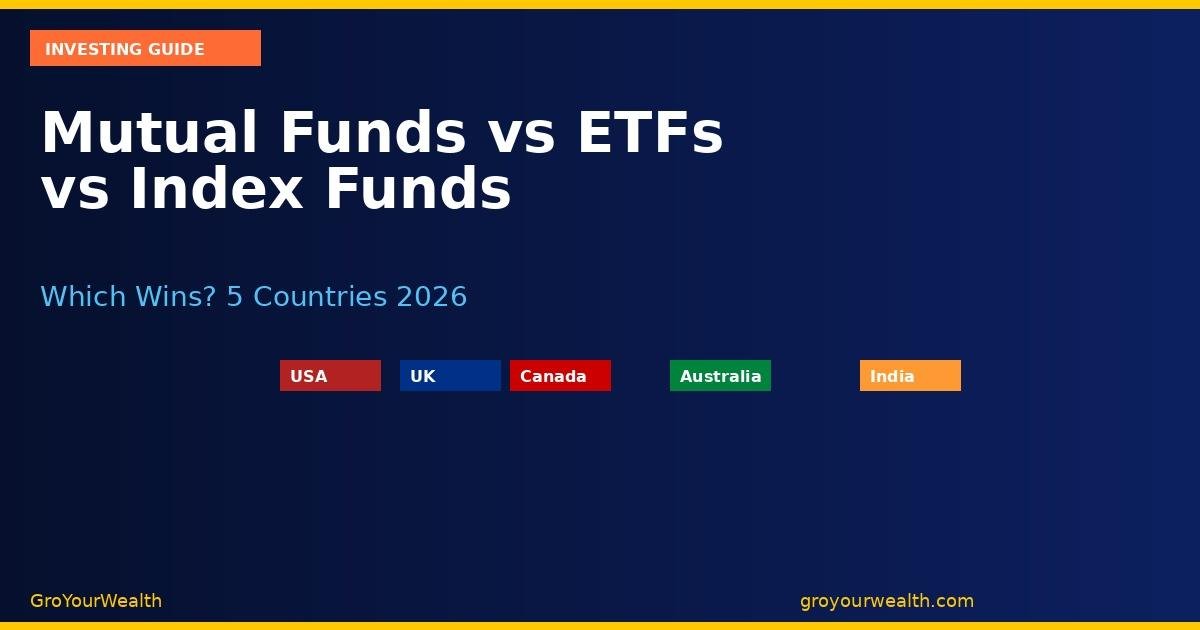
After researching thousands of retail investors, one pattern stands out: most don’t fully understand the differences between mutual funds, ETFs, and index funds — even though choosing the right one can cost or save you tens of thousands over 20 years. This guide breaks down exactly how each works, how they compare across the US, UK, Canada, Australia, and India, and which one matches your goals and budget.
📺 Watch on YouTube
$47,000+
Difference over 30 years (low-cost vs actively managed)
1.5%–2%
Average active fund fee (vs 0.03%–0.5% for index)
92%
Active funds beaten by index funds over 15 years
## Understanding the Three: Core Definitions
**Mutual Funds** are professionally managed investment pools. A fund manager chooses the stocks or bonds inside. You own shares of the fund. Fees are typically 1–2% annually (some higher).
**Index Funds** are a TYPE of mutual fund that automatically tracks a market index like the S&P 500, FTSE 100, or NSE Nifty 50. No manager makes individual picks. Fees are very low (0.03–0.5% annually). Mutual funds CAN be index funds, but most active mutual funds are NOT.
**ETFs (Exchange Traded Funds)** work like index funds but trade on stock exchanges like individual stocks. You buy and sell them during market hours, not at day’s end. Most ETFs are index-based, though some are actively managed. They usually cost less than mutual funds.
## The Real Cost Comparison: Why Fees Matter
Active mutual fund managers charge you 1.5–2% per year to “beat the market.” Here’s the problem: over 15 years, 92% of them don’t. Meanwhile, you’re paying thousands in fees while underperforming a simple index fund.
**30-Year Cost Example (starting with $10,000 at 7% annual growth):**
– Index fund (0.1% fee): Final value = $76,122
– Active mutual fund (1.5% fee): Final value = $62,457
– **Difference: -$13,665 lost to fees alone**
This assumes identical market returns. Active fund underperformance makes the gap even wider.
## How They Work: The Mechanics
### Mutual Funds
1. You send money to the fund company
2. A manager (or team) buys stocks/bonds based on their strategy
3. Your shares appreciate as holdings grow
4. You sell shares back to the fund at the day’s closing price
**Advantage:** Professional selection, active rebalancing
**Disadvantage:** High fees, often underperform index, difficult to exit during market stress
### Index Funds
1. You invest in a mutual fund or ETF that mirrors an index
2. The fund automatically holds the same stocks as the index in the same weightings
3. When the index changes, the fund rebalances automatically
4. No manager making individual picks
**Advantage:** Low fees, consistent with market performance, highly predictable
**Disadvantage:** You match the index average (not beating it), less flexibility
### ETFs
1. Similar holdings to index funds but trade on exchanges
2. You buy/sell during trading hours like individual stocks
3. Price fluctuates intraday (unlike mutual funds, which settle at day’s end)
4. Can use limit orders, short selling, and other trading strategies
**Advantage:** Transparency, intraday trading, low costs, tax efficiency
**Disadvantage:** Slightly wider spread than mutual fund transactions, requires brokerage account
## Country-by-Country Breakdown
USA
United States
Best for index funds and ETFs. The US has the world’s largest ETF and index fund market. Choices are unlimited. Cost: 0.03–0.5% annually for index products. Popular platforms: Vanguard, Fidelity, Charles Schwab. Recommendation: Start with VOO (Vanguard S&P 500 ETF) at 0.03% fee or VTI (total US market) at the same cost.
UK
United Kingdom
Mutual funds still common, ETFs gaining fast. ISA and SIPP accounts offer tax benefits that favour ETFs. Regulatory environment (FCA) protects investors. Platforms like Vanguard UK, DEGIRO, and Hargreaves Lansdown offer both. Recommendation: VUSA (Vanguard S&P 500 USD ETF) or VMID (FTSE 250 ETF) for UK exposure.
Canada
Canada
ETFs dominate the index investing space. TFSA and RRSP accounts work seamlessly with ETFs. Mutual funds available but less common among beginner investors. Platforms: Questrade, Interactive Brokers. Recommendation: VGRO (Vanguard Growth ETF) or VFV (S&P 500 USD ETF) for simplicity.
Australia
Australia
Superannuation + ETFs = the standard. Index ETFs available through ASX. Platforms like Spaceship, Stake, and SelfWealth offer low-cost trading. Recommendation: VAS (Vanguard Australian Shares) or VGAD (Vanguard Growth Allocation) for diversification.
India
India
Index mutual funds lead; ETFs emerging. SEBI-regulated mutual funds offer direct and regular plans. Direct plans cost less (1–1.5% vs 2–2.5% on regular). ETFs available on NSE/BSE but lower adoption. Platforms: Groww, Zerodha Coin, Upstox. Recommendation: Nifty 50 Index (Direct Plan) or Sensex Index (Direct Plan) mutual funds via Groww.
## Comparison Table: Which Suits Your Situation?
Feature
Mutual Fund (Active)
Index Fund
ETF
Annual Fee
1.5–2.5%
0.03–0.5%
0.04–0.6%
Manager Picks Stocks?
Yes (often underperforms)
No (auto-mirrors index)
No (auto-mirrors index)
Trading Hours
Daily (settled at close)
Daily (settled at close)
Real-time (during market hours)
Tax Efficiency
Moderate (turnover creates gains)
High (low turnover)
Highest (minimal turnover)
Minimum Investment
Usually ₹100–₹1,000 (India)
Often lower or fractional
Can buy fractional shares
Transparency
Holdings disclosed monthly
Holdings always match index
Real-time transparency
Best For
Those who trust manager expertise
Most beginner investors
Active/frequent traders
## The Math: Interactive Calculator
What’s the real impact of choosing wrong? Use the calculator below to compare three investment options over time:
Mutual Fund vs Index Fund vs ETF Growth Calculator
See how fees and inflation impact your wealth over 30 years
## Five Key Rules to Choose Right
Rule 1: Ignore active manager hype. 92% of active managers don’t beat index funds over 15 years. The odds are against them and against you if you choose them.
Rule 2: Fees compound backwards. A 1.5% fee compounds against you for 30 years. Start with the lowest cost option (usually index funds or ETFs).
Rule 3: Index funds = mutual funds for most people. Don’t overthink it. An index mutual fund bought through your broker achieves 90% of what an ETF does with less daily noise.
Rule 4: ETFs shine for frequent traders. If you’re buying/selling multiple times per year, ETFs’ real-time trading and tax efficiency matter. If you’re buy-and-hold, it barely matters.
Rule 5: Start simple. A single low-cost index fund covering your entire market (S&P 500, FTSE 100, Nifty 50) beats 99% of complex, multi-fund portfolios built by beginners.
## The Real Decision: What Fits Your Life?
**Choose an Active Mutual Fund if:**
– You have strong conviction in a specific fund manager or investment thesis
– You’re comfortable with higher fees for potential outperformance (knowing odds are low)
– You want a hands-off approach and prefer not to think about it
**Choose an Index Fund (Mutual Fund) if:**
– You’re a beginner and want simplicity at the lowest cost
– You want to invest regularly and let compound interest do the work
– You’re in India and prefer the mutual fund ecosystem (SEBI-regulated)
– Your country has good index fund options (USA, UK, Canada, Australia)
**Choose an ETF if:**
– You like the flexibility of trading during market hours
– You want the most transparent, real-time holdings
– You’re active with your portfolio and rebalance frequently
– You want the absolute lowest fees (ETF spreads are tight)
– You’re in a tax-optimized account (ISA, TFSA, SIPP)
## Common Mistakes to Avoid
Mistake #1: Chasing Recent Winners
Last year’s best fund is rarely this year’s best. Active fund rankings flip constantly. Index funds are boring and consistent — that’s the whole point.
Mistake #2: Underestimating Fee Impact
A “small” 1% difference in fees over 30 years costs you $13,000+ on a $10,000 initial investment. Fees matter more than you think.
Important: Not Financial Advice
This guide is educational — always consult a qualified financial advisor before investing
Past performance does not guarantee future results
Consider your risk tolerance, time horizon, and personal financial situation
Diversification and asset allocation should reflect your goals, not general advice
## What We’ve Covered
In this article, you’ve learned:
– **The difference** between mutual funds, index funds, and ETFs
– **Why fees matter** so much (92% of active managers underperform)
– **How each works** mechanically and what you actually own
– **Country-by-country options** in USA, UK, Canada, Australia, and India
– **When to choose each** based on your situation and timeline
– **Real numbers** on long-term cost impact with the calculator
The single biggest decision most investors make incorrectly is paying 1.5%+ in fees for active management when a 0.1% index fund achieves the same or better results. Fixing this one choice can add $13,000+ to your wealth over 30 years.
Disclaimer: This article is educational content only and does not constitute financial advice. The information presented is based on general market data and historical performance. Individual circumstances vary. Before making any investment decision, consult a qualified financial advisor who understands your personal situation, risk tolerance, and long-term goals. Past performance does not guarantee future results. All investments carry risk, including potential loss of principal.