GroYourWealth Personal Finance Education for Everyone
Loans & Credit Cards
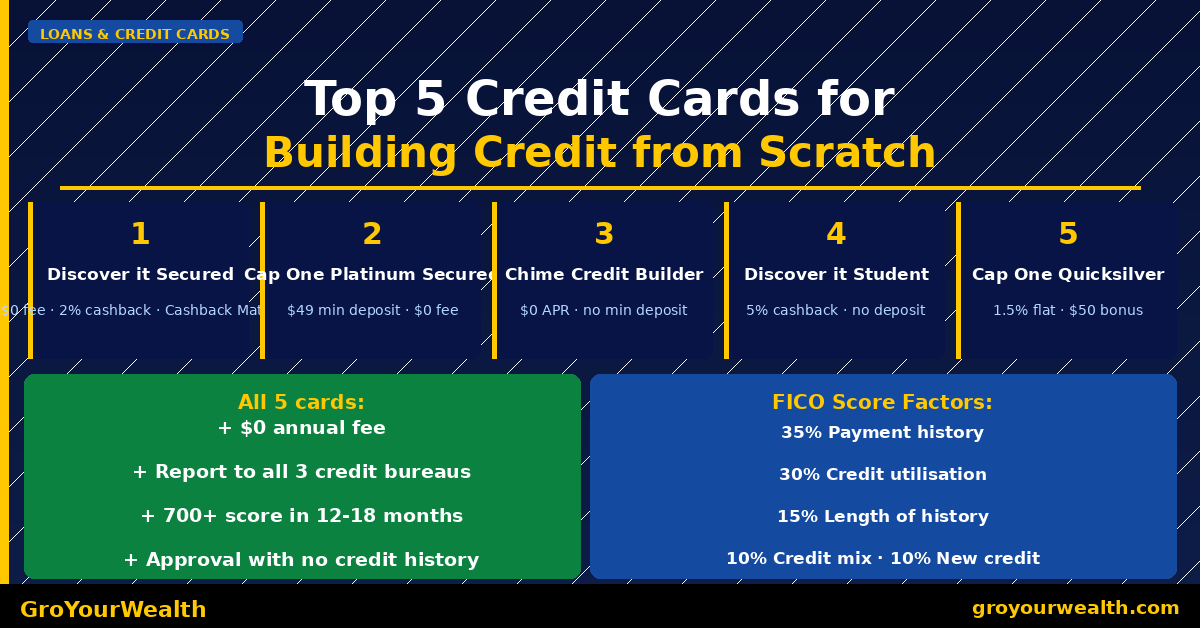
Top 5 Best Credit Cards for Building Credit from Scratch (US 2026)
📅 18 March 2026 ⏰ 10 min read 🇺🇸 United States
$0
Annual fee on all 5 cards
$49
Lowest secured deposit available
700+
Score achievable in 12-18 months
5%
Max cashback (Discover Student)
If you have no credit history or a damaged credit score, getting approved for a credit card feels like an impossible loop. You need credit to build credit, but you cannot get credit without credit. In 2026, that loop can be broken. There are credit cards designed specifically for people starting from zero.
Used correctly, these cards can take you from no credit history to a score in the 700s within 12 to 24 months. This guide covers all five cards with real numbers on fees, deposits, APRs, and rewards. If you are also managing existing debt, see our guide on debt consolidation loans vs credit counseling.
Key Point
All five cards on this list have a $0 annual fee and report to all three major bureaus — Equifax, Experian, and TransUnion. These are the non-negotiables for any credit-building card.
Watch the full comparison on YouTube
How Credit Building Works — FICO Score Breakdown
Your FICO score is calculated using five factors. Understanding them tells you exactly how to improve fastest.
35%
Payment History
Single most important factor. One missed payment drops score 60-100 points and stays 7 years.
30%
Credit Utilisation
Keep balance below 30% of limit. Below 10% is ideal. On a $300 limit, stay below $90.
15%
Length of History
Longer accounts = better. Start early. Keep old cards open even after upgrading.
10%
Credit Mix
Different credit types help slightly. Not critical when starting out.
10%
New Credit
Each application = hard inquiry = temporary score drop. Apply for one card at a time.
The Complete Formula
Use card for small purchases then pay the full balance before the due date every month then keep utilisation below 30%. That is the entire credit-building strategy.
Secured vs. Unsecured Cards
A secured card requires a cash deposit ($200-$500 typically) which becomes your credit limit. Deposit is returned when you graduate after 12-18 months. Approved with no credit history at all.
An unsecured starter card requires no deposit. Available to students or those with thin credit files. Same credit-building outcome without tying up cash.
The Top 5 Cards — Full Reviews
1
Discover it Secured Credit Card Best Overall
Annual Fee: $0
Min Deposit: $200 (max $2,500)
APR: 28.24% variable
Rewards: 2% gas/restaurants up to $1,000/quarter · 1% all else
Welcome Bonus: Cashback Match — year 1 dollar-for-dollar
Graduation Review: Automatic from 7 months
Bureaus: All 3
Deposit Returned: Yes — on graduation
Best for: Anyone starting from zero who wants to earn rewards while building credit. Zero annual fee and cashback make this genuinely free to use responsibly.
2
Capital One Platinum Secured Lowest Deposit
Annual Fee: $0
Min Deposit: $49, $99, or $200 (based on application)
APR: 29.99% variable
Rewards: None
Credit Limit: $200 min · can exceed deposit
Limit Review: Automatic from 6 months
Bureaus: All 3
Graduation: Capital One Platinum unsecured
Best for: Applicants who want the lowest possible upfront deposit ($49 option), or those rebuilding after credit difficulty with a major issuer.
3
Chime Credit Builder Secured Visa Safest Option
Annual Fee: $0
Min Deposit: No minimum
APR: 0% — no interest charged
Rewards: None
Min Credit Score: None required
Utilisation Reported: No — payment history only
Bureaus: All 3
Requirement: Chime checking account + direct deposit
Best for: People coming out of financial difficulty who want zero APR risk, no minimum deposit, and no utilisation reporting. Safest possible restart.
4
Discover it Student Cash Back Best for Students
Annual Fee: $0
APR: 18.24%-27.24% variable (lowest on list)
Min Credit Score: None (student status)
Rewards: 5% rotating categories up to $1,500/quarter
Base Rewards: 1% on everything else
Welcome Bonus: Cashback Match — year 1 dollar-for-dollar
Good Grades: $20 credit per school year (3.0+ GPA)
Bureaus: All 3
Best for: College students who want to build credit with a genuinely rewarding card, not a fee-heavy starter product.
5
Capital One Quicksilver Student Simplest Student Card
Annual Fee: $0
APR: 19.99%-29.99% variable
Min Credit Score: None (student status)
Rewards: 1.5% unlimited flat cashback on everything
Welcome Offer: $50 cash bonus after $100 spend in 3 months
Free Tool: CreditWise free credit monitoring
Bureaus: All 3
Best Feature: No categories, no caps — total simplicity
Best for: Students who want one flat rate, autopay, and never have to think about categories or activation again.
All 5 Cards — Side-by-Side Comparison
Card
Deposit
APR
Rewards
Best For
Discover it Secured
$200-$2,500
28.24%
2% + 1% + Match
General builders wanting rewards
Cap One Platinum Secured
$49 minimum
29.99%
None
Lowest deposit, rebuilding
Chime Credit Builder
No minimum
0%
None
Zero APR risk, safest restart
Discover it Student
No deposit
18.24-27.24%
5% rotating + Match
Students — max rewards
Cap One Quicksilver Student
No deposit
19.99-29.99%
1.5% flat unlimited
Students — simplicity
APR Warning — Every Card
Never carry a balance. All five cards have high APRs. Pay the full statement balance every month. Interest charges will eliminate all reward value within days.
Keep utilisation below 30% — ideally below 10%. On a $300 limit, keep your balance below $90. Below $30 is ideal.
Pay the full statement balance every month. Not the minimum — the full balance. Avoids all interest and builds the strongest payment history.
Set up autopay for the full balance immediately. One missed payment drops your score 60-100 points and stays on your report for seven years.
Do not apply for multiple cards at once. Each application equals a hard inquiry equals a temporary score drop. One card at a time.
Keep the card open after your score improves. Length of credit history is 15% of your FICO score. Closing old accounts reduces your average account age.
Credit Score Progress Estimator
Estimate your score trajectory based on your starting point and usage plan.
Your Results — Select Options Above
Item
Estimate
Starting score
–
Estimated score after selected period
–
Score range reached
–
Select options above and click Estimate
Estimates based on typical patterns. Individual results vary. Not a guarantee.
Your Action Plan
Are you a student? Go directly to Discover it Student (max rewards) or Capital One Quicksilver Student (simplicity). No deposit needed.
No credit history and not a student? Discover it Secured is the best starting point. $200 deposit, $0 fee, rewards, strongest graduation path.
Coming out of financial difficulty? Chime Credit Builder. $0 APR, no minimum deposit, no utilisation reporting. Safest possible restart.
Set up for autopay success. Use for 1-2 small recurring purchases monthly. Set autopay for the full statement balance on day one.
Track your score monthly. All cards on this list include free credit monitoring tools. With consistent use you can reach 700+ in 12-18 months from zero.
Disclaimer: This article is for educational purposes only and does not constitute financial advice. Credit card terms, APRs, rewards, and features are subject to change. Always verify current terms with the card issuer before applying. Credit score estimates are illustrative only — individual results vary.