GroYourWealth Personal Finance Education for Everyone
Insurance & Protection
Why Gap Insurance is Essential for New Car Owners in 2026
📅 13 March 2026 ⏱ 9 min read 🌍 USA · UK · Australia · Canada
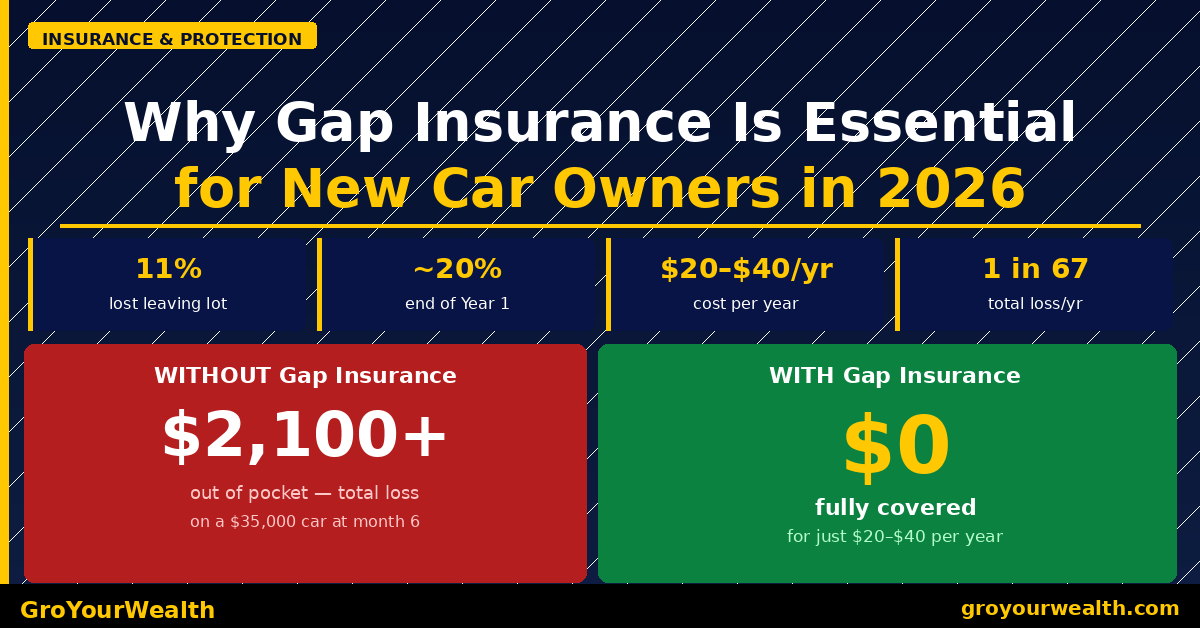
11%
Value lost leaving the lot
~20%
Depreciation by end of Year 1
$20–$40
Gap insurance cost per year
1 in 67
US annual total loss probability
The moment you drive a new car off the dealership lot, it loses roughly 11% of its value. By the end of the first year, that drop reaches around 20%. Your standard car insurance does not cover that gap. If your brand-new $35,000 car is written off or stolen in the first year, your insurer pays you the current market value — but if you still owe more on your loan, you are personally responsible for the difference.
Gap insurance — Guaranteed Asset Protection — exists to cover exactly that shortfall. In 2026, it costs as little as $20 to $40 per year when added to an existing policy. This guide explains exactly what it is, who needs it, where to buy it, and how to calculate whether your vehicle currently has a gap.
💡 Key Definition
Gap insurance covers the difference between what your standard insurer pays (Actual Cash Value) and what you still owe on your car loan or lease. Without it, you can be left paying off a loan on a car you no longer have.
▶ Watch the full video on YouTube — Why Gap Insurance is Essential for New Car Owners in 2026
What Is Gap Insurance and How Does It Work?
GAP stands for Guaranteed Asset Protection. It is a supplemental auto insurance product that pays the difference between two figures in the event of a total loss or theft:
Your standard insurer’s payout — the Actual Cash Value (ACV) of your vehicle on the day of the loss
Your outstanding loan or lease balance — what you still owe the lender on that date
Standard comprehensive or collision insurance always pays ACV — the market value on the day of the incident. Not what you paid. Not what you owe. Gap insurance bridges the difference and pays it directly to your lender.
How Fast Do New Cars Depreciate? Year-by-Year Breakdown
Understanding depreciation is the foundation of understanding why gap insurance exists. New cars lose value faster than almost any other major purchase.
Timepoint
Cumulative Depreciation
Remaining Value (on $35,000 car)
Gap Risk Level
Leaving the lot
~11%
~$31,150
High
End of Year 1
~20%
~$28,000
Very High
End of Year 2
~30%
~$24,500
High
End of Year 3
~40–50%
~$17,500–$21,000
Moderate
End of Year 5
~60%+
~$14,000 or less
Low / None
⚠ The Danger Window
The steepest depreciation happens in Years 1 and 2 — precisely when most buyers have the largest loan balance. This is the maximum financial vulnerability window that gap insurance is designed to protect.
The Gap in Real Numbers: A $35,000 Car Example
Let us work through a realistic example so you can see the exact financial exposure.
📋 Real-World Scenario — Month 6 Total Loss
Vehicle purchase price $35,000
Down payment $3,500 (10%)
Amount financed $31,500
Loan term / APR 60 months at 7% APR
Outstanding loan balance — Month 6 ~$28,600
Actual Cash Value (ACV) — Month 6 ~$26,500
Standard insurer pays $26,500
⚠ Gap you owe out of pocket (without gap insurance) $2,100
✅ With gap insurance — out of pocket $0
Annual cost of gap insurance (via your insurer) $20–$40/yr
Who Needs Gap Insurance — and Who Doesn’t
✅ You NEED Gap Insurance If…
Down payment was less than 20%
Loan term is 60 months or longer
You are leasing (often required)
Vehicle has high depreciation rate
You rolled negative equity from previous loan
Your loan balance currently exceeds car’s market value
❌ You Likely DON’T Need It If…
Down payment was 20% or more
Loan term is 36 months or less
Paying cash — no loan at all
Vehicle has strong resale value (e.g. Toyota Tacoma, Honda Civic)
Loan balance already below current market value
💡 The One Question to Ask
If my car was written off today, would my insurance payout cover what I still owe? Check your car’s current value free at KBB.com or Edmunds.com and compare against your loan balance. If your loan balance is higher — you need gap insurance.
Where to Buy Gap Insurance: 3 Options Ranked
There are three places to buy gap insurance — and the price difference between them is significant. Always check your existing insurer first.
1
Your Existing Auto Insurer
$20–$40 per year
Add gap or loan/lease payoff coverage to your existing policy. Progressive, Allstate, GEICO, State Farm all offer this. Cheapest option by far — as little as $3–$5 per month. Always check here first.
Best Option
2
Standalone Gap Insurance Provider
$200–$400 one-time
Dedicated providers such as EasyCare or Ownersedge offer standalone gap policies. One-time payment for the life of the loan. Good option if your auto insurer does not offer gap coverage.
Good Option
3
Through the Dealership
$400–$700 (rolled into loan)
Dealers charge $400–$700 and roll it into your loan — meaning you also pay interest on the gap insurance itself. This is almost always the most expensive route. Not recommended unless no other option exists.
Avoid
Gap Insurance vs. Loan/Lease Payoff Coverage: What’s the Difference?
You will often encounter two similar product names. Here is how they compare:
Feature
Traditional Gap Insurance
Loan/Lease Payoff Coverage
What it covers
Full difference between ACV and loan balance — no cap
Up to 25% above ACV — capped
Cap on coverage
None — full gap covered
Typically 25% above ACV
Best for
Negative equity rollovers, high loan-to-value
Standard financed purchases (most common scenario)
Available from
Dealers, standalone providers
Most major auto insurers (Progressive, Allstate, GEICO)
Typical cost
$200–$700 one-time
$20–$40 per year added to existing policy
Sufficient for most buyers?
✅ Yes (if no rollover equity)
✅ Yes for standard purchase
💡 Which Should You Choose?
For a standard new car purchase with a typical down payment and no negative equity rollover, Loan/Lease Payoff Coverage from your existing insurer at $20–$40/yr is sufficient and the best value. If you rolled significant negative equity from a previous loan, consider traditional gap insurance with no coverage cap.
What Gap Insurance Does NOT Cover
Understanding the limitations is just as important as knowing the benefits. Gap insurance does not cover:
Your insurance deductible — this reduces the ACV payout before the gap is calculated, effectively increasing your out-of-pocket exposure by the deductible amount
Mechanical breakdowns, repairs, or maintenance costs
Extended warranties or service contracts rolled into your loan
Personal belongings inside the vehicle at time of loss
Missed loan payments or late fees that have accrued on the account
Carry-over balances from a previous vehicle loan added to the current loan
Partial damage — gap insurance only triggers on a total loss declaration, not partial repairs
Is Gap Insurance Worth It? The Cost vs. Protection Analysis
Let us be direct about the value calculation.
📊 Cost vs. Protection — Real Numbers
Annual gap insurance cost (via insurer) $20–$40/yr
Potential financial exposure without it (Year 1, $35K car) Up to $5,000+
US annual total loss / theft probability ~1 in 67 (~1.5%)
Expected annual gap loss ($3,000 avg gap × 1.5%) ~$45/yr
Asymmetric risk — $2,100–$5,000 unexpected loss vs $30/yr premium Gap insurance wins
The probability-based expected value nearly breaks even — but the asymmetric nature of the risk makes gap insurance clearly worth purchasing. A $2,100 unexpected out-of-pocket bill arriving after an already-stressful accident is financially damaging in a way that $30 per year in premium simply is not. For the first two to three years of a financed vehicle, gap insurance at $20–$40 per year is one of the clearest cost-to-protection values in personal finance.
🧮 Gap Insurance Calculator
Enter your loan and vehicle details to find out if you currently have a gap — and how much gap insurance would cost to protect you.
Your current loan balance
Your car’s current market value
Effective ACV after deductible
Your gap exposure (without gap insurance)
Estimated annual gap insurance cost
How to File a Gap Insurance Claim: Step-by-Step
If your vehicle is declared a total loss or confirmed stolen, follow these steps to file your gap claim successfully.
File your primary auto insurance claim immediately and obtain the ACV payout figure in writing from your insurer.
Request a 10-day payoff quote from your lender — this is the exact amount required to close your loan as of a specific date.
Contact your gap insurance provider (your auto insurer, standalone provider, or dealership finance office) and formally notify them of the total loss.
Submit required documents: primary insurer’s settlement letter, lender payoff quote, police report (if stolen), and your loan or lease agreement.
The gap insurer pays your lender directly — not you. The payment goes to close the remaining loan balance. Most claims are processed within 30 days.
Your Action Plan: 4 Steps Starting Today
Check your gap right now. Look up your car’s current market value free at KBB.com or Edmunds.com and compare it to your current loan balance. If your loan exceeds your car’s value — you need gap insurance today.
Call your existing auto insurer. Ask specifically: “Do you offer gap insurance or loan/lease payoff coverage, and what does it cost to add to my current policy?” In most cases it will be $20–$40 per year — approve it on the spot.
If buying a new car soon — add gap insurance before or on the day of purchase. Never through the dealership. Call your insurer the same day. The dealership option at $400–$700 is never the right choice.
Cancel when the gap closes. As soon as your loan balance drops below your car’s current market value — typically around Year 2 to 3 — cancel the gap coverage. You only need it while the gap exists.
GroYourWealth publishes daily personal finance content — videos, guides, and tools — for viewers across the USA, UK, Australia, Canada, and India. Subscribe and never miss a money lesson.
Disclaimer: This article is for educational purposes only and does not constitute financial, insurance, or legal advice. Insurance products, coverage limits, and pricing vary by provider, state, and individual circumstances. Always consult a licensed insurance professional before making coverage decisions. All figures cited are estimates based on industry averages as of 2026.