GroYourWealth Daily Money Education · USA · UK · AU · CA · IN
Debt & Credit Score Mastery
📅 12 March 2026 ⏱ 14 min read ✍ GroYourWealth 🌍 US Guide
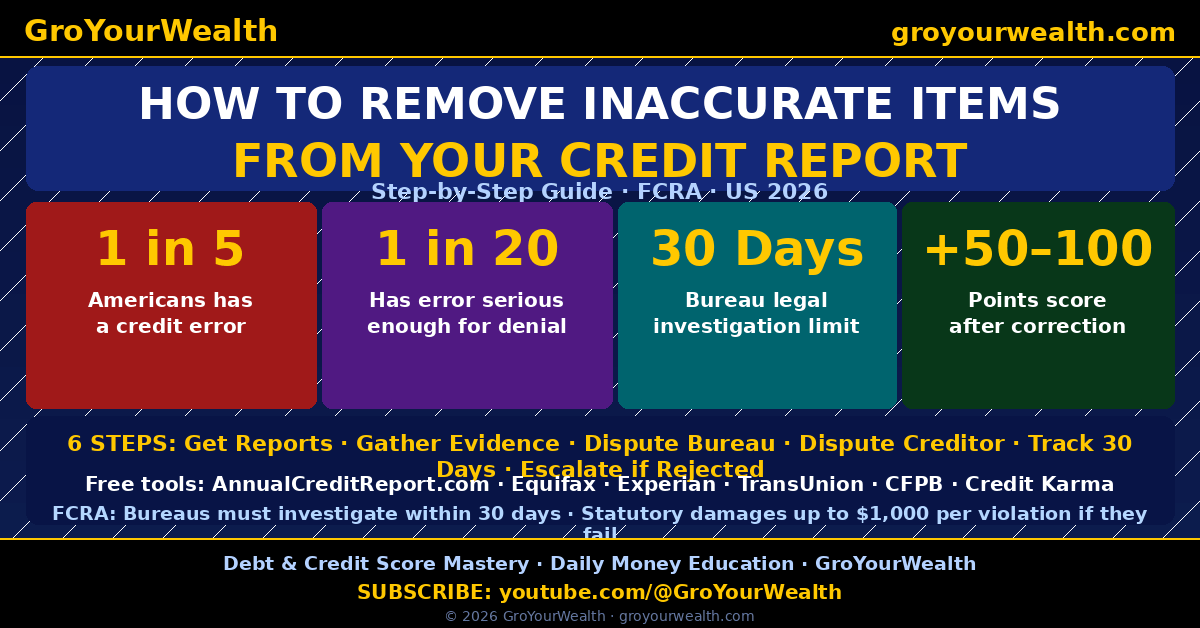
1 in 5
Americans has an error on their credit report (FTC data)
1 in 20
Has an error serious enough to cause denial or higher rate
30 Days
Legal deadline — bureaus MUST investigate under the FCRA
+50–100
Points score improvement after one corrected error
Did you know 1 in 5 Americans has an error on their credit report — and most of them have no idea? These are not minor typos. A single inaccuracy can drop your credit score by 50 to 100 points, cause you to be denied for a mortgage or car loan, raise your interest rate significantly, and even affect job applications in certain industries.
The good news: under the Fair Credit Reporting Act (FCRA), you have a legal right to dispute and remove inaccurate items from your credit report — completely free of charge — and bureaus must respond within 30 days by law. This step-by-step guide covers exactly how to do it.
▶ Watch the full step-by-step guide on GroYourWealth — How to Remove Inaccurate Items from Your Credit Report (US 2026)
How Common Are Credit Report Errors?
According to the Federal Trade Commission, one in five consumers — 20% — has at least one error on one of their three credit reports. One in twenty has an error serious enough to cause them to be denied credit or to pay a significantly higher interest rate.
The three credit bureaus — Equifax, Experian, and TransUnion — each maintain a completely separate file on you. An error on one report may not appear on another, which is why you must check all three.
🔑 Your Free Legal Right
Under the FCRA you are entitled to one free credit report from each bureau every 12 months at AnnualCreditReport.com — the only federally authorised site. You can request all three at once or stagger one every four months for year-round monitoring. No credit card required.
4 Types of Errors to Look For
Go through every section of your report carefully and highlight anything that looks wrong, unfamiliar, or outdated. There are four main categories to check.
Error Type
What to Look For
Key Risk
Personal Information
Wrong name, address, date of birth, or Social Security number
Mixed file — someone else’s negative data on your report
Account Errors
Accounts not yours · wrong balance or limit · duplicates · closed accounts shown as open
Inflated utilisation · lower score
Payment History
On-time payments marked as late or missed · derogatory marks that should be removed
Biggest score damage — 35% of FICO score
Outdated Negatives
Most negatives must be removed after 7 years · Bankruptcies after 10 years
If still showing past deadline — illegal, must be deleted
The 6-Step Dispute Process
1
Get All Three Free Credit Reports
Go to AnnualCreditReport.com — the only federally authorised site under the FCRA. Request all three reports from Equifax, Experian, and TransUnion. Download or print each one. Go through every section: personal information, accounts, payment history, hard inquiries, and public records. Highlight every item that looks incorrect, unfamiliar, or outdated. Keep a written log with the account name, account number, and exactly what is wrong.
2
Gather Your Evidence
Collect documentation for each error before filing a single dispute. Strong disputes include: bank statements showing on-time payments incorrectly reported as late · letters from creditors confirming closed accounts or paid balances · court documents for discharged bankruptcies or resolved judgements · identity documents if personal information is wrong. Always send photocopies only — never originals. Keep all originals yourself.
3
File Your Dispute With the Credit Bureau
File directly with each bureau that has the error — Equifax.com, Experian.com, or TransUnion.com — using their online dispute portal (fastest), by certified mail with return receipt (best paper trail), or by phone (least preferred — always follow up in writing). Your dispute letter must include: full name · address · date of birth · SSN · the specific item disputed · why it is wrong · copies of supporting documents. Under the FCRA, the bureau must investigate within 30 days — or 45 days if you provide additional information during the process.
4
Dispute With the Original Creditor Simultaneously
Contact the original creditor — the company that reported the data — at the same time as the bureau. This creates a parallel dispute track and often speeds up resolution. Write to the creditor’s customer service address (not billing). Under the FCRA, any furnisher (company reporting data) that receives notice of a dispute is legally required to investigate and correct inaccurate information — and must notify all three bureaus if they confirm an error.
5
Track Your Dispute — 30-Day Clock
Keep a dispute tracking log: date filed · method used · confirmation number · expected response date. If the bureau cannot verify the disputed item within 30 days, they are legally required to remove it. After the investigation you receive written results and a free updated credit report if any change was made. Score improvements from corrections typically reflect within 30 to 60 days.
6
If Rejected — Escalate
If your dispute is rejected, you have four options: (1) Add a 100-word consumer statement to your report — future lenders see your side. (2) File a complaint at ConsumerFinance.gov (CFPB) — federal authority over bureaus. (3) Escalate to the FTC at FTC.gov. (4) Consult a consumer protection attorney — under the FCRA, wilful failure to correct an error entitles you to actual damages, statutory damages up to $1,000 per violation, plus attorney fees. Many attorneys take these cases on contingency.
What to Expect — Dispute Timeline
Day 1
File dispute online or via certified mail — save all confirmation numbers
Day 2–5
Bureau acknowledges receipt — you receive a confirmation reference
Day 30
FCRA legal deadline — bureau must complete investigation by this date
Day 30–45
Written results sent to you + free updated credit report (if any change made)
Day 30–60
If item corrected or removed — score improvement reflected within this window
⚖️ Key FCRA Rule
If the bureau cannot verify the disputed item within 30 days, they are legally required to remove it from your report — even if no error is confirmed. This is one of the most powerful protections the FCRA provides.
What You Can and Cannot Remove
This distinction is critical — and understanding it will protect you from credit repair fraud.
✅ You Can Remove
Factually inaccurate items — wrong dates, amounts, or account details
Accounts that do not belong to you — mixed file errors
Negative items past the legal reporting window (7 years most, 10 years bankruptcy)
Items the bureau cannot verify within 30 days
❌ You Cannot Remove
Accurate late payments — genuine missed payments stay 7 years
Legitimate collections — real debts you owe cannot be erased
Valid bankruptcies within the reporting window
Any accurate negative information — regardless of how it affects your score
⚠️ Credit Repair Fraud Warning Any company claiming they can remove accurate negative information from your credit report is committing fraud. Everything a paid credit repair company can legally do, you can do yourself — completely free. Never pay for credit repair services.
Credit Score Impact Estimator
Use this tool to estimate how much a corrected credit report error could improve your score and what it could save you on your next loan.
📊 Credit Report Error Impact Calculator
Error type selected
Estimated score improvement after correction
Estimated interest rate before correction
Estimated interest rate after correction
Estimated total interest savings over loan term
Free Tools and Resources
Everything you need to dispute errors and monitor your credit is available at no cost. Never pay a credit repair company — you can do everything they do, yourself, for free.
Tool
What It Does
Cost
AnnualCreditReport.com
Official free reports from all 3 bureaus — federally authorised
Free
Equifax.com
Free dispute portal + identity theft alerts
Free
Experian.com
Free dispute portal + ongoing credit monitoring
Free
TransUnion.com
Free dispute portal + credit lock feature
Free
ConsumerFinance.gov (CFPB)
Federal complaint portal — if bureaus fail to respond correctly
Free
FTC.gov
Federal Trade Commission escalation + identity theft reports
Free
Credit Karma
Ongoing free credit monitoring — alerts for any new changes
Free
MyFICO.com
See your actual FICO score — the score most lenders use
Paid (free trial available)
Your Action Plan — Start This Week
1
This Week: Download All Three Reports
Go to AnnualCreditReport.com and download your Equifax, Experian, and TransUnion reports. Read every line. Highlight every error, unfamiliar item, or outdated entry.
2
Gather Evidence
Bank statements · creditor letters · court documents · identity proof if needed. Prepare photocopies of everything relevant to each error found.
3
File Disputes Online + With Creditors
Use the dispute portal at each bureau’s website. Simultaneously send a written dispute letter to the original creditor’s customer service address. This dual-track approach speeds up resolution.
4
Track — 30-Day Deadline
Log every dispute with date, method, and confirmation number. Bureau has 30 days to respond under the FCRA. If they cannot verify, they must remove.
5
Monitor Monthly
Set up free ongoing monitoring via Credit Karma or Experian’s free tier. Check for any new changes monthly. One corrected error can add 50–100 points to your score — potentially saving thousands on your next loan.