GroYourWealth Daily Money Education · USA · UK · AU · CA · IN
Debt & Credit
📅 10 March 2026 ⏱ 12 min read ✍ GroYourWealth 🌍 US Guide
$9,500
Average US credit card debt per household
22%
Average US credit card APR in 2026
26 yrs
Time to pay off on minimum payments only
$14,300
Interest paid on minimums — more than you borrowed
If you are carrying multiple debts — credit cards, personal loans, medical bills — you have probably heard two solutions mentioned more than any other: debt consolidation loans and credit counseling. Both promise to help you get out of debt faster and pay less overall. But they work in completely different ways, they cost different amounts, and choosing the wrong one could actually damage your credit score.
This guide breaks down exactly how each one works, what they truly cost, who each is right for, and which one saves you more money — on the same debt, with the same numbers, side by side.
▶ Watch the full video on GroYourWealth — Debt Consolidation Loans vs. Credit Counseling (US 2026)
Why Minimum Payments Are a Trap
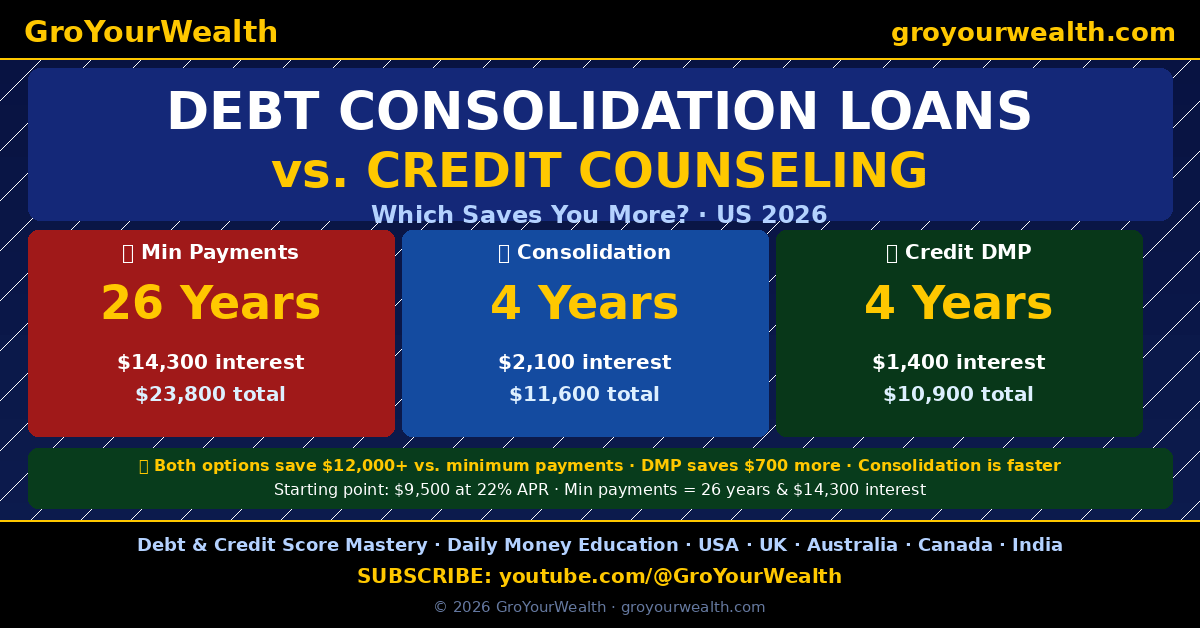
The average American household carrying credit card debt owes approximately $9,500. At the average US credit card APR of around 22% in 2026, making only minimum payments takes over 26 years to pay off — and generates more than $14,300 in interest alone.
⚠️ The Real Cost of Minimum Payments
You borrow $9,500. You repay $23,800 total — including $14,300 in pure interest. You pay more in interest than you originally borrowed. This is the trap both options are designed to break.
What Is a Debt Consolidation Loan?
A debt consolidation loan is a new personal loan that you use to pay off all your existing debts in one go. Instead of making multiple payments at different interest rates, you make one single monthly payment at one fixed interest rate.
Example — How It Works
You have three credit cards totalling $9,500 at an average of 22% APR. You take out a consolidation loan at 10% APR over 4 years. Your monthly payment is approximately $240, and your total interest paid drops from $14,300 to around $2,100 — a saving of over $12,000 versus minimum payments.
✅ The Key Requirement
You generally need a credit score of 670 or above to qualify for a rate low enough to make consolidation worthwhile. Below that threshold, lenders may offer you a rate higher than your current debt — which defeats the purpose entirely.
Pros and Cons
✅ Advantages
One fixed monthly payment — no juggling multiple due dates
Lower interest rate if credit score is 670+
Fixed payoff timeline — typically 2 to 5 years
Credit score improves as utilisation falls over time
Fastest setup — approval in minutes, funding in 1–3 days
❌ Disadvantages
Requires credit score 670+ for a competitive rate
Small credit score dip from hard inquiry on application
Risk of re-accumulating debt on cleared cards
Some lenders charge origination fees of 1–8%
Variable rate loans can rise — always choose fixed
💡 Critical Rule
After consolidating, do not use those cleared credit cards again. This is how people end up with more debt than they started with.
Top Debt Consolidation Loan Providers — US 2026
These four lenders offer some of the best rates for US borrowers in 2026. All can fund within 1–3 business days of approval.
LightStream
6.99% APR
$5K–$100K · No fees · Same-day funding possible · Rate beat guarantee
SoFi
8.99% APR
No origination fees · Unemployment protection · Soft credit check to view rate
Marcus by Goldman Sachs
6.99% APR
Zero fees of any kind · Fixed monthly payments · No prepayment penalty
Discover Personal Loans
7.99% APR
30-day money-back guarantee · Direct creditor payoff · No origination fee
What Is Credit Counseling?
Credit counseling is a completely different approach. You work with a nonprofit agency — such as the National Foundation for Credit Counseling (NFCC) — where a certified counselor reviews your full financial picture and then negotiates directly with your creditors on your behalf.
How the Debt Management Plan (DMP) Works
Free Consultation: A certified nonprofit counselor reviews your income, expenses, and all debts. Use NFCC.org or FCAA.org — accredited nonprofits only.
Creditor Negotiation: The agency negotiates with each creditor to reduce rates — typically from 22% down to 6–8% — and waive late fees.
Single Monthly Payment: You make one payment to the agency each month. They distribute it to each creditor. Agency fee: $25–$50 per month.
Financial Education: Budgeting and money management coaching is included throughout.
🔑 Key Advantage of Credit Counseling
No minimum credit score required. A Debt Management Plan is available to anyone regardless of credit history — making it the primary option for those who cannot qualify for a low-rate consolidation loan.
Pros and Cons
✅ Advantages
No credit score requirement — available to anyone
Interest rates negotiated down to 6–8% from 22%+
Late fees and over-limit fees typically waived
Agency fee only $25–$50/month — nonprofit only
Genuine financial education and coaching included
❌ Disadvantages
Takes 3–5 years to complete the plan
Enrolled credit cards must be closed
DMP noted on credit report during the plan
Requires consistent monthly payments for full duration
Missing a payment may cancel the plan entirely
Side-by-Side Cost Comparison
Same starting point: $9,500 debt at 22% APR. Three different paths. Here is the real cost of each.
❌ Minimum Payments Only
26 yearstime to pay off
$14,300interest paid
$23,800total repaid
🔵 Consolidation Loan @ 10% APR · 4 years
$240/momonthly payment
$2,100interest paid
$11,600total repaid
✅ Credit Counseling DMP @ 7% APR · 4 years
$227/momonthly payment
$1,400interest paid
$10,900total repaid
📊 The Verdict on Costs
Both options save you over $12,000 in interest versus minimum payments.
The DMP saves $700 more than the consolidation loan on the same debt at the same term.
The consolidation loan is faster to set up — approval in minutes, funds in 1–3 days — and leaves your credit card accounts open.
Full Feature Comparison
Feature
Debt Consolidation Loan
Credit Counseling (DMP)
Credit Score Required
670+ for best rates
None — open to all
Interest Rate
6.99%–10%+ (based on credit)
6–8% (negotiated)
Monthly Fee
None
$25–$50/month (nonprofit)
Setup Time
Minutes–3 days
A few days
Payoff Timeline
2–5 years
3–5 years
Credit Cards
Accounts stay open
Enrolled cards must close
Credit Report Impact
Small dip, then improvement
DMP notation, then rebuilds
Interest Paid ($9,500)
~$2,100
~$1,400
Total Repaid ($9,500)
~$11,600
~$10,900
Financial Coaching
None
Included
Best Provided By
LightStream · SoFi · Marcus
NFCC.org · FCAA.org
Which Option Is Right for You?
🔵 Choose a Debt Consolidation Loan if:
Your credit score is 670 or above
You want one clean loan — no agency involved
You are disciplined enough not to re-use cleared cards
You want the fastest possible setup (1–3 days)
You want to keep your credit card accounts open
Best providers: LightStream · SoFi · Marcus · Discover
🟢 Choose Credit Counseling (DMP) if:
Your credit score is below 670
You want professional guidance and structured support
You are comfortable closing enrolled credit cards
You want the lowest possible total interest cost
You need late fees waived and rate negotiation help
Best agency: NFCC.org — free initial consultation
⚡ Bottom Line
Both options are far better than doing nothing and continuing to pay 22% APR. The worst choice is keeping minimum payments going for 26 years. Pick the option that fits your credit score and get started.
How Each Option Affects Your Credit Score
Phase
Consolidation Loan
Credit Counseling DMP
At application / enrollment
−5 to −10 pts (hard inquiry)
DMP noted on credit report
Month 1–6
Stable / slight rise as utilisation falls
Card closures: −20 to −40 pts temporarily
Year 1–2
+50 to +100 pts from on-time payments
Gradual rebuild from consistent payments
Plan / loan complete
Significant gain — utilisation near zero
+60 to +100 pts — debt gone, history rebuilt
⚠️ Important Comparison Context
Both options are vastly less damaging than debt settlement (−100 to −150 pts, 7 years on record) or bankruptcy (−200 pts, 10 years on record). Neither permanently damages your credit — both rebuild it over the plan period.
Red Flags — Avoid These at All Costs
Consolidation Loan Red Flags
⚠️ Origination fee above 5% Eats into your savings immediately — shop elsewhere.
⚠️ Guaranteed approval regardless of credit score No legitimate lender guarantees approval. This is predatory.
⚠️ Variable interest rate If rates rise, so do your payments — always choose fixed rate.
⚠️ APR higher than your current debt Some offers are worse than doing nothing — check carefully.
Credit Counseling Red Flags
⚠️ Agency fee above $50/month Nonprofit maximum is $50. Above that means for-profit — avoid entirely.
⚠️ For-profit credit counseling company Only use agencies accredited by NFCC or FCAA.
⚠️ Promises to “settle” debt for less than owed That is debt settlement — a completely different product that devastates your credit score for 7 years.
⚠️ Upfront fee before any service is provided Walk away immediately. Legitimate nonprofit agencies do not charge upfront.
Your Action Plan — Start Today
1
Check Your Credit Score for Free
Go to AnnualCreditReport.com or check through your bank’s app. Score 670 or above? Get rate quotes from LightStream, SoFi, and Marcus — compare rates and fees carefully. Score below 670? Go straight to NFCC.org for a free initial consultation.
2
List Every Debt You Owe
Write down the balance, interest rate, and minimum payment for every single debt. Total them up. This is your number to beat — compare what consolidation or a DMP will cost you in total interest versus what you are paying now.
3
Run the Numbers Then Act
Use a free debt consolidation calculator before committing to either path. The goal is always the same: pay the least interest possible, in the shortest time possible, without creating new debt in the process. The only wrong move is to do nothing and keep paying 22%.