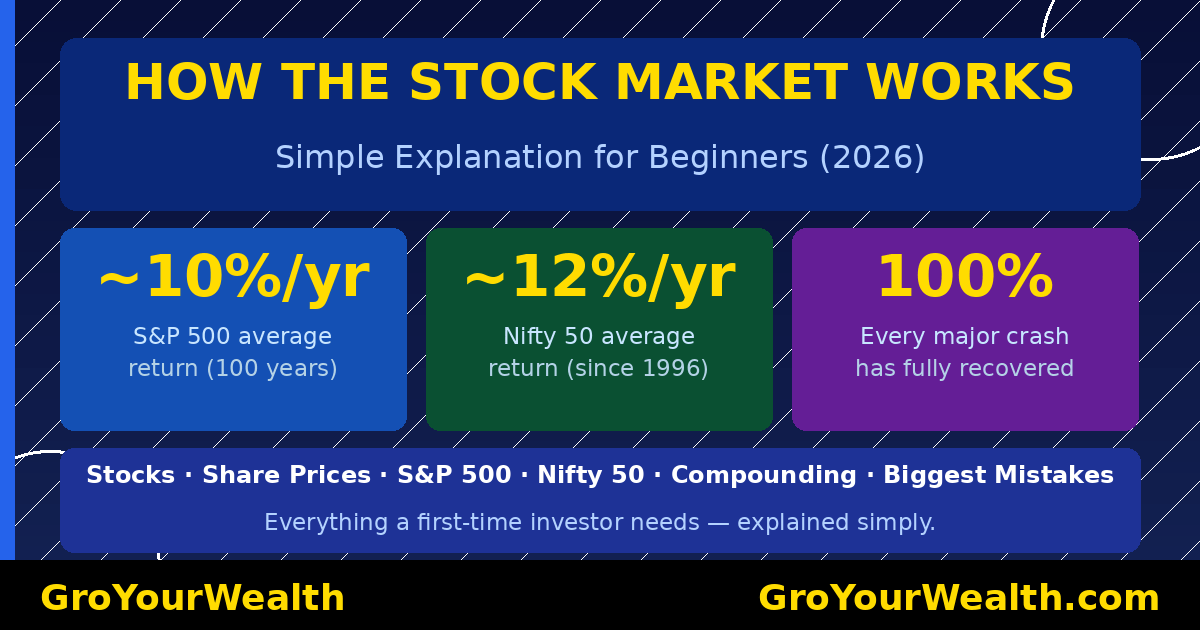
What you will learn: What the stock market actually is, how share prices go up and down, what the S&P 500 and Nifty 50 mean, why the market always recovers, and the three biggest mistakes beginners make. No jargon. No financial background required.
▶ Watch the full video on GroYourWealth YouTube
How the Stock Market Works — Simple Explanation for Beginners 2026
Table of Contents
- What Is the Stock Market?
- What Is a Stock (Share)?
- How Do Share Prices Move?
- What Is the S&P 500 and Nifty 50?
- Why the Stock Market Always Recovers
- How Compounding Works in Your Favour
- The 3 Biggest Mistakes Beginners Make
- How to Start Investing This Week
- Frequently Asked Questions
55%+of adults invest in stocks — most never learned the basics
<30%can correctly explain what a stock actually is
~50%panic-sell during downturns — locking in permanent losses
The gap between investing and actually understanding what you own is the number one cause of poor investor returns. Most people don’t lose money because of bad luck — they lose because of panic and ignorance. This article changes that.
1. What Is the Stock Market?
The stock market is a giant marketplace where ownership slices of companies are bought and sold. Think of a farmers’ market — except instead of fruit and vegetables, people trade stakes in real businesses.
When a company like Reliance Industries, Apple, or HDFC Bank wants to raise money to grow, it can offer a portion of itself to the public. Investors buy shares of that company, and those shares then trade on a stock exchange — India’s National Stock Exchange (NSE) and Bombay Stock Exchange (BSE), or the US NYSE and NASDAQ — where prices change every second based on supply and demand.
Simple definition: The stock market = a place where you can buy small ownership pieces of real companies, hold them, and profit as those companies grow over time.
The world has over 50 stock exchanges. Indian markets run 9:15am–3:30pm IST. US markets run 9:30am–4:00pm Eastern Time. All transactions in India are regulated by SEBI (Securities and Exchange Board of India) — the regulator that protects investor rights and ensures fair markets.
📘 Related Video : ETF Investing for Beginners — What Are ETFs and How to Start (2026)
2. What Is a Stock (Share)?
A stock, also called a share, represents a tiny ownership stake in a company. If a company has issued 1 million shares and you own 1,000 of them, you own 0.1% of that company — you are literally a part-owner of that business.
As a shareholder, you benefit in two ways:
- Capital appreciation: If the company grows and becomes more valuable, your shares increase in price. Buy at ₹100, price rises to ₹250 — you’ve made 150%.
- Dividends: Many profitable companies distribute a portion of their earnings to shareholders as regular cash payments. In India, companies like TCS, Infosys, and HDFC Bank are known for consistent dividends.
Owning stock is not gambling. You are a part-owner of a real business with real employees, real customers, and real profits. As of 2026, over 100 million Demat accounts have been opened in India — showing how mainstream stock market investing has become.
3. How Do Share Prices Move?
Share prices change every second the market is open because of one simple force: supply and demand.
More buyers than sellers? Price goes UP.
More sellers than buyers? Price goes DOWN.
Two things drive those buy and sell decisions:
- Company performance: Strong quarterly earnings, revenue growth, or a new product launch — investors become more confident, more people want to buy, and the price rises. Reverse happens with bad news.
- Market sentiment: Fear, optimism, interest rate decisions by the Reserve Bank of India (RBI) or the US Federal Reserve, and global events all affect how investors feel. In the short term, emotion drives prices more than fundamentals.
Key insight: Short-term price movements are impossible to predict reliably — even for professionals. According to S&P Global’s SPIVA report, over 90% of actively managed funds underperform their benchmark index over a 20-year period. This is why time in the market consistently outperforms trying to time the market.
📘 Related: How to Raise Your Credit Score Fast in 2026 — a better credit score means lower loan interest, freeing up more money to invest every month.
4. What Is the S&P 500 and Nifty 50?
These are stock market indices — pre-selected lists of the most important companies in a market that serve as a barometer for the overall economy.
| Index | Country | Companies | Avg Annual Return | How to Invest |
|---|---|---|---|---|
| S&P 500 | USA | 500 largest US companies | ~10%/year (100 yrs) | Motilal Oswal S&P 500 ETF |
| Nifty 50 | India | 50 largest NSE companies | ~12%/year (since 1996) | Nippon Nifty BeES, SBI Nifty ETF |
| Sensex | India | 30 largest BSE companies | ~12%/year | Mirae Asset Sensex ETF |
| FTSE 100 | UK | 100 largest UK companies | ~7%/year | Via international brokers |
You can track the live Nifty 50 performance at any time on the NSE live market page. Buying an index ETF is the simplest way to invest in these indices without picking individual stocks.
5. Why the Stock Market Always Recovers
The stock market has crashed many times. Every single time, it has recovered and reached new all-time highs.
2000 — Dot-com crash: S&P 500 fell ~49%. Nifty 50 fell ~55%. Both recovered fully within 7 years.
2008 — Global Financial Crisis: S&P 500 fell ~57%. Nifty 50 fell ~60%. Both recovered fully within 5 years.
2020 — COVID-19 crash: S&P 500 fell ~34% in 33 days. Nifty 50 fell ~38%. Both recovered fully within 6 months.
Why does it always recover? Because the stock market represents real businesses run by real people solving real problems. As long as humans continue to innovate, create, and consume — the economy grows and the market reflects that growth over time.
6. How Compounding Works in Your Favour
Compounding is the mechanism by which your returns generate their own returns. Investopedia defines compound interest as earning returns on both your principal and previously earned returns — and it is the most powerful force in personal finance.
| Time Period | Monthly SIP (₹10,000) | Total Invested | Final Value at 12%/yr | Profit |
|---|---|---|---|---|
| 10 years | ₹10,000/month | ₹12 Lakhs | ₹23.2 Lakhs | ₹11.2 Lakhs |
| 20 years | ₹10,000/month | ₹24 Lakhs | ₹96 Lakhs | ₹72 Lakhs |
| 30 years | ₹10,000/month | ₹36 Lakhs | ₹3.5 Crore | ₹3.14 Crore |
The rule of 72: Divide 72 by your annual return rate to find how many years it takes to double your money. At 12%/year: 72 ÷ 12 = 6 years to double. At 10%/year: 72 ÷ 10 = 7.2 years.
7. The 3 Biggest Mistakes Beginners Make
1
Panic selling during crashes.
Selling during a crash locks in your losses permanently. Every investor who stayed invested through 2008 and 2020 recovered everything and made new gains. According to DALBAR’s Quantitative Analysis of Investor Behavior, the average investor earns significantly less than the market average — entirely due to panic buying and selling at the wrong times.
2
Trying to time the market.
Missing just the 10 best trading days over a 20-year period cuts your total returns in half. “Waiting for the right time” means missing the best recovery days, which almost always happen during periods of maximum fear and uncertainty. The best strategy: invest every month, regardless of market conditions.
3
Not starting because of information overload.
A simple monthly SIP in a Nifty 50 ETF beats the vast majority of actively managed funds over 20+ years — confirmed by both Indian and global data. You don’t need to be a genius. You need to start. Even ₹500 per month is enough to begin building real long-term wealth.
8. How to Start Investing This Week
1
Open a Demat account (India).
Zerodha, Groww, Angel One, and Upstox are all SEBI-regulated brokers. The process is fully online — takes 10 minutes with your PAN card, Aadhaar, and bank details. Outside India: Vanguard (USA/Australia), Hargreaves Lansdown (UK), or Questrade (Canada).
2
Choose your first index ETF.
India: Nippon India Nifty BeES (expense ratio 0.04%) or SBI Nifty 50 ETF (0.07%). Global exposure: Motilal Oswal S&P 500 ETF (0.50%). Always pick the lowest expense ratio available.
3
Set up a monthly SIP and automate it.
Even ₹500/month. Automate the transfer so it happens on the same date every month without you thinking about it. Never stop during a market crash. Let compounding do the work.
Also on GroYourWealth:
→ How to Raise Your Credit Score Fast in 2026 — A strong CIBIL score means lower interest rates on home loans and personal loans, leaving more money to invest every month.
Frequently Asked Questions
What is the minimum amount to start investing in stocks in India?
You can start with as little as ₹100. Many ETFs on the NSE trade below ₹100 per unit. There is no minimum — any amount is enough to begin. SEBI’s investor education portal also has free resources for new investors.
Is the stock market safe for beginners?
Short-term: prices can fall significantly. Long-term (10+ years): broadly diversified index ETFs have never failed to deliver positive returns historically. Diversification, consistency, and a long time horizon are the three keys to managing risk.
What is the difference between NSE and BSE?
Both are Indian stock exchanges regulated by SEBI. The NSE has the highest daily trading volume and is home to the Nifty 50 index. The BSE is the oldest exchange in Asia and tracks the Sensex index. Most large companies are listed on both. For index investing, it makes no practical difference which exchange you use.
What happens to my shares if my stockbroker goes bankrupt?
Your shares are held in your Demat account with a depository — NSDL or CDSL in India — completely separate from your broker. If your broker shuts down, your shares remain 100% safe and you can transfer them to another broker.
How much can I realistically earn from the Indian stock market?
The Nifty 50 has delivered approximately 12% average annual returns since 1996. The S&P 500 has averaged approximately 10% per year over 100 years. These are historical averages, not guarantees. But they represent the strongest long-term wealth-building track record of any major asset class globally. Use our compounding table above to calculate your own projections.
What is the difference between a stock, a mutual fund, and an ETF?
A stock = one company. A mutual fund = a basket of companies managed by a professional (higher fees). An ETF = a basket of companies that tracks an index automatically (lowest fees).
About GroYourWealth
Simple, honest financial education for everyday investors in India and worldwide. New videos every day on the GroYourWealth YouTube channel.
groyourwealth.com