What you will learn: What an ETF is and how it differs from stocks and mutual funds, how the expense ratio silently destroys wealth, the best beginner ETFs in the USA, UK, Australia, Canada and India with exact costs, and a step-by-step guide to buying your first ETF this week — no prior investing experience required.
Best Beginner ETFs by Country — USA, UK, Australia, Canada, India
One Share = 500 Companies — How That Works
How to Buy Your First ETF This Week
The 3 Rules of ETF Investing
Frequently Asked Questions
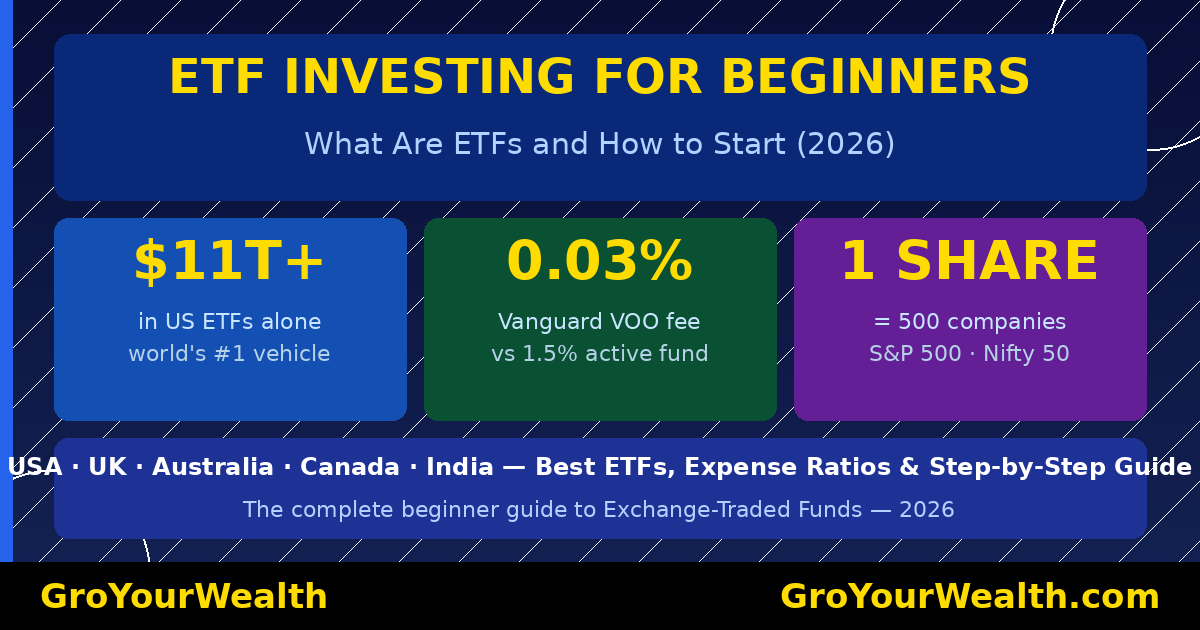
$11T+Assets in US ETFs alone — the world’s most popular investment vehicle
0.03%Vanguard VOO expense ratio — world’s cheapest S&P 500 ETF
~10%S&P 500 average annual return over 100 years — the ETF benchmark
Most people who avoid investing believe it requires expertise, large sums of money, or constant monitoring. ETFs were designed specifically to remove all three of those barriers. This guide explains everything from first principles — no jargon, no assumed financial background required.
1. What Is an ETF?
An ETF — Exchange-Traded Fund — is a basket of investments packaged into a single security that trades on a stock exchange. Instead of researching and buying dozens of individual company stocks, you buy one ETF and instantly own a proportional stake in every company inside it.
The simplest definition: An ETF is like a pre-made shopping basket. Instead of handpicking every item, you buy the basket — and it already contains everything you need, automatically maintained and rebalanced by the index it tracks.
The most popular ETF in the world is Vanguard’s VOO — it tracks the S&P 500 and holds shares in 500 of the largest US companies including Apple, Microsoft, Amazon, Google, and Meta. One share of VOO (approximately $530 as of early 2026) gives you proportional ownership in all 500 companies simultaneously.
For Indian investors, the equivalent is the Nippon India Nifty BeES ETF — one unit (approximately ₹260–280) gives you exposure to all 50 companies in the Nifty 50 index including Reliance Industries, TCS, HDFC Bank, Infosys, and ICICI Bank.
2. ETF vs Stock vs Mutual Fund — The Key Differences
Feature
Individual Stock
Mutual Fund
ETF
What you own
1 company only
Basket managed by fund manager
Basket tracking an index — automatic
Management
You pick
Professional fund manager
No manager — index-tracked automatically
Typical annual fee
Brokerage only
0.5%–2.5%/year
0.03%–0.50%/year
How it trades
Real-time on exchange
End-of-day price only
Real-time on exchange like a stock
Diversification
None — single company risk
High
Very high — hundreds of companies
Minimum investment
1 share price
Varies ($500–$3,000 in US)
1 share or fractional from $1
The critical difference between an ETF and a mutual fund is the fee structure and performance record. According to the S&P Global SPIVA report, over 92% of actively managed US large-cap mutual funds underperform the S&P 500 over a 20-year period — while charging you 10–80 times more in annual fees than a comparable index ETF.
Unlike mutual funds — which are priced once at the end of each trading day — ETFs trade in real time on stock exchanges, exactly like individual company shares. The price fluctuates throughout the day based on supply and demand from buyers and sellers.
Major exchange trading hours: NYSE/NASDAQ (USA) 9:30am–4:00pm ET | London Stock Exchange (UK) 8:00am–4:30pm GMT | ASX (Australia) 10:00am–4:00pm AEST | NSE/BSE (India) 9:15am–3:30pm IST.
For long-term investors, intraday price movements are irrelevant. The price you pay today matters far less than remaining invested consistently for 20–30 years. Checking your ETF price daily causes anxiety and emotional decision-making — both of which hurt long-term returns.
4. The Expense Ratio — The Only Number That Matters
The expense ratio is the annual fee an ETF charges — expressed as a percentage of your total investment. It is deducted automatically and silently from the fund’s daily returns. You never see it as a separate charge.
The real cost over 30 years: $1,000/month invested for 30 years at 10% gross return — 0.03% expense ratio (VOO) → $2.27M final value. 1.5% expense ratio (typical active fund) → $1.62M final value. That is $650,000 permanently destroyed by fees — on identical market returns. In India: ₹10,000/month at 12% gross — Nifty BeES at 0.04% → ₹3.49 Crore. Active fund at 2.5% → ₹2.27 Crore. Difference: ₹1.22 Crore gone to fees.
ETF
Country
Expense Ratio
Annual Cost on $10,000 / ₹10L
Rating
Vanguard VOO (S&P 500)
🇺🇸 USA
0.03%
$3/year
⭐ World’s best
Fidelity FZROX (Total Market)
🇺🇸 USA
0.00%
$0/year
⭐ Zero cost
iShares Core FTSE 100
🇬🇧 UK
0.07%
£7/year
⭐ Best UK option
Vanguard VAS (ASX 300)
🇦🇺 Australia
0.07%
A$7/year
⭐ Best AU option
iShares XIC (S&P/TSX)
🇨🇦 Canada
0.06%
C$6/year
⭐ Best Canada option
Nippon Nifty BeES
🇮🇳 India
0.04%
₹40 per ₹1 Lakh invested
⭐ Best India option
Typical Active Mutual Fund
Any
1.5%–2.5%
$150–$250 / ₹1,500–₹2,500
⚠ Avoid
5. Best Beginner ETFs by Country (2026)
🇺🇸 United States — Start Here
The gold standard for US investors is Vanguard VOO (S&P 500, 0.03%) or VTI (Total US Market, 0.03%). Both are available commission-free on Vanguard, Fidelity, and Schwab. Fidelity also offers FZROX and FZILX at 0.00% — literally zero annual cost. Warren Buffett’s recommendation in his public Berkshire Hathaway shareholder letters: put the majority of long-term savings in a low-cost S&P 500 index fund.
🇬🇧 United Kingdom
UK investors have access to iShares Core FTSE 100 ETF (0.07%) and Vanguard FTSE All-World ETF (0.22%) via platforms including Vanguard UK and Hargreaves Lansdown. Crucially, all gains inside a Stocks and Shares ISA (£20,000/year allowance for 2026) are completely tax-free — making the ISA wrapper one of the world’s most generous tax advantages for retail investors.
🇦🇺 Australia
Australian investors can access Vanguard Australia‘s VAS (ASX 300, 0.07%) and VGS (International Shares, 0.18%) via CommSec, SelfWealth, or Pearler. Australian investors should also consider maximising concessional super contributions (taxed at 15%) before investing in taxable ETF accounts — superannuation is one of the world’s most tax-efficient long-term savings structures.
🇨🇦 Canada
Canadian investors can access iShares XIC (S&P/TSX Composite, 0.06%) and Vanguard VFV (S&P 500 in CAD, 0.09%) via Questrade or Wealthsimple. A TFSA (Tax-Free Savings Account) allows all ETF gains to grow completely tax-free — 2026 annual contribution room is C$7,000 with cumulative room available since 2009.
🇮🇳 India
Indian investors can access Nippon India Nifty BeES (0.04%) and SBI Nifty 50 ETF (0.07%) via Zerodha, Groww, or Angel One. For US market exposure without a foreign brokerage account, the Motilal Oswal S&P 500 ETF (0.50%) is available on all major Indian platforms. All investments are regulated by SEBI and shares are held securely with NSDL or CDSL — completely separate from any broker.
When you buy one share of VOO or a Nifty 50 ETF, you own a proportional economic interest in every company in the underlying index. The ETF fund itself holds the actual company shares; your ETF unit represents your stake in that entire basket.
Example (USA): One share of VOO (~$530) gives proportional exposure to Apple (~7% weight), Microsoft (~7%), Amazon (~3.5%), and 497 more companies. If Apple doubles in value, VOO’s price rises proportionally — without you owning Apple stock directly. If Apple goes bankrupt, VOO barely moves because it is only 7% of the basket.
Example (India): One unit of Nifty BeES (~₹270) gives proportional exposure to all 50 Nifty companies. Reliance (~10%), HDFC Bank (~12%), ICICI Bank (~8%), TCS (~7%) and 46 more. No single company failure can significantly harm your investment.
This design delivers three things simultaneously: instant diversification across hundreds of companies, automatic rebalancing as companies grow or shrink, and professional index maintenance — all at near-zero cost. According to Investopedia, ETFs have become the preferred vehicle for both retail and institutional investors precisely because they combine mutual fund diversification with stock-like liquidity at minimal cost.
7. How to Buy Your First ETF This Week
1
Open a brokerage account.
USA: Fidelity, Vanguard, Schwab — all free, no minimums, fractional shares available.
UK: Vanguard UK or Hargreaves Lansdown — open a Stocks and Shares ISA first.
Australia: CommSec, SelfWealth, or Pearler.
Canada: Questrade or Wealthsimple — open a TFSA for tax-free growth.
India: Zerodha, Groww, or Angel One — requires PAN card + Aadhaar. All online, 10–15 minutes.
2
Choose your first ETF by country.
USA: VOO or VTI (0.03%). UK: iShares Core FTSE 100 (0.07%) or Vanguard FTSE All-World (0.22%). Australia: VAS (0.07%) or VGS (0.18%). Canada: XIC (0.06%) or VFV (0.09%). India: Nippon Nifty BeES (0.04%) or SBI Nifty 50 ETF (0.07%). Always choose the lowest expense ratio broad-market option for your country first.
3
Place your first buy order.
Search the ETF ticker in your broker’s search bar (VOO, VTI, VAS, XIC, etc.). Select “Buy.” USA/UK/Australia/Canada: fractional shares available from as little as $1/£1/A$1/C$1.
India: minimum is approximately ₹260–280 for one unit of Nifty BeES. Confirm the order — it executes within seconds during market hours.
4
Set up automatic monthly investing.
USA: set up automatic investments in your brokerage (Fidelity, Vanguard, Schwab all support this). UK: set up a regular monthly investment via direct debit. Australia: set up BPAY or DRP. Canada: set up Pre-Authorised Contributions (PAC) on Questrade. India: set up a SIP (Systematic Investment Plan) — minimum ₹500/month on Groww or Zerodha. Automate it so it runs without any monthly decision from you.
Every additional 1% in annual fees costs you roughly $500,000–$700,000 over a 30-year investing lifetime at typical contribution levels. Vanguard VOO at 0.03% vs a typical active fund at 1.5% is a 50x difference in fees — on the same underlying market exposure. This is the single most controllable variable in your long-term investment outcome.
2
Invest a fixed amount every month — no exceptions.
According to DALBAR’s 30-year Quantitative Analysis of Investor Behavior, the average investor significantly underperforms the market index — not because of bad fund choice, but because of emotional market timing and panic selling during downturns. Investors who simply invested the same fixed amount every month for 20–30 years consistently outperformed those who tried to time entries and exits.
3
Never sell during a crash — hold for the long term.
Every major global market crash — 1929, 1987, 2000, 2008, 2020 — was followed by full recovery and new all-time highs. US S&P 500 and Indian Nifty 50 both recovered completely after each crash within 3–7 years. Selling during a crash locks in permanent losses. Holding through the crash means full recovery plus new gains. Time in the market always beats timing the market.
Frequently Asked Questions
What is the minimum amount needed to start investing in ETFs?
USA: As little as $1 with fractional shares on Fidelity or Charles Schwab.
UK: From £1 on Vanguard UK or via fractional shares on Trading 212.
Australia: Approximately A$85 for one VAS unit on CommSec.
Canada: From C$1 with fractional shares on Wealthsimple.
India: Approximately ₹260 for one Nifty BeES unit, or ₹500/month via SIP on Groww or Zerodha.
What is the difference between an ETF and an index fund?
An index fund is any fund that passively tracks a market index. An ETF (Exchange-Traded Fund) is the format — it trades in real time on an exchange like a stock. Most modern index funds are structured as ETFs. The terms are frequently used interchangeably. The practical difference: ETFs trade in real time throughout the day; traditional index mutual funds price once at end of day. For long-term investors, this distinction has no material impact on outcomes.
Is ETF investing safe? Can I lose all my money?
A broad-market ETF like VOO (500 US companies) or Nifty BeES (50 Indian companies) would require every single company in the index to go bankrupt simultaneously for you to lose everything — which has never happened in any major global market in history. Short-term losses of 30–50% during crashes are possible and have occurred. But every such crash in history has been followed by full recovery. Long-term investing (10+ years) in a broad-market ETF has never produced a permanent total loss in the USA, UK, Australia, Canada, or India.
Should I choose an S&P 500 ETF or a domestic market ETF?
USA investors: VOO or VTI gives direct, currency-matched US exposure at the lowest possible cost. UK investors: Start with a FTSE 100 or FTSE All-World ETF inside an ISA. Australian investors: VAS for domestic, VGS for global. Canadian investors: XIC for domestic, VFV for US exposure. Indian investors: Start with a Nifty 50 ETF as your core holding, then add the Motilal Oswal S&P 500 ETF for international diversification. Diversifying across multiple markets reduces country-specific risk.
How are ETF gains taxed in different countries?
USA: Long-term gains (held 1+ year) taxed at 0%, 15%, or 20% depending on income. Short-term gains taxed as ordinary income.
UK: All gains inside a Stocks and Shares ISA are completely tax-free. Outside ISA, gains above the £3,000 annual CGT allowance are taxed.
Australia: ETFs held 12+ months qualify for the 50% CGT discount.
Canada: All gains inside a TFSA are completely tax-free.
India: Long-term capital gains (held 12+ months) taxed at 10% above ₹1.25 lakh/year. Always consult a qualified tax advisor in your jurisdiction.
What happens to my ETF if the provider (Vanguard, iShares, etc.) goes bankrupt?
Your assets are held in a legally segregated custodian structure — completely separate from the fund company’s own balance sheet. If Vanguard or iShares were to cease operating, your underlying assets (the actual company shares held in the fund) would be transferred to another custodian or liquidated at current market value. In India, assets are held with NSDL or CDSL depositories — entirely separate from any broker or fund house. Your investment is protected by this legal structure regardless of what happens to the intermediary.
About GroYourWealth
Simple, honest financial education for everyday investors in India and worldwide. New videos every day on the GroYourWealth YouTube channel.