This is one of the most debated personal finance questions — and one of the most poorly answered. Most people either invest while carrying expensive high-interest debt (costing them thousands in avoidable interest), or they refuse to invest at all until every last debt is cleared (missing years of critical compound growth in the process).
The correct answer is neither extreme. It depends on one number — the interest rate on your debt — and a simple rule that makes the decision straightforward.
The Simple 7% Rule
The 7% rule is the clearest framework for making this decision. It is based on the long-term average annual return of a diversified stock market index fund — historically between 7% and 10% per year before inflation over long time periods.
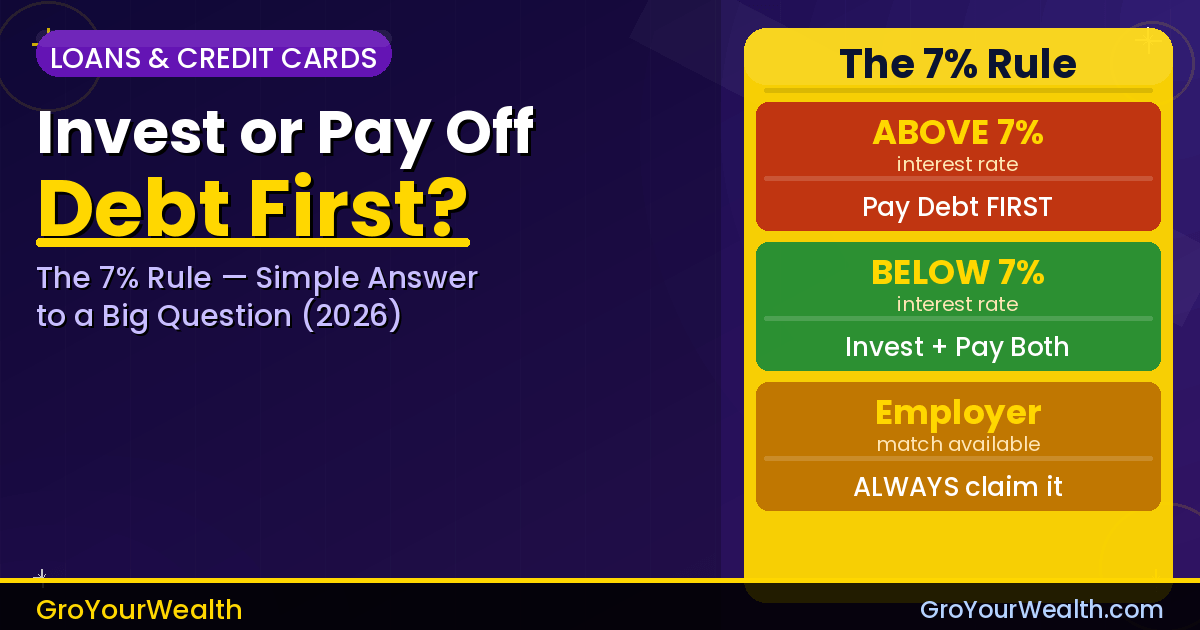
ABOVE 7% interest rate → Pay off debt FIRST
A 20% credit card costs 20% guaranteed. No investment reliably beats that risk-free return.
BELOW 7% interest rate → Invest AND pay debt simultaneously
The expected investment return exceeds the cost of holding the debt.
ALWAYS get your full employer match first
A 50% match is an instant 50% return — nothing beats it.
Applying the 7% Rule to Common Debt Types
Debt Type
Typical Rate — What to Do
Credit cards
18–29% — Pay off immediately
Personal loans
8–15% — Pay off first
Car loans
5–7% — Pay minimums, invest the rest
Student loans
4–6% — Invest AND pay down together
Mortgages
3–7% — Invest AND pay minimums in most cases
The One Exception — Always Claim Your Employer Match
Regardless of your debt interest rate, always contribute enough to your workplace retirement account to receive the full employer match — before doing anything else with extra money.
Here is why: if your employer matches 50% of contributions up to 6% of your salary, contributing that 6% gives you an instant 50% return before the money is even invested. No credit card interest rate in the world costs more than a guaranteed 50% return. Claim the full match first, always.
A Practical Example — The 7% Rule in Action
Imagine you earn $4,000 per month and carry these debts:
$6,000 credit card at 22% interest — minimum payment $120/month
$12,000 car loan at 5.5% interest — minimum payment $230/month
Employer matches 50% on first 4% of salary contributed to retirement
Here is how to apply the 7% rule step by step:
Contribute 4% of salary to retirement ($160/month) — claim the full $80/month employer match immediately
Attack the credit card aggressively — 22% is far above the 7% threshold; this is the priority
Pay only the minimum on the car loan — 5.5% is below threshold; redirect extra to investing after the credit card is gone
Once the credit card is eliminated, redirect the full freed-up payment into investments
The Numbers — Why High-Interest Debt Must Come First
Compare two people, both with $8,000 in credit card debt at 20% interest and $500 per month available:
Strategy
10-Year Financial Outcome
Invest $500/month, pay only minimums on debt
Invests $60K but pays $9,200+ in avoidable interest — net ahead by ~$50,800
Pay off debt first, then invest the freed payment
Debt cleared in ~19 months. Invests $500/month for 8+ years — net ahead by ~$67,000
Person B comes out $16,000 ahead over 10 years — not through better investments, but by eliminating the 20% interest drag first.
Your Decision Framework — 3 Questions
Is your debt interest rate above 7%? → Pay it off first before investing beyond the employer match
Does your employer offer a retirement match? → Always contribute enough to claim the full match regardless
Is your debt rate below 7%? → Invest consistently while paying the minimum on the debt
The Bottom Line
Above 7%: eliminate the debt first. Below 7%: invest and pay simultaneously. And regardless of your interest rate — always claim the full employer match. That is the complete framework.
Once high-interest debt is cleared, the money previously spent on interest becomes available to invest. For the complete step-by-step system to eliminate your debt, read our complete debt payoff plan — covering every step from listing your first debt to making your last payment.
And once you are debt-free and investing consistently, learn more about why long-term investing builds more wealth than short-term strategies — so you can grow your portfolio with confidence.