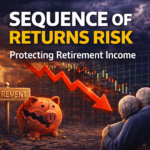
Most retirement planning focuses on average investment returns.
But retirees rarely experience average results in a smooth, predictable order.
Instead, the timing of market gains and losses can dramatically change:
- How long savings last
- How safely withdrawals continue
- Whether retirement income remains stable
This hidden danger is called sequence of returns risk, and it is one of the most critical yet least understood threats to long-term financial security.
What Sequence of Returns Risk Really Means
Sequence risk refers to poor market performance early in retirement, when withdrawals begin at the same time portfolio values decline.
Even if long-term average returns look normal, early losses can permanently damage portfolio longevity.
This connects closely with retirement income planning that determines how long savings truly last.
Why Early Losses Are So Dangerous
During accumulation years:
- Market declines can recover over time
- No withdrawals reduce compounding pressure
During retirement:
- Withdrawals continue even in downturns
- Selling assets at low prices locks in losses
- Recovery becomes far more difficult
This combination can shorten retirement by many years, even when total returns appear reasonable.
A Simple Illustration of the Risk
Two retirees may receive the same average return over 25 years.
- Retiree A experiences strong early returns → stable income
- Retiree B faces early market crash → faster depletion
Identical averages.
Completely different outcomes.
That difference is sequence risk.
Strategies That Reduce Sequence of Returns Risk
1. Diversified Asset Allocation
Holding a mix of:
- Stocks for growth
- Bonds for stability
- Cash for short-term withdrawals
reduces the need to sell volatile assets during downturns.
This aligns with global diversification strategies that protect wealth during market crashes.
2. Flexible Withdrawal Rates
Instead of fixed withdrawals every year, retirees can:
- Reduce withdrawals during market declines
- Increase spending during strong markets
Flexibility significantly improves portfolio survival probability.
3. Cash Buffer or “Bucket Strategy”
Maintaining 1–3 years of expenses in cash or low-risk assets allows withdrawals without selling investments during downturns.
This protects long-term compounding.
4. Delayed Retirement or Part-Time Income
Even small income sources can:
- Reduce withdrawal pressure
- Extend portfolio life
- Improve psychological confidence
Income flexibility is one of the most powerful sequence-risk defenses available.
The Role of Taxes in Withdrawal Stability
Taxes influence:
- Net retirement income
- Withdrawal sequencing
- Portfolio longevity
Efficient tax planning complements tax-efficient withdrawal strategies that extend retirement savings.
Government Retirement Guidance
Official retirement income planning resources are available from the U.S. Social Security Administration, including benefit timing and long-term income considerations:
Understanding guaranteed income sources helps reduce pressure on investment withdrawals, lowering overall sequence risk.
Why Sequence Risk Matters More Today
Modern retirees face:
- Longer life expectancy
- Market volatility
- Reduced pension availability
These factors increase dependence on personal investment portfolios, making sequence risk management essential for financial stability.
Final Thoughts
Sequence of returns risk reveals a powerful truth:
Retirement success is not determined only by how much you earn
or even how much you save.
It depends on how safely withdrawals interact with market timing.
By combining:
- Diversification
- Flexible withdrawals
- Cash reserves
- Tax efficiency
retirees can transform uncertainty into sustainable long-term income security.
Protecting retirement is not about predicting markets—
it is about preparing for the order in which they arrive.